


Salvia nemorosa Seeds | Queen Rose Sage
LATIN NAME: Salvia nemorosa
COMMON NAME: Queen Rose Sage
Plant Profile
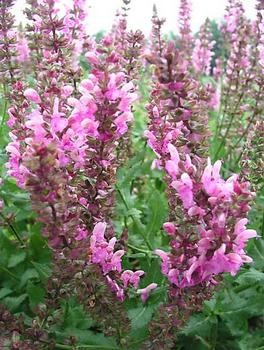
Salvia nemorosa is the Balkan clary, a steppe plant that has become one of the most dependable late-spring perennials in cultivation. Plants form a woody-based clump of wrinkled, dark green leaves to about 40 cm, then send up square stems carrying dense spikes of two-lipped flowers. The species is violet-blue; the selection sold as Queen Rose shifts that colour into a soft rose-pink without losing the darker calyx that gives the spike its depth.
Flowering starts in late May and would be over by early July if the plant were left alone. Cut the spent spikes back to a sideshoot and a second, lighter flush follows in August and often into September, which is why the plant earns its space in a small garden. Foliage stays low and tidy through winter, and the grey-green basal rosette is present even in February.
The plant comes from dry grassland and woodland edges on limestone, and it behaves accordingly: it wants sun, it tolerates drought once established, and it resents winter wet far more than winter cold. Heights vary with light, from 35 cm in poor dry ground to 60 cm in a richer border.
Science & Biotechnology
Salvia is one of the largest genera in the mint family, with close to a thousand species, and its chemistry is correspondingly varied. The ornamental claries are not the culinary or medicinal sages, but they share the glandular trichomes and the diterpene-rich resin that give the genus its scent. Salvia nemorosa oil is dominated by sesquiterpenes such as caryophyllene and germacrene, with only traces of the thujone found in common sage.
The genus has become a model for the study of floral mechanics. The two stamens of a Salvia flower form a lever: a bee pushing into the corolla triggers the anther to dab pollen onto its back, and the stigma of the same flower is positioned to avoid self-pollination until the pollen has been carried away. That lever has evolved repeatedly, and it is one of the reasons salvias are so efficient at setting seed in the presence of pollinators.
Uses & Benefits
A pink salvia is a useful colour bridge in a border that would otherwise be all blues and yellows in June. Plant it beside catmint, perennial geraniums and pale achilleas, or run it along the front of a sunny wall where the foliage can bake and the scent rise. The flowers hold on the plant for weeks and cut well, though the stems are short enough that they suit small vases rather than tall arrangements.
Bees work the spikes heavily, and the plant is a reliable nectar stop in the gap between spring blossom and the main summer flow. Hummingbirds visit it in North America. The leaves are aromatic when bruised, which makes the plant rabbit-resistant in practice, though nothing is rabbit-proof in a hard winter. In a gravel garden the clump stays compact and the flowering is heavier.
Growing from Seed
Sow in late winter or early spring on the surface of a moist seed compost, at 18-20°C; germination in two to three weeks is typical, and light improves it. A month of cold before warmth is not essential but does even out the results with older seed. Pot on promptly, since the seedlings grow fast once they have three or four leaves.
Set plants out at 30-40 cm apart in full sun on well-drained soil, ideally neutral to alkaline. Water through the first summer, then leave them to it; irrigation in a rich border produces soft growth that flops. Cut the first flush of spent spikes back to a fresh sideshoot at the base to force the second flowering, and tidy the old foliage in March rather than autumn, since the rosette protects the crown.
Our Take
One of the few perennials that reliably flowers twice, and a pink that sits easily among blues. Cut it back in July and it will still be worth looking at in September.
Related Reading
If Queen Rose Sage appeals to you, these related plants are worth a look: