


Althaea officinalis Seeds | Erfurter Marshmallow
LATIN NAME: Althaea officinalis
COMMON NAME: Marshmallow
Plant Profile
The modern marshmallow candy is a sugar foam with no link to the plant, but the original version was whipped from the mucilaginous root of Althaea officinalis, and that root is exactly what ‘Erfurter’ was selected to produce. Chew a piece of the fresh root and it turns slippery and soothing on the tongue, a texture from complex plant polysaccharides rather than from any added gum. The cultivar is a German-bred strain chosen for uniform, productive roots.
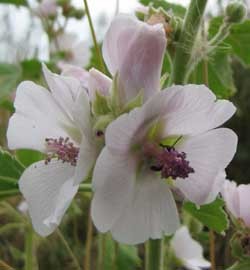
Althaea officinalis is a softly hairy perennial reaching about one and a half metres, with rounded, lobed, velvety leaves and short-stalked pale pink to white five-petalled flowers marked by an epicalyx, the extra whorl of bracts typical of the mallow family. The thick, tapering root is the prized organ, rich in cortex. The genus Althaea is close to hollyhock (Althaea rosea), and both show the family’s characteristic fused column of stamens.
The name Althaea comes from a Greek word meaning “to heal,” which signals the plant’s long medicinal standing. It is native to the brackish margins of Europe, North Africa, and western Asia, and was cultivated in kitchen and physic gardens for centuries before the sweet took its name. ‘Erfurter’ is a cultivated form rather than a wild type, selected by horticulturists for reliable, fleshy roots suited to both garden and field.
The mucilage is held in the root cortex, the outer layer beneath the bark, which is why traditional processors peeled and sliced the root before extraction rather than using the woody core. The historic “pate de guimauve” was made by whipping a decoction of this root with sugar and egg white until it foamed and set, a far cry from the gelatine-based sweet sold today. Modern work still turns to the root for demulcent syrups.
Science & Biotechnology
The root bark holds a large amount of mucilage, a mix of polysaccharides such as rhamnogalacturonan and arabinogalactan that swell in water to form a demulcent gel. Alongside the mucilage sit flavonoids, including quercetin glycosides, and various phenolic acids. This combination, not any single strong compound, gives marshmallow its traditional soothing action on irritated membranes.
Althaea has been multiplied in vitro through organogenesis from leaf and root explants, and cell cultures have been explored for polysaccharide production. Pharmacological studies support a demulcent effect on the throat and mucous membranes and note anti-inflammatory activity, which underlies the herb’s use in syrups, gargles, and skin poultices.
Uses & Benefits
Traditionally the root was extracted with sugar and egg white to make the original marshmallow confection, and it still flavours herbal syrups and soothing teas. As a poultice the softened root or leaf eased minor skin irritation. In the ornamental garden the tall stems with their pale flowers suit a moist border, and the blooms feed bees and other pollinators through summer. Beyond the root, the young leaves can be cooked like spinach or added to salads for a mild mucilaginous texture, and the flowers are sometimes crystallised for decoration, a gentle echo of the plant’s confectionery past. The dried root, cut and simmered, is the base of many traditional throat syrups still made at home, and a spoonful of the cooled decoction soothes a dry cough.
Growing from Seed
Marshmallow needs moist, fertile, slightly alkaline soil and full sun, and it is happiest where the ground stays damp, unlike most kitchen herbs. Sow the seed where it will grow or start in pots, and thin or space plants to 45 to 60 cm apart once they carry several true leaves. The roots need about two seasons of growth before they are worth lifting for harvest; lift them in autumn of the second year, wash, peel, and slice them for drying.
Water amply through dry weather and keep the soil from drying out, since the plant is built for wetlands. As a hardy perennial it dies back in winter and returns from the crown, so cut the stems down in autumn and mulch the base. The chief disease is hollyhock rust (Puccinia malvacearum), which jumps from nearby mallows, and aphids may cluster on the young shoots; removing affected lower leaves helps.
Our Take
I grow ‘Erfurter’ at the damp edge of the bed where little else thrives, and its close cousin hollyhock makes a tall backdrop. For other old garden medicinals try lovage, English sage, and German chamomile.
Related Reading
More species in the same orbit as Marshmallow: