


Thymus vulgaris Seeds | French Thyme
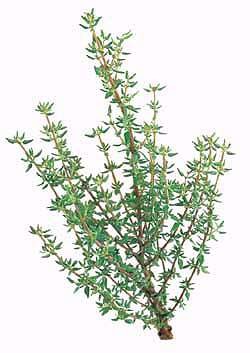
LATIN NAME: Thymus vulgaris
COMMON NAME: French Thyme
Plant Profile
Thymus vulgaris is a small, evergreen subshrub, 15 to 40 cm, with a woody base and many slender, upright branches. The tiny, grey-green leaves are linear to oval and rolled at the edge, packed with oil glands that give the crushed leaf its scent. In early summer the branch tips carry whorls of minute, two-lipped flowers in white or lilac.
The species is native to the western Mediterranean, southern France, Spain, and Italy, where it clothes dry, stony hills that are lime-rich. The name Thymus is an old Greek word for the plant, long linked in folklore with courage and purification. French thyme is the form fixed in Provencal cookery and in the dried bouquet garni.
The thymol chemotype is pungent and slightly harsh; the linalool and geraniol chemotypes smell floral and sweet and are grown for perfume rather than the table. Wild populations sort by soil and altitude, so a plant collected high on a Spanish mountain may smell nothing like one from a French lowland, another reason nurseries sell named clones.
When seedlings reach two pairs of true leaves, thin to one per cell and set plants 20 to 30 cm apart in the garden so air moves through the low canopy and the base stays dry.
Science & Biotechnology
French thyme looks like a single tidy herb, but underneath the grey foliage it is a puzzle of chemical races. A given Thymus vulgaris plant belongs to one chemotype, its oil is built around thymol, or carvacrol, or linalool, or geraniol, or paracymene, or alpha-terpineol, and the type is inherited, not random. The culinary French thyme most of us grow is the thymol chemotype, the same phenol used in antiseptic mouthwash, and that is why a sprig smells simultaneously of warm kitchen and of pharmacy.
Steam distillation of the flowering herb yields thyme oil whose major phenol, thymol or carvacrol, decides its grade. Thymol is the stronger antimicrobial and is the compound recovered for use in oral-care and surface products. Breeders map the monoterpene pathway to push a plant toward the thymol end and away from the blander linalool end.
Thyme oil and its phenols are documented inhibitors of food-spoilage and food-borne microbes, which is why the herb seasons cured meats and rich dishes in warm climates. The effect is concentration-dependent and belongs to food science, not to home medicine.
Elite chemotypes are multiplied by stem cutting or tissue culture so the oil profile stays fixed, because seed from a mixed hillside population will not breed true.
Uses & Benefits
Strip the leaf from the stem and add it to stocks, roasted poultry, and vegetables; it is a pillar of herbes de Provence alongside savory, rosemary, and oregano. Use it early in long cooks so the flavor infuses, or scatter the fresh leaf on a finished roast.
Thyme makes a low, fragrant mat between stones and at the front of a border, and the flowers are a bee magnet in early summer. Shear lightly after bloom to keep the cushion tight.
Thyme infusions have a long folk place for coughs and digestion; these are cultural practices, not claims.
A sprig of thyme infused in cider vinegar makes a sharp salad dressing, and a thyme honey, made by laying fresh stems in warm honey, is a Provencal stand-by for a sore throat and a fine glaze for roasted roots. The stem is too woody to eat, so lift it out before the dish reaches the table.
Growing from Seed
Sow onto a very free-draining mix of sand, grit, and a little compost, pressing the fine seed in without covering it, since light aids it. Keep just moist and warm; thyme sulks in cold, wet trays.
Shear the plant to a few centimetres after flowering to keep it from going woody and bare at the center. The one rule is sharp drainage, a gravel or grit mulch over the crown, and a covered spot in the wettest climates, carries it through winter.
Our Take
French thyme is the herb I tuck between pavers, because brushing past it releases the scent all season. Grow the thymol type for the kitchen, keep its feet dry, and shear it after bloom.
Related Reading
More species in the same orbit as French Thyme: