


Tradescantia ohiensis Seeds | Ohio Spiderwort
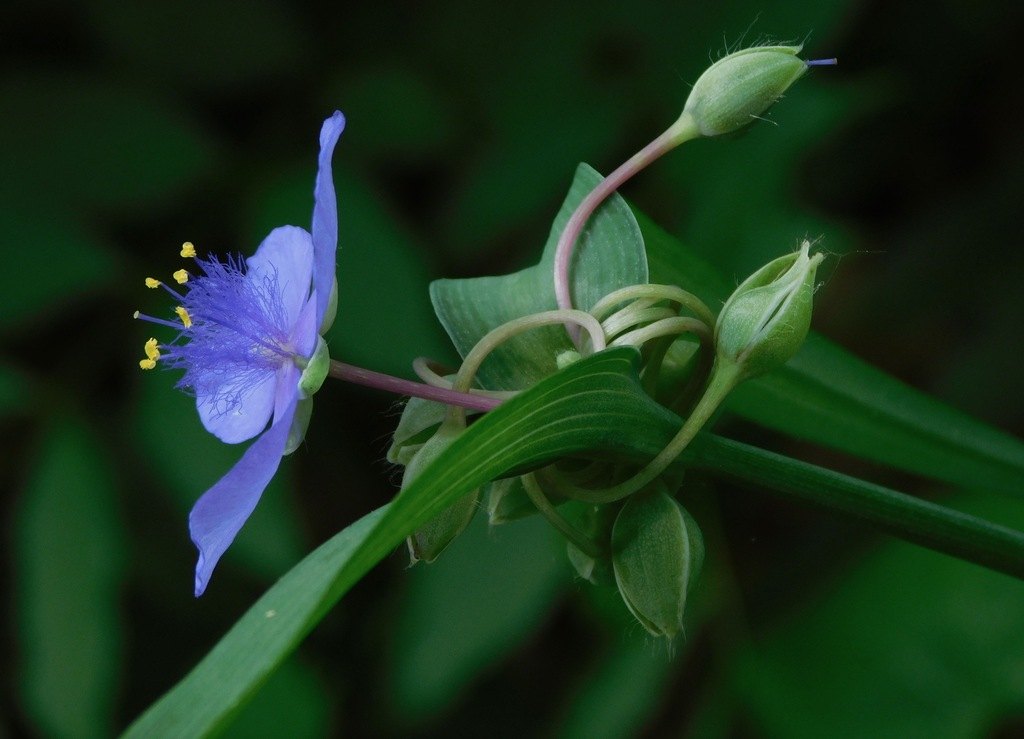
LATIN NAME: Tradescantia ohiensis
COMMON NAME: Ohio Spiderwort
Plant Profile
Bluejacket, or Ohio spiderwort, is the most common and widely distributed Tradescantia in the United States, running from Maine west to Minnesota and south to Texas and Florida, with a small Canadian outpost in extreme southern Ontario near Windsor. It is a tall, grassy-leaved perennial of open ground, reaching about a metre and a quarter in good conditions.
The species is recognisable by a set of quiet signatures: leaves and stems coated in a bluish-grey bloom, leaves that leave the stem at a sharp acute angle, sepals whose hairs carry no glands, and a habit taller than most of its relatives. The three-petalled blue flowers open in morning clusters and are gone by afternoon heat, replaced daily by fresh buds on the same stem.
Its habitats read like a map of ordinary America: roadsides, along railroads, fields and thickets, and less typically woods and stream edges. This is a plant of disturbed, open, sometimes rough ground, which is precisely why it thrives in the corridors humans cut through the landscape.
Where species meet, bluejacket mingles freely. At least nine related species are thought capable of forming hybrids with it, and populations where ranges overlap often hold plants that defy clean identification. For gardeners this matters little; for botanists drawing the species’ boundaries it has been a professional headache for a century.
Science & Biotechnology
The genus made a quiet contribution to laboratory science: the stamen hairs of spiderworts became a classic bioassay, their chain-of-beads cells changing colour under radiation and chemical mutagens, allowing mutation rates to be counted with a hand lens. Generations of genetics students met mutagenesis first through a spiderwort flower.
The daily schedule of the flowers is engineering as much as habit. Each bloom opens at dawn with abundant nectar, is fully worked by visiting bees before midday, and dissolves into a viscous fluid by afternoon, so the plant spends nothing on petals that no pollinator will see. A stem carries a progression of buds to keep the sequence running for weeks.
That hybridising generosity has a scientific upside: T. ohiensis sits at the centre of a natural experiment in species boundaries, where morphological, cytological and molecular studies of its hybrids have informed how botanists define species in the first place. The garden plant is also a textbook in disguise.
Uses & Benefits
The plant is edible on several levels: flowers and young shoots can be eaten raw, leaves cooked as greens. The flavour is mild and the texture pleasant, and the blue flowers make an unusually handsome scatter over a salad, one of the few truly blue foods the garden offers.
The leaves carry a clear, mucilaginous sap with a recorded practical use: crushed and applied, they soothe insect bites in much the same way as aloe vera, a folk application noted wherever the plant grows. It is a handy trick to know on any prairie walk, and the plant’s abundance makes the remedy effectively free.
In designed landscapes bluejacket is a workhorse of prairie plantings, rain gardens and pollinator beds: tough, tolerant of both wet ground and drought once established, and generous with its morning blue through early summer. Its grassy foliage blends into mixed plantings and vanishes quietly after flowering. Allied plants on the list: Lagurus ovatus, Hordeum jubatum and Lolium multiflorum.
Growing from Seed
Seed germinates best after a period of cold, moist stratification, four to six weeks in a refrigerator or a winter sown outdoors. Sow on the surface or with only a dusting of soil, keep evenly moist, and expect germination as the weather warms. Fresh seed behaves best, though stored seed remains serviceable for a couple of years.
Seedlings grow quickly into grassy clumps and can be planted out in spring or early autumn. Space them forty-five centimetres apart; the clumps lean and flop gracefully among companions, and a neighbours-supports-neighbours planting suits their habit better than staking ever will.
Maintenance is one cut: after the first flowering flush, shear the clumps by half to prompt fresh foliage and a second, lighter bloom, and to prevent excessive self-sowing. Clumps can be divided in spring, and every piece with roots re-establishes without ceremony in sun or part shade.
Our Take
Ohio spiderwort is the native perennial for gardeners who want science, food and beauty in one package: a mutation bioassay in its anthers, a salad in its flowers, a balm in its leaves, and a reliable morning-blue show in early summer. Few species give so much for so little care.
Sow it in a mixed prairie bed or along a path you walk each morning, and be there when the day’s flowers open, because by lunch they will be liquid. The plant keeps its own hours, and the scheduling is part of its charm.
Related Reading
Readers interested in Ohio Spiderwort frequently explore these as well: