


Swertia bimaculata Seeds | Two-spotted Swertia
LATIN NAME: Swertia bimaculata
COMMON NAME: Two-spotted Swertia
Plant Profile
Swertia bimaculata is the gentian relative that flowers when the family has usually gone home. Siebold and Zuccarini described it from Japan in the 1840s, and its range turned out to be enormous: the whole of central and southern China, the Himalaya, Taiwan, Japan, and disjunctly south to peninsular Malaysia, from lowland streamsides to mountain slopes.
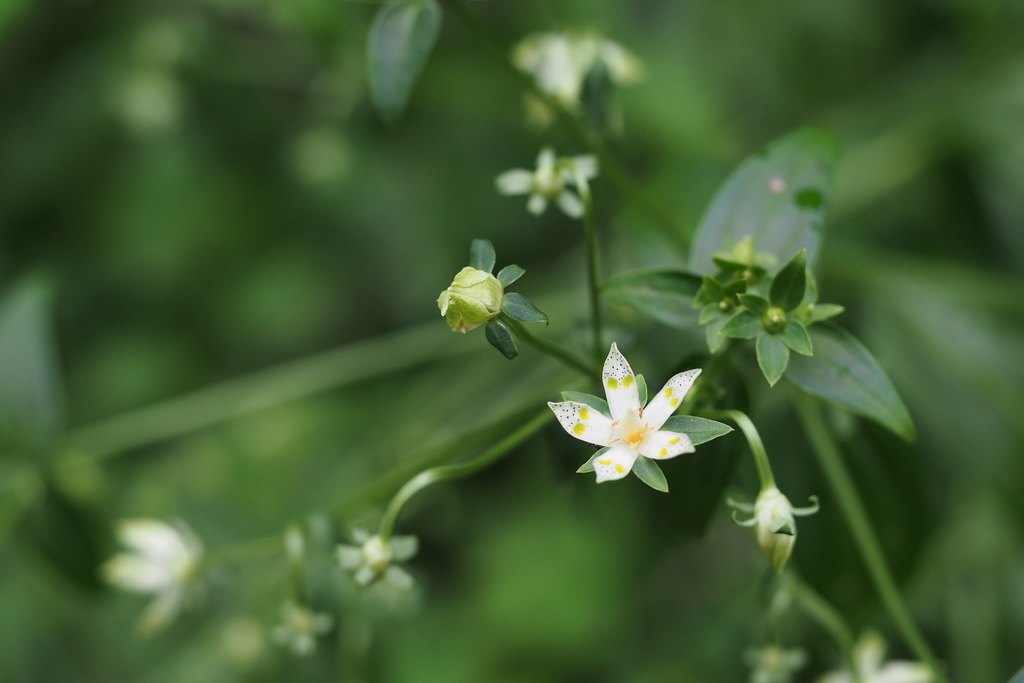
The plant is a stout perennial sixty to a hundred centimetres tall with pairs of lanceolate leaves climbing the stem, branching at the top into a wide panicle. The flowers open in September and October: four white sepals spreading flat, each marked with the two dark green-purple spots and a gland pit fringed with hairs that give the species its name.
Those spots and pits are not decoration. The fringed nectary glands sit along the flower like runway lights for pollinators, guiding insects to nectar pooled in the pits, and the paired spots advertise the arrangement. The structure is diagnostic for the genus and particularly showy in this species.
In Chinese it is zhang ya cai, the river-deer tooth herb, a name it shares with medicinal relatives, and in the Himalayan and Tibetan traditions its bitter principle places it in the group of liver remedies known in Chinese as zang yin chen.
Science & Biotechnology
The bitterness is chemistry, not opinion. The plant carries iridoid glycosides, swertiamarin and sweroside chief among them, the same bitter secoiridoids that give gentian root its punch. Pharmacological work on these compounds reports hepatoprotective and anti-inflammatory effects, the scientific shadow of the herb’s traditional use for liver complaints.
The genus Swertia itself is a systematic battleground, with well over a hundred species spread from Europe to Southeast Asia and several recent studies arguing for splitting it into narrower genera. Molecular work keeps reorganising the group, but this species sits solidly in the core Asian clade, however the shelves get rearranged.
The flowering schedule is its cleverest trait. Autumn bloom in a family of spring and alpine specialists means the plant meets a different pollinator guild, moths and late flies and bees stocking up before winter, and its disjunct range from Japan to Malaysia suggests that late-season timing travels well across climates that would not suit a spring gentian at all.
Uses & Benefits
In Tibetan and Himalayan medicine the dried whole plant belongs to the zang yin chen group used for hepatitis, fevers and gallbladder complaints, prescribed as a bitter decoction. Chinese regional medicine uses it for similar purposes, and the bitter compounds have kept the plant on the list of species under pharmacological study.
In the garden it offers a rare package: a stately perennial with architectural panicles that peaks in September and October, when open-faced white flowers are scarce. It suits woodland edges, streamside plantings and moist borders, where its height reads as structure rather than floppiness and the spotted flowers carry at close range.
The bitterness that makes it a drug also makes it deer-proof, and the plant presents no management challenge beyond moisture. As a conversation piece it has few peers: a gentian that ignores the family’s spring calendar, spots its flowers like a warning sign, and grows from temperate Japan into the tropics. The catalogue keeps Eustoma grandiflorum, Oxypetalum caeruleum and Tabernaemontana alternifolia from neighbouring families.
Growing from Seed
The seed is dust-fine and needs light and coolness. Sow in late winter on the surface of a moist, fine medium, do not cover it, and hold the tray cool and shaded. Germination is slow and uneven, often spread over months, and the seedlings arrive as tiny green specks that need steady moisture.
First-year plants make a rosette and little else; the flowering stem is a second-year event, and moisture through the first summer decides whether rosettes survive to produce it. Grow them in individual pots until they have real root, then plant out into humus-rich soil that stays damp but never sodden.
Sited beside water or in a shaded moist border, the plant settles in and can self-sow lightly on bare, damp ground nearby. Give it morning sun and afternoon shade in hot districts, keep the root zone cool with a leafy mulch, and the autumn panicles become an annual certainty rather than an experiment.
Our Take
Most gardeners know gentians as alpine cushions that sulk in warm gardens; this species is the opposite strategy, a tall, easy, woodland-edge plant that saves its flowers for October. The spots and gland pits are worth a hand lens, and the pollinators agree.
Sow the dust-fine seed cool and uncovered in late winter, keep everything moist through the first summer, and expect flowers in the second autumn. Plant it where other perennials have already finished, and the two-spotted panicles will close the season with a plant almost nobody else on the street is growing.
Related Reading
Continue exploring with these related plants: