


Pinus thunbergii Seeds | Japanese Black Pine Kuromatsu
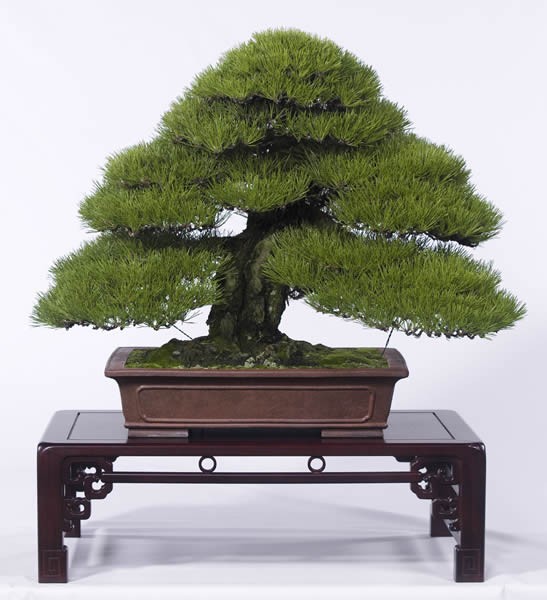
LATIN NAME: Pinus thunbergii
COMMON NAME: Japanese Black Pine
Plant Profile
Pinus thunbergii earns its name from the near-black bark that splits into rough, irregular plates as the tree ages, a stark contrast to the tidy grey of many garden conifers. It is a tree shaped by salt: left on an exposed coast it grows into the flat, windswept form beloved of Japanese garden painting, with a broad crown leaning away from the prevailing wind. The species was described by Carl Peter Thunberg, who travelled Japan in the late 1700s, and its Japanese name simply means black pine.
The foliage is gathered in bundles of two stiff, dark-green needles, each running six to twelve centimetres and edged so sharp that gloved hands are wise when pruning. The cones are squat and woody, four to seven centimetres long, carried in clusters near the crown, and they take more than a single season to ripen and shed their winged seed. The black bark, the paired stiff needles, and the heavy cone together mark the tree against the softer red pine and the five-needle Japanese white pine grown nearby in parks.
Gardeners have selected forms that never occur in the wild trunk. The cultivar Oculus-draconis, the dragon’s-eye pine, carries a yellow to red band across each needle and has been kept in temple gardens for centuries as a curiosity. It shows how much variation sits inside one species once humans choose the odd branch and root it, a reminder that a seed-grown row will not all look like the garden picture.
Black pine is shaped by pinching the spring candles, the upright new shoots, rather than by shearing. Remove part of each candle by hand as it extends to keep the tree compact and to expose the inner branches, a method that suits both the garden specimen and the bonsai bench.
Science & Biotechnology
The volatile oil pressed from the needles is dominated by monoterpenes, with alpha-pinene, beta-pinene, myrcene, and limonene leading the profile, and a smaller load of bornyl acetate that gives the crushed needle its resinous bite. That chemistry is the reason the wood and foliage smell so strongly, and it is studied for the same reason pine needle oils are studied elsewhere: a cheap, renewable source of fragrance and solvent compounds.
Uses & Benefits
The tree’s first job in Japan was protective: dense rows of black pine were planted on sandy coasts to hold the shore against wind and spray, and many of those shelterbelts still stand. In the garden it is trained as a sculptural specimen, its branches wired and thinned over years into the leaning, open silhouette seen at temple gates.
Historically the trunk was tapped for resin used in lamps and torches, and the pale, workable timber was cut for construction and joinery where a straight clear board was wanted. The wood is not as heavy or fragrant as some pines, which keeps it useful rather than precious, and the same pale board is what makes the species a quiet workhorse rather than a showy one.
Growing from Seed
The serious biotech story is defence. The pine wood nematode, Bursaphelenchus xylophilus, carried by a long-horned beetle, kills black pines across parts of east Asia, and breeders screen seedling families for those that slow the nematode and seal the wound. Tissue culture and clonal propagation let a resistant parent be multiplied true to type, so a beach planted from cuttings can carry the same defended genetics that a seed row would scatter. Labs also multiply selected dwarfs and banded forms by shoot-tip culture, holding the mother’s shape without waiting for seed to express it by chance.
The seed carries a hard coat and a short internal rest, so it wants a cold, moist chilling before it will sprout evenly; collect ripe cones, let them dry and shed the seed, then hold the seed in damp sand through the cold part of the year. Sow the stratified seed on a free-draining, sandy bed and cover it lightly, then keep the surface just moist until the seedling stands.
Thin the row so each young tree has room to build a taproot, and move seedlings to individual pots once they show a few pairs of needles and stand several centimetres tall. Through the first cool season, protect the foliage from hard frost by siting the bed against a wall or under light cover, and only set plants into the open coast once the stem has hardened.
No account of Pinus thunbergii is complete without niwaki, the Japanese art of shaping trees as living sculpture, because the black pine is its central subject. The gardener wires the branches while they are still green and flexible, then pads out the candles each spring so the foliage forms the flat clouds that read as a miniature landscape. The species tolerates this handling better than almost any other conifer, and a tree worked for decades becomes a family heirloom. For the home grower a single specimen in a wide pot, pruned by hand and given full sun, captures the same spirit without a training course, and the near-black bark anchors the composition through winter. The needles are thinned by hand so the inner buds get light, and the result is a tree that looks older than it is, which is the whole aim of the art.
Our Take
Black pine rewards patience more than effort: give it sun, sand, and wind, and it will form character on its own. If you want related conifers for a mixed screen, the Masson’s pine, the Armand pine, and the Korean pine each bring a different bark and needle to the same genus.
Related Reading
If Japanese Black Pine appeals to you, these related plants are worth a look: