


Jacaranda mimosifolia Seeds | Blue Tree Blazing
LATIN NAME: Jacaranda mimosifolia
COMMON NAME: Jacaranda
Plant Profile
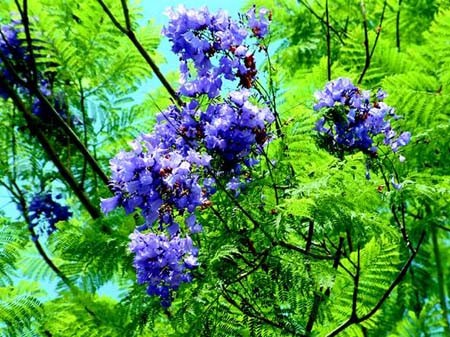
The species is a tall, fast-growing tree, deciduous or semi-evergreen depending on climate, with a broad, open crown carried on a straight trunk. The leaves are the giveaway: large, twice-pinnate, divided into many fine leaflets that read as fern fronds from a distance, which is the mimosifolia of the name even though the plant is no mimosa. The flowers are held in loose panicles, each bloom a slightly tilted trumpet with a paler throat, and they open before or with the new leaves in warm spring. The fruit is a round, woody capsule that splits to release thin, winged seed, the standard package of the bignonia family.
Each flat capsule holds a stack of seeds, every one with a papery wing that lets the wind carry it once the pod splits. The wing is the reason a single tree can seed a whole neighbourhood, and it is also why the seed sows best on the surface where the wind would leave it, not buried deep. The capsule persists on the tree through winter, a useful ID clue when the flowers are long gone.
Planted for the flower, the jacaranda is also a useful shade tree once the canopy fills, and its light, dappled shade suits a lawn or a plaza. The wood is used locally for boxes and carving, and the tree’s tolerance of urban heat makes it a climate-adapted choice for warming cities. In frost-prone places it is grown as a conservatory specimen or a summer patio tree, brought under cover before the cold. The fallen flower carpet is a feature, not a nuisance, in the cultures that love the tree.
Give it full sun and room for a wide crown, and pair the blue with the gold of the tabebuia relatives above for a two-colour avenue planted a season apart. The catalpa pair gives a later, white-and-purple show for the same boulevard role where a slightly hardier tree is needed.
Science & Biotechnology
The leaves and wood of jacaranda carry the fatty acid named jacaric acid, a conjugated linolenic acid studied for its place in seed-oil chemistry and for potential biological activity. The genus also holds iridoid glycosides and the phenolic load typical of Bignoniaceae, which gives the foliage its mild bitterness and its resistance to most browsing. None of this makes the tree a crop, but it explains why the leaves are left alone and why the wood, though soft, is workable for turnery and light joinery across its home range.
The bignonia family is full of showy trumpets, and the Catalpa bungei and the Catalpa bignonioides share the big-leafed, bean-pod look with a different flower, while the golden trumpet tree and the Tabebuia aurea offer the same avenue drama in yellow and gold. Knowing the family helps you pick a trumpet tree for the colour you want.
Uses & Benefits
Because seedlings vary in flower colour and form, and because a street tree wants uniformity, Jacaranda mimosifolia is cloned by shoot-tip culture and by nodal culture to hold a selected blue. Somatic embryogenesis has been reported in Jacaranda, opening a clean route to large numbers of identical liners for boulevard planting. The work supports the nursery trade more than the home grower, who usually buys a named young tree.
Growing from Seed
For a short spell each spring, cities from Pretoria to Brisbane to Lisbon turn the colour of a bruised sky, and one tree is to blame. Jacaranda mimosifolia drops a canopy of trumpet-shaped, blue-purple flowers so dense that the fern-like leaves underneath disappear, and the fallen petals carpet the pavement in violet. The display is brief and total, which is why the tree is planted by the thousand along boulevards even though it asks for frost-free warmth and a long season. A jacaranda in full flower is less a tree than a weather event, and people plan weddings and exams around it.
Jacaranda seed is thin and winged and wants light to move, so sow it on the surface of a free-draining, sandy mix and hold it warm and bright; a cold rest does it no favour and a wet seedbed rots the wing. The seedling is quick once warm, so pot it on by the height of the stem and grow it in full sun. Protect the young tree from frost for its first few seasons, since a cold check stalls the soft new growth and can kill a small plant.
Press the seed lightly into the medium rather than covering it, keep it evenly moist, and shade it only from the harshest midday sun. Move the seedling to its own pot when the stem reaches a hand’s span, and harden it gradually to full light. For a flowering tree in a hurry, buy a grafted or cloned young plant; the seed route gives a tree, but it may take its time before the first blue season.
Our Take
I time my spring around the jacaranda, and the week the petals fall is the week I sweep the path and smile. The seedlings are easy in warmth but slow to flower, so I treat a seed-grown tree as a long bet and a bought tree as a sure thing.
Related Reading
Gardeners who grow Jacaranda often pair it with these related subjects: