


Pinus massoniana Seeds | Masson’s Pine
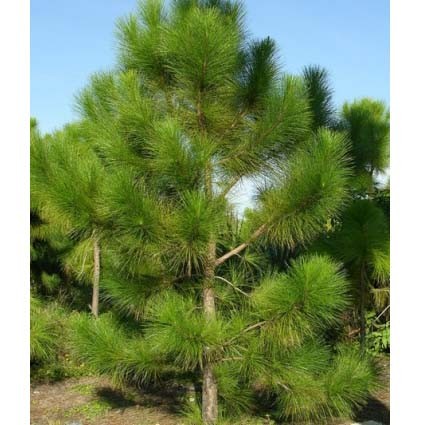
LATIN NAME: Pinus massoniana
COMMON NAME: Masson’s Pine
Plant Profile
Masson’s pine was named by the botanist A. B. Lambert in 1803 to honour Francis Masson, the Kew collector who travelled the world for plants, and the tree went on to become the backbone of southern China’s resin industry. Those long, slender, drooping needles in pairs weep from every branch and feed a tapping tradition that has supplied rosin and turpentine for centuries, even as a tiny worm now threatens the whole enterprise.
The species is a two-needle pine with fascicles of slender, soft needles often fifteen to twenty centimetres long that hang and sway rather than stiffen. That graceful habit separates it at a glance from the three-needle pines and from the stiffer northern species of the same region, and it gives the tree its Chinese name of horse-tail pine.
The trunk carries thick, reddish-brown bark that breaks into broad plates, a feature tied to the tree’s tolerance of fire and poor, acidic, often thin soils. The cones are small and ovoid, each holding winged seed released as the cone opens, and the seed feeds birds and small mammals through the winter.
Masson’s pine is a light-demanding pioneer that colonises bare, eroded, and acidic sites where few other trees establish. It is a workhorse of reforestation across southern China precisely because it asks so little of the ground and grows fast enough to cover a degraded hillside within a few years.
The natural range tracks the warmer, wetter half of China, thinning out where winters grow cold and where competing hardwoods take hold. That southern allegiance is why the tree is the signature conifer of the lower Yangtze hills and the red-soil uplands farther south, rather than a tree of the northern plains.
Science & Biotechnology
The tree exudes a copious oleoresin that is tapped for rosin and turpentine, a commodity trade centuries old. The resin is a mixture of terpenes, including alpha-pinene, beta-pinene, and limonene, the compounds that give turpentine its smell and rosin its uses in varnish, paper, and adhesive, and the bark and needles carry the same volatiles.
Masson’s pine is a host of the pine wood nematode, Bursaphelenchus xylophilus, whose insect vector is the longhorn beetle Monochamus. The nematode causes pine wilt, a rapid, often fatal disease, and is a major forest-health concern across East Asia and beyond, reshaping how the tree is planted and monitored.
Because of that threat, breeding and provenance trials aim to select trees with slower wilt development and better form, while monitoring programmes track the beetle vector. Tissue culture and molecular work support the longer-term improvement of the species, and seed orchards now favour the more resilient provenances.
Beyond rosin, the needles and wood are rich in the same terpene skeleton, which is why the species is studied for essential-oil composition and for the extractives that give the timber its working qualities. That chemistry also underpins the tree’s traditional uses of pollen and resin in regional practice.
Uses & Benefits
The straight, pale timber is used for construction and for paper pulp, while the resin supports a large rosin industry. In the garden the tree is valued as a fast, tolerant, informal pine for warm climates, though it grows too large for small plots and drops its long needles widely.
Pine pollen and resin appear in regional traditional uses, and the tree is a familiar feature of southern Chinese hillsides and painting. Appreciate those uses through the literature rather than harvesting wild trees, since untapped, healthy stands are worth more standing than cut.
Growing from Seed
Sow the winged seed in a clean, free-draining nursery bed and cover lightly; the seedling is recognised by its strap-like cotyledons followed by the first true needle pair. Thin seedlings once they stand a few centimetres tall so each has room to form a deep taproot and a straight stem.
Give the species full sun and a sandy, acidic loam; it tolerates drought and poor ground once established but dislikes waterlogging and liming. Water young beds through dry spells and weed the line so the tiny seedlings are not smothered, and protect the tips from birds that pull the new shoots.
In regions where the pine wood nematode occurs, watch for sudden wilting and browning of the crown and for the emergence holes of Monochamus beetles. Remove and destroy affected trees promptly, and prefer resistant stock where it is offered, because early removal is the only reliable check on the disease’s spread.
Our Take
For other warm-climate pines to plant alongside, the Yunnan Pinus yunnanensis, the Chinese Pinus tabulaeformis, the Japanese black Pinus thunbergii, and the slash Pinus elliottii all share Masson’s love of sun and acidic ground.
Related Reading
Gardeners who grow Masson’s Pine often pair it with these related subjects: