


Liatris spicata Seeds | Blazing Star / Gayfeather
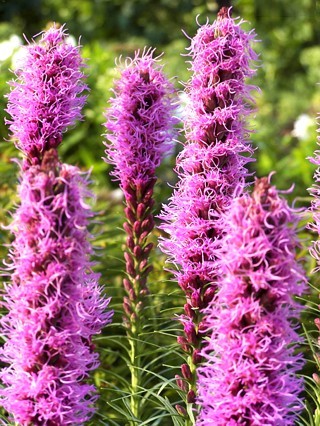
LATIN NAME: Liatris spicata
COMMON NAME: Blazing Star / Gayfeather
Plant Profile
Almost every flowering spike in the garden opens from the bottom upward, so the top is the last to bloom. Liatris spicata breaks the rule. Its feathery wand of purple flowers opens from the top first and works downward, which is why the plant always looks as though it is just beginning even when it is half finished. The effect is unusual enough that first-time growers often worry they have a broken plant, when in fact they have one of the few composites that flowers in reverse.
Below ground the plant stores energy in a short, corm-like crown rather than a true bulb, and from it rise narrow, grasslike leaves on upright stems. The foliage is quiet and fine, so the spike reads as the main event. Because the crown sits at the soil line, the plant is hardy and long-lived once settled, and it spreads slowly into a broader clump without becoming a nuisance.
The plant’s narrow footprint makes it a problem-solver for the middle of a border where round, bushy perennials would crowd the view.
Liatris is a favourite of flower farmers because the spikes are long-lasting both fresh and dried. Cut them when the top third of the spike has opened, and they hold colour in the vase for a surprising length of time. Dried, the wands keep their shape and a muted tone that fits winter arrangements better than most meadow flowers.
Science & Biotechnology
The genus Liatris has long interested chemists because its roots contain polyacetylene compounds and related constituents that have been screened for antimicrobial and anti-inflammatory activity.
Gardeners sometimes mistake the storage organ for a bulb and plant it too deep. It is a solid, corm-like crown that wants to sit at or just below the soil surface, and planting it deep is the usual reason a new Liatris fails to appear. Once correctly placed in lean, moist-but-draining soil, the crown is dependable and returns yearly with little care.
Uses & Benefits
The tubular flowers are a precise fit for butterflies, skippers and night-flying moths, which probe the bloom for nectar along the whole length of the spike. In a prairie or meadow planting the wand acts as a vertical nectar station that draws a different set of pollinators than the flat daisies around it. Leaving the spent spikes standing feeds goldfinches on the seed through early winter.
Growing from Seed
Liatris spicata is one of the few North American prairie species to have entered general garden cultivation as a named perennial rather than a wildflower curiosity, and selections such as the white ‘Alba’ and the dense ‘Kobold’ have been bred for tighter habit and heavier bloom. The species itself is a wetland-edge plant in the wild, which is why it tolerates heavier soil and more summer moisture than many prairie natives, a useful trait for the mixed border that is not always bone dry.
Because the spike opens from the top, a first-year grower sometimes assumes the plant is finishing when it is only beginning, and cuts the wand for the vase too early. The simple rule is to wait until the lower buds show colour; by then the upper flowers are already open and the stem will have maximum length in water. Left in the garden, the sequential opening stretches the display over many weeks.
Liatris is slow to flower from seed but patient growers are rewarded with a long-lived clump.
The seed is fine and light, best sown on the surface of a moist, free-draining compost and kept bright until it sprouts, after which it should be grown on without crowding. Because seedlings are slender at first, a fine mist rather than a heavy watering can keeps the surface from crusting over the tiny plants.
Set young plants or crowns about 30 centimetres apart in full sun and soil that stays moist in summer yet drains in winter. Thin the clumps if they become dense so air moves through the stems, which keeps the foliage clean. A light trim of spent spikes encourages a tidier crown, though leaving some standing feeds the birds.
Our Take
Blazing star is the rare vertical accent that asks for almost nothing once its crown is down. It belongs with fleabane and sunflower in a prairie drift, and it threads beautifully through lupine spires.
Related Reading
Readers interested in Blazing Star / Gayfeather frequently explore these as well: