


Dianthus × hybrida Seeds | Rainbow Loveliness Dianthus
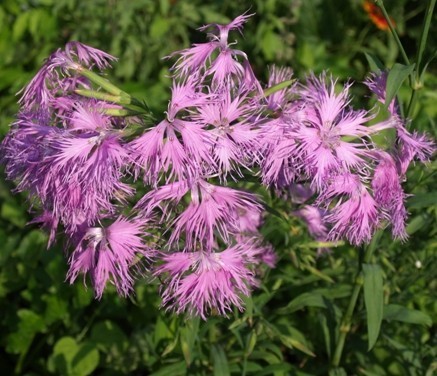
LATIN NAME: Dianthus × hybrida
COMMON NAME: Rainbow Loveliness Dianthus
Plant Profile
‘Rainbow Loveliness’ builds a low, spreading cushion of slender, blue-grey leaves, the classic Dianthus foliage that looks dusted with frost even in full sun. From this tidy mound rise wiry, branching stems that carry the flowers well above the leaves, so the blooms read as floating colour rather than a heap of green. The leaves are narrow and glaucous, and the stems are square in cross-section, a quiet family trait of the Caryophyllaceae that you can feel with a fingertip. The plant stays compact through the season and asks for little once it is settled.
The fringed petal margin is the cultivar’s namesake feature and its main appeal. Each of the five petals is cut into a fine, comblike edge that catches light and gives the blossom its lacy, hand-tied look. The flowers open across a long early-summer window in a blend of pink, crimson, white and lavender, often several tones on one plant. The fringe is not merely decorative; in wild Dianthus the toothed edge acts as a pollen guide and a structural cue for visiting bees, and breeders have simply exaggerated it into the garden show we grow today.
This is a front-of-border and edging plant first, a container plant second, and a cut flower third, though it does all three with ease.
The wiry stems and firm petals make excellent cut flowers, and a handful of ‘Rainbow Loveliness’ will scent a room for the better part of a week in water. Cut the stems in the cool of the morning, strip the lower leaves, and the fringed blooms hold their colour and their scent far longer than softer annuals. They also dry without losing their shape, which makes them a candidate for small winter posies.
In the garden it pairs naturally with other sun-loving, lean-soil plants. Good neighbours include Sweet William for a deeper colour block and carnations for height behind it; blazing star makes a fine vertical contrast later in the season. All share the grit-and-sun temperament that keeps ‘Rainbow Loveliness’ in flower.
Science & Biotechnology
Dianthus sits in the Caryophyllaceae, the pink family, close to carnation (Dianthus caryophyllus) and the old-fashioned clove pink. The genus is prized less for leaf chemistry than for floral volatiles, and ‘Rainbow Loveliness’ is a strong example of why the nose is the best field guide to a pink.
The heady scent of a good pink comes from a volatile mix led by eugenol and supported by smaller phenolic and terpene notes. This is the same principal compound that gives clove oil its bite, which is why a well-scented Dianthus is so often described as smelling of cloves. Selective breeding for fragrance has, in effect, amplified a compound that wild populations carry in trace amounts. The result is a flower you can identify blindfolded, and a useful reminder that the perfume counter and the perennial border share more molecules than gardeners expect.
‘Rainbow Loveliness’ is a Sweet William type, which sets it apart from the patch-forming cottage pink (Dianthus plumarius) and the tall carnation. Compared with the clove pink it forms a looser, taller cushion and flowers in a freer colour mix rather than the neat single tones of the old border pinks. It is also hardier than many show carnations, standing cold winters in a well-drained site without lifting. For a breeder’s flower it is reassuringly tough.
Uses & Benefits
Most garden pinks are content to look pretty and stay quiet. ‘Rainbow Loveliness’ is not one of them. Each flower is edged with a deep, lacelike fringe, the botanical signature of Sweet William parentage, and when you lean in the whole bloom exhales the warm, peppery note of clove oil. That scent is no accident of perfume breeding; it is chemistry. The same molecule that gives a carnation its smell, eugenol, rides in the petal oils of this Dianthus, which means a flower bred for the cottage border shares its aromatic fingerprint with the kitchen spice shelf. This is a plant that asks to be smelled before it is described.
Growing from Seed
‘Rainbow Loveliness’ is raised from seed as a short-lived perennial; many growers treat it as a biennial for the freshest flower show.
The seed is fine and light, so sow it on the surface of a gritty, free-draining seed compost and press it down rather than covering it. Light helps the seed sprout, and a closed propagating lid keeps the surface from drying. Move the tray to bright, indirect light and keep the medium just moist until the seedlings show, then open the lid gradually to harden them.
Once the young plants have made several true leaves, set them out at about 25 centimetres apart in full sun and lean, alkaline to neutral soil. A gravel mulch over the crown through the first winter keeps the base dry and prevents the rot that finishes off more Dianthus than any frost. Cut the stems back after flowering to keep the cushion tight, and the plant will return denser the next spring.
Our Take
‘Rainbow Loveliness’ rewards the patient with a scent you can smell across the path, but it hates wet feet more than it hates cold. Give it grit, give it sun, and deadhead to keep the fringe coming.
Related Reading
More species in the same orbit as Rainbow Loveliness Dianthus: