


Digitalis purpurea Seeds | Purple Foxglove
LATIN NAME: Digitalis purpurea
COMMON NAME: Purple Foxglove
Plant Profile
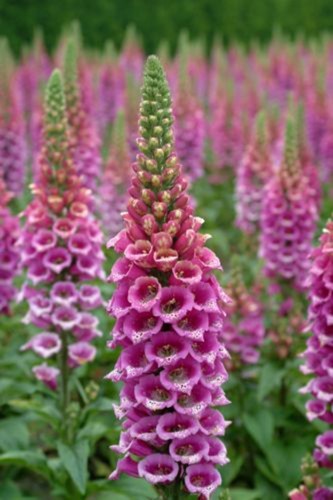
Digitalis purpurea is a true biennial. In its first season it builds only a low rosette of broad, downy leaves, hoarding energy in the taproot. In the second season it sends up a one-sided spike that can reach two metres, hung with tubular, purple-pink flowers marked inside with deep spots and a fringe of white hairs. After flowering and seeding the parent plant dies, but not before scattering the next generation across the border.
The leaf carries cardiac glycosides, chiefly digitoxin and the hydroxylated relative digoxin. Both bind to the Na+/K+-ATPase pump on heart-muscle cells, slowing the pump, raising intracellular calcium, and producing the positive inotropic effect that strengthens each contraction. The margin between a helpful dose and a dangerous one is narrow, which is why the drug is measured in microgrammes and why the whole garden plant must be treated as toxic.
Garden breeders have tamed the wild form without removing its drama. The ‘Excelsior’ group was selected for flowers carried all around the stem rather than one-sided, in colours from white and cream to rose and purple, opening the foxglove to brighter borders.
In the wild the plant favours the dappled light of woodland edges and the acid, disturbed ground of clearings; in the garden it accepts sun if the root stays cool and the soil stays moist. The ‘Excelsior’ hybrids and their successors bring the same tolerance for partial shade that makes foxglove precious in the shadowed back of a border where few bold spikes will grow.
Science & Biotechnology
An elegant detail of the supply chain is that the final, valuable hydroxylation step is still often performed by the plant itself. Chemically synthesised precursors are fed to Digitalis suspension cultures or to whole plants, and the plant’s own 12beta-hydroxylase converts them into digoxin. This biotransformation, where a living plant acts as a chemical reactor, is a classic case study in plant biotechnology and is being extended through hairy-root culture and genome-informed enzyme engineering.
Uses & Benefits
A single foxglove leaf can be fatal if eaten, yet the same molecules that stop a heart are the ones doctors still reach for when a heart begins to fail. In 1775 an English country physician named William Withering noticed that a folk remedy given by a village herbalist eased the swollen limbs of dropsy patients; over the next decade he tested the plant on 156 cases and in 1785 published An Account of the Foxglove, the founding text of modern cardiac pharmacology. Few garden plants can claim to have opened a whole branch of medicine while remaining a cottage-garden favourite.
Those spots and hairs are not decoration; they are a nectar guide built for a single kind of visitor. The bumblebee lands on the lower lip, brushes the spotted throat, and the white hairs dust its back with pollen as it reaches the nectar. Flowers open from the base of the spike upward, so a bee climbing the stem performs steady cross-pollination on its way. Honeybees are too small to trip the mechanism, which is why the foxglove is a bumblebee plant first.
Digoxin remains on the formulary for certain atrial arrhythmias and for heart failure that does not respond to other care. Few pre-1800 herbal preparations survived into evidence-based medicine largely unchanged in principle; this is one of them. The original source was the leaf of Digitalis purpurea and its Mediterranean cousin Digitalis lanata, the latter now the main commercial supplier of standardized leaf material.
Growing from Seed
The only real difficulty is respecting the rhythm: leaves the first year, flowers the second.
Foxglove seed is extremely fine and needs light to sprout, so sow it on the surface of a moist, fine compost and press it down without covering. Keep the surface shaded and evenly moist until the seedlings appear, then give bright light. Because the seed is dust-like, a gentle mist is kinder than a watering can.
When the seedlings have a few true leaves, move them to small pots, and set the young rosettes into their final spot in good time for them to establish before cold weather. A spacing near 35 centimetres lets the second-year spike stand without crowding. Choose a site with cool, humus-rich soil that is slightly acid, and shelter from the hottest midday sun.
Our Take
Foxglove is low-maintenance and high-reward: sow once and it will self-sow its way into a permanent presence. Pair it with lupine and Sweet William for a classic cottage drift, and note that every part stays poisonous, so site it away from children and pets.
Related Reading
Gardeners who grow Purple Foxglove often pair it with these related subjects: