


Borago officinalis Seeds | Borage
LATIN NAME: Borago officinalis
COMMON NAME: Borage
Plant Profile
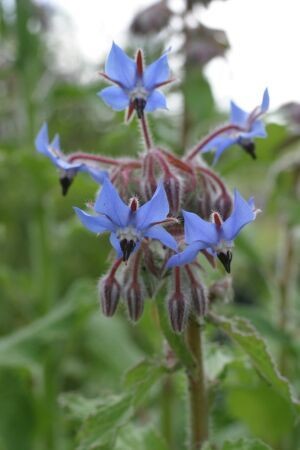
Every aerial surface of borage is covered in stiff, glassy, hooked trichomes of two kinds: eglandular bristles that deter grazers and glandular hairs that secrete mucilage. The nodding, five-lobed flowers open true blue, and their five dark anthers converge into the prominent black cone at the corolla throat that gives the genus its starflower look. Boraginaceae characteristically bear their blooms in scorpioid cymes that uncurl like a fiddlehead as they open, and borage follows this rule exactly. The lower flowers in a cluster open first, so a single stem shows buds, fresh blue corollas and fading older blooms at once, a useful field mark when you are sorting the species from its relatives.
Science & Biotechnology
Borage is the only common garden herb whose commercial value sits less in its leaves than in its seeds. Pressed borage seed yields an oil unusually dense in gamma-linolenic acid, an omega-6 fatty acid that the human body normally makes only in small amounts from dietary linoleic acid. Among the cultivated oilseed crops, borage is one of the richest known botanical sources of this compound, typically reported around eighteen to twenty-four percent of the total fatty acids, noticeably higher than evening primrose oil. That single biochemical fact, not the blue flower, is why borage seed is farmed and cold-pressed at scale across parts of Europe and North America.
Native to the drier margins of the Mediterranean and western Asia, borage behaves as a hardy annual that self-sows wherever it is happy, dropping thousands of angular nutlets once the flower wands dry. It asks for open sun and a reasonably drained soil and stands poor ground that would stall fussier herbs. John Gerard’s Herball of 1597 already praised the plant as a cheering cordial, and the species has been carried by gardeners ever since for both the bee pasture and the pot. A spring sowing in most climates will keep a patch going for years through volunteers alone.
The seed oil’s gamma-linolenic acid content is the headline, but the leaves and stems carry a different and more cautionary chemistry. Borage foliage contains the 1,2-double-bond pyrrolizidine alkaloids, chiefly intermedine, lycopsamine, amabiline and supinine, the form most harmful to the liver. Regulatory bodies such as the European Medicines Agency advise against prolonged internal use of preparations made from the aerial parts. The seed oil itself is generally low in alkaloids when properly processed, but the distinction between seed and leaf matters: the flower and young leaf are used as food, while the leaf tea as a tonic is the part regulators flag.
Candied borage flowers have long adorned cordials, punch bowls and desserts in Britain and France, and the fresh blue corollas floating in Pimm’s or frozen into ice cubes remain a safe, alkaloid-poor use because the pyrrolizidine load builds up in the photosynthetic tissue rather than the petals. This is the one place where borage earns its old friend status without a caveat, and the petals lend a faint cucumber note to cold drinks that the leaves also carry, though more strongly.
Uses & Benefits
In Liguria and parts of Spain the young shoots are still cooked like asparagus or dropped into tortilla and fritters, the mild cucumber note surviving the heat, while the flowers flavour vinegar and sugar. As a living crop borage is also one of the most reliable bee plants in the herb garden, its open blue discs visited by honeybees and bumblebees from first flowering to frost, and it is planted in orchards and field margins to boost pollinator visits. The seed, once cleaned and dried, stores well and is the part traded for oil extraction, with a single healthy plant yielding a surprising quantity of tiny nutlets.
Home growers rarely press their own oil, but the agronomy is straightforward: a warm, sunny bed produces a heavy seed set, and the nutlets thresh cleanly from the dry stalks. Commercial fields use screw presses and sometimes solvent finishing to maximise the gamma-linolenic acid recovery, then refine the oil to a pale, bland-tasting product sold in capsules. The defatted meal left behind is itself a protein-rich animal feed, so little of the harvest is wasted.
Growing from Seed
Sow the small, dark nutlets shallowly, barely covered, in a prepared seedbed or modules, and thin the seedlings once they carry two to three true pairs of leaves so each plant has room to branch. Borage resents root disturbance, so transplant small, and set the strongest individuals about forty centimetres apart. Keep the bed weed-free while the rosette establishes, then water only in sustained dry spells; overfeeding pushes soft leaf at the expense of flower and seed. Allow a few plants to set seed for next year’s volunteers, and cut whole stems for seed when the lower nutlets turn brown. A light midseason cut after the first flush can push a second wave of bloom and a later seed crop.
Our Take
Borage earns its place twice over: as a pollinator magnet and as a gamma-linolenic acid crop you can grow yourself. If you enjoy seed-oil herbs, compare it with evening primrose and the cheerful calendula, and for more blue-flowered bee forage see English lavender.
Related Reading
Gardeners who grow Borage often pair it with these related subjects: