


Astragalus laxmannii Seeds | Standing Milkvetch
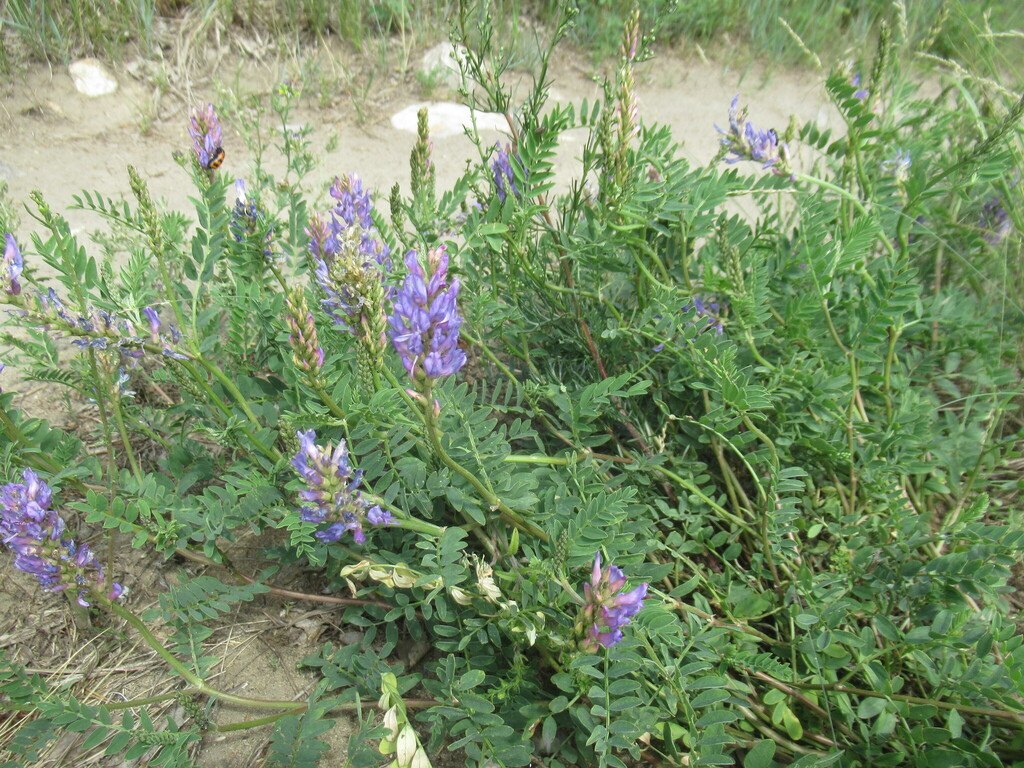
LATIN NAME: Astragalus laxmannii
COMMON NAME: Standing Milkvetch
Plant Profile
Standing milkvetch is a perennial of the Fabaceae from the steppe belt that runs from the Volga to Manchuria: Kazakhstan, Siberia, Mongolia, northern China, Korea and Japan. It also occurs, oddly, across the northern plains of North America, where it is treated as a native. It reaches about 40 cm, sometimes a little more, with several upright stems from a woody base and a taproot that goes down further than the top growth suggests.
The leaves are pinnate, with nine to fifteen narrow leaflets, and the flowers are pale purple to lilac in elongated racemes that open in early summer. The pods that follow are narrow, slightly curved and leathery, and they rattle when they are ripe. That rattle is how you find the plant in a grazed paddock where the top growth has been taken off.
Asian plants were long treated as a separate species, Astragalus adsurgens, and that name is still the one used in most Chinese agricultural literature. Where the two were merged the older name took priority, and the plant itself did not change at all. Only the label on the seed bag did.
Science & Biotechnology
Astragalus is the largest genus of flowering plants, with something like three thousand species, most of them in the dry mountains of Central Asia. It is the genus that gave the world gum tragacanth, tapped from A. gummifer and its relatives. It is also the genus that gave livestock managers the word locoweed, and both facts belong in any account of it.
A deep taproot is the defining adaptation. It reaches water that the shallow-rooted grasses of the steppe cannot, and it survives grazing that would kill them. The plant nodulates with rhizobia and fixes nitrogen, so the ground beneath it improves over time. It is sown with grasses rather than instead of them, and the mixture does better than either alone.
The genus carries a warning. Many Astragalus species accumulate selenium from the soil, and some carry the indolizidine alkaloid swainsonine, which causes the neurological damage called locoism. Standing milkvetch is not one of the notorious species, but it belongs to a genus where grazing animals are always worth watching. Cattle that develop a taste for one locoweed will hunt it out.
Uses & Benefits
In northern China it is sown as shadawang on the Loess Plateau and in Inner Mongolia, for hay, for grazing and for holding eroding slopes. It ranks among the few legumes that will establish on the dry, stony, alkaline ground that makes up much of that country, and it is often mixed with Chinese wildrye. Seed of it is sold by the tonne to projects trying to stop the Yellow River carrying the plateau to the sea.
As a nitrogen fixer it lifts the protein content of a grass mix and improves the soil for the next crop, and its taproot makes it useful on banks and cuttings where nothing else will hold. It also comes back after fire, from the root.
It is also a bee plant, and a good-looking one in flower: pale lilac spikes above grey-green foliage, in a place where most of the vegetation is grey and low. In a steppe garden it ranks among the first things to look like a garden plant. The rest of the Fabaceae here runs to Astragalus root, Thermopsis and Gueldenstaedtia.
Growing from Seed
The seed coat is hard and germination is uneven without scarification. Nick it, or soak it in warm water for a few hours, then sow on the surface of a firm bed in late winter or early spring and cover no more than a centimetre. Light helps, and so does a cool start; a heated propagator is the wrong tool for this species.
It needs full sun and sharp drainage. On wet ground the crown rots in the first winter; on dry ground it will outlive most of what is sown with it. In a garden, give it a raised bed or a gravel slope and leave it alone. It resents watering more than it resents drought.
Establishment is slow. The first season goes into the taproot and there is little top growth to show for it, which discourages anyone who expects a legume to look like a legume by July. Flowering usually starts in the second or third year, and the plant is short-lived on rich soil and long-lived on poor.
Our Take
Standing milkvetch is a plant for the places other legumes refuse: dry, alkaline, wind-scoured and grazed. It is not a garden flower and does not pretend to be one. Sown where it belongs, it does the two things that matter on marginal land. It holds the soil, and it feeds the soil. Nothing else in the catalogue does both for the price.
Related Reading
More species in the same orbit as Standing Milkvetch: