


Adonis aestivalis Seeds | Summer Pheasant’s-eye
LATIN NAME: Adonis aestivalis
COMMON NAME: Summer Pheasant’s-Eye
Plant Profile
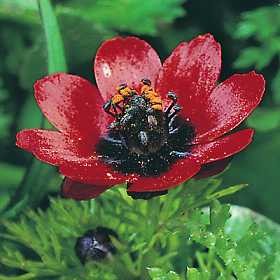
The most memorable thing about summer adonis is its flower: a shallow bowl of ten to twenty narrow, flame-red petals held flat above finely cut foliage, with a dark, almost black central boss that makes the red look as though it is burning. It is one of the truest scarlets in the cool-season garden and it opens over a long spring-to-summer window.
The genus takes its name from Adonis of Greek myth, the youth associated with blood-red flowers and with the cycle of death and return each spring. Botanists reaching for a name for these red, anemone-like blooms reached straight for that story, and the myth still colours how the plant is read in the border.
The leaves are divided into slender, thread-like segments that give the whole plant a soft, airy texture, quite unlike the bold leaves of many border flowers. The flower itself is a simple cup of narrow petals around a dense cluster of stamens and carpels, and the many petals are what separate it from the tighter five-petal forms of its relatives.
Adonis aestivalis is a plant of warm, open, cultivated and disturbed ground across southern Europe, the Mediterranean, and western Asia. It has travelled with agriculture and now turns up as a casual in fields and roadsides well beyond its native range.
Unlike the spring-flowering perennial Adonis vernalis of colder steppe, this species is an annual that completes its life in a single warm season. It wants full sun and a free-draining soil, and it is happiest where the ground warms through the growing period rather than where it stays cold and damp.
In the wild the red bowls are worked by solitary bees and early butterflies that find the open cup an easy landing, and a drift of adonis in a meadow reads as a sheet of emitted light at a distance. The plant’s fine foliage lets it mingle with cereals and legumes without shading them out, which is part of why it travels so readily with farming.
Science & Biotechnology
Among the named compounds studied in Adonis are adonitoxin and cymarin, cardenolides that strengthen heart contraction and that have been measured in related species used in traditional cardiac preparations. Their presence is what gives the genus its medical reputation and its cautionary edge in the garden.
Uses & Benefits
The Adonis genus is notable for cardiac glycosides, the class of compounds that acts on the heart, and several species have a long record in herbal medicine for exactly that property. The chemistry is the reason the plant should be admired and not eaten, and it places Adonis among the pharmacologically serious members of the buttercup family.
As an ornamental, summer adonis is valued for its pure red and its fine foliage, and it works as a meadow mark or a front-border accent where a bright, brief flush is wanted. The same compounds that interest pharmacologists mean the plant is one to enjoy with the eyes rather than the palate.
Growing from Seed
The stems are slender but the colour is strong enough to read at a distance, so a drift of adonis lights up a mixed meadow or a spring planting. In the vase the bowl-shaped flowers hold their scarlet for several days, making a small but vivid cut contribution.
Raise summer adonis by sowing where it is to grow, because the slender taproot dislikes being moved. Choose a sunny, open site with light, free-draining soil and sow as the ground can be worked.
Drill the fine seed shallowly into a prepared bed and thin the seedlings once they stand a few centimetres tall, keeping the strongest plants spaced so air moves through the foliage. A light, gritty seedbed gives the cleanest stand.
Left to itself the plant drops seed and returns the following season, so a single sowing can establish a recurring patch. Thin the self-sown seedlings by height in spring to keep the display open rather than crowded. Related spike flowers to grow nearby include delphinium, larkspur, and the close cousin Adonis dentata.
Our Take
I sow summer adonis where I want a shock of red that asks for nothing once it is up, and I let it self-sow so the patch renews without effort. Admire the colour, but keep it out of the kitchen, because the very chemistry that makes the genus famous is not for eating.
Related Reading
Gardeners who grow Summer Pheasant’s-Eye often pair it with these related subjects: