


Rinorea anguifera Seeds | Snake-fruited Rinorea
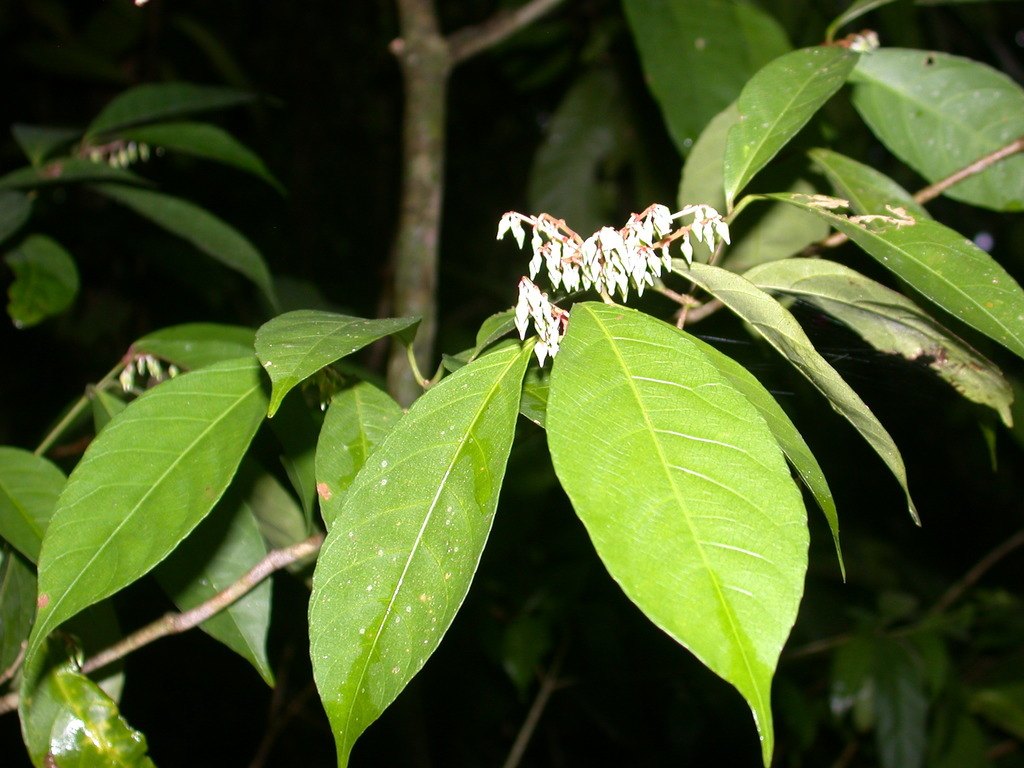
LATIN NAME: Rinorea anguifera
COMMON NAME: Snake-fruited Rinorea
Plant Profile
Rinorea anguifera is a shrub or small tree to 10 m of the tropical forest understorey, described by Loureiro and moved to Rinorea by Kuntze in 1891. It has toothed leaves 14 to 28 cm long, small white or cream flowers in dense axillary clusters, and a capsule covered in moss-like branched hairs that splits with a snap. It is a violet, which is the first surprising thing about it.
The Violaceae is mostly a family of herbs: violets, pansies, the little woodland plants of temperate regions. Rinorea and a handful of other genera are woody, and they are trees of the tropical forest, with the same floral plan in a different body. The combination is one of the more interesting facts in the family.
Its range runs from Thailand through Laos, Cambodia and Vietnam into peninsular Malaysia, Singapore, Sumatra and Borneo, and it grows in the shade of primary and old secondary forest up to 600 m. It is common where it occurs and easy to walk past, flowering at a few metres in the understorey. Singapore lists it as critically endangered, which says more about the fate of that forest than about the plant.
The genus name is from the Greek for nose, a reference to the shape of the capsule, and the epithet means snake-bearing, which describes the way the ripe capsule opens: two valves that curl back like a pair of jaws. The names are old and slightly fanciful, and they are accurate enough.
Science & Biotechnology
The flower is built on the violet plan but without the spur and the lower lip that make a violet a violet. Five sepals, five petals, five stamens with the anthers joined around the ovary, and a superior ovary with three placentas. The symmetry is nearly radial, which is unusual in the family.
The capsule, 1.5 to 3.5 cm across, is covered before it opens in a dense mass of branched hairs that make it look like a moss ball. As it dries, tension builds in the valves, and when the seam fails the halves curl back and flick out the seed. A plant can scatter its seed over several metres in a single dry afternoon.
Each fruit holds up to six seeds, 4 to 7 mm long, egg-shaped, glossy and straw-coloured, and they are shed as the valves open. The branched hairs on the capsule are the dispersal device: they catch on fur and feathers and slow the fall of the seed through the understorey. Seed set is often poor, and the plant leans on shade and patience rather than on quantity.
Uses & Benefits
The wood is hard and fine-grained and is used for small turnery and tool handles where the tree is common enough to cut. It is not a timber species of the first rank, and the trees are usually left standing in the shade of the bigger crop.
In local medicine the bark and leaves are used for skin complaints and for stomach problems, and the plant appears in several regional pharmacopoeias. The documentation is thin, and the plant is not traded internationally. It ranks among the many understorey trees with a small place in local practice.
Ecologically it is a component of the forest understorey, and understorey trees are the ones that suffer most when a forest is logged, because they cannot move and they cannot resprout from a stump as easily as a pioneer. A forest without its Rinorea is a forest that has lost part of its structure. The catalogue keeps Viola wittrockiana, Euphorbia marginata and Euphorbia myrsinites from neighbouring families.
Growing from Seed
Seed should be sown fresh, because the elaiosome and the thin coat mean it does not store well. Sow in a humus-rich mix at warm temperatures and keep it shaded; germination is slow and uneven, and a proportion of the seed may wait several months before it moves.
The seedlings want deep shade, high humidity and a soil that stays moist, and they are slow. Plant out when the stem is pencil-thick, in leaf litter under a canopy, and keep the roots mulched; this is a forest-floor plant and it resents both drought and full sun.
Once established it needs little: shade, moisture and an annual mulch. It is tender to frost and needs a warm climate, and in a cool one it is a glasshouse subject. Pruning is limited to the removal of a wayward branch, and the plant makes its own shape.
Our Take
This is a plant for the person who likes the quiet parts of a forest and the quiet parts of a family. A woody violet is a small surprise, and an understorey tree that depends on ants to move its seed is a larger one.
Grow it in shade, in a warm climate, and give it time. It will not flower like a pansy, and it will not grow like a pioneer; it will do the slow work that understorey trees do, and that is worth watching.
Related Reading
Continue exploring with these related plants: