


Hordeum murinum Seeds | Wall Barley
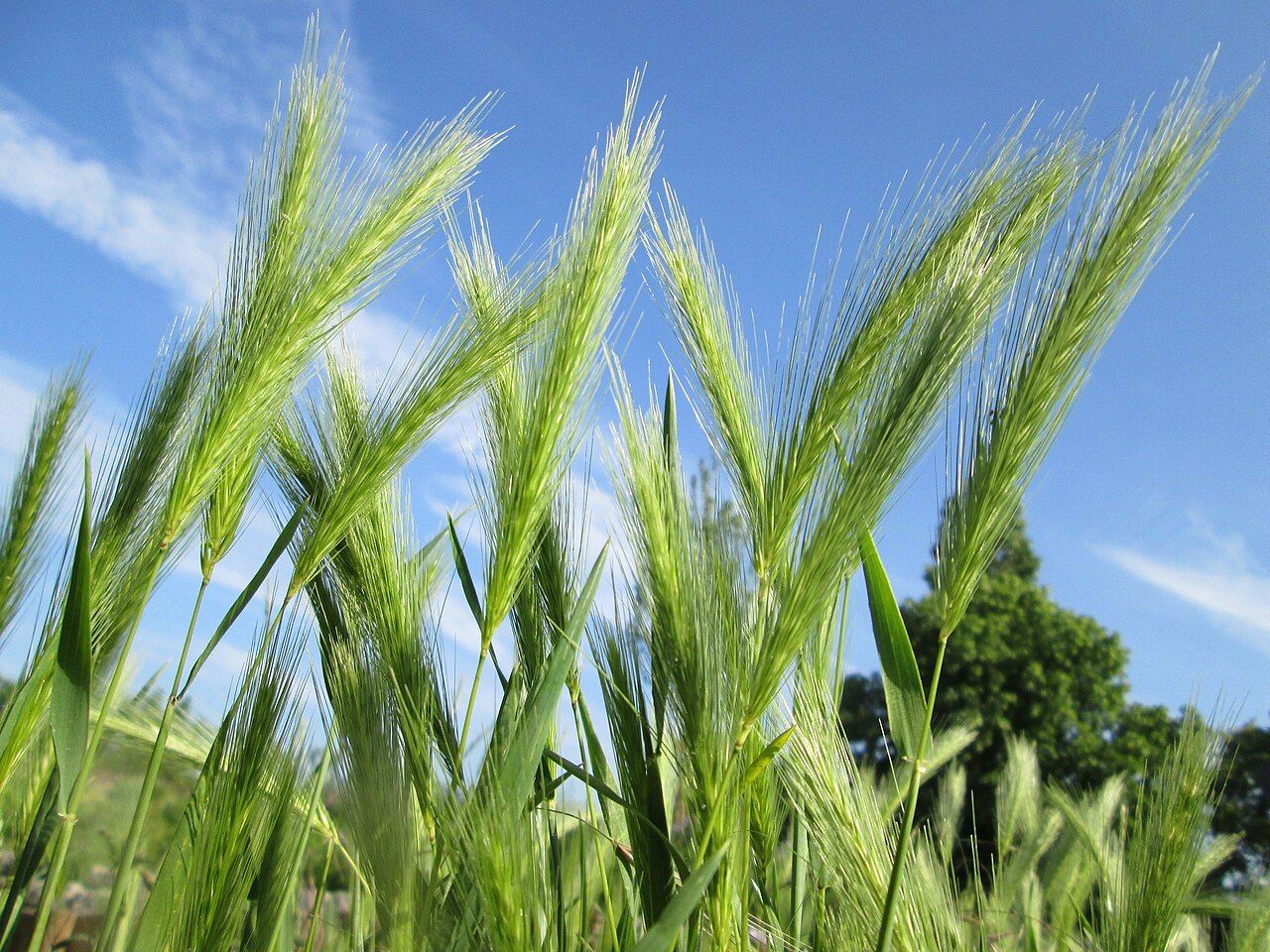
LATIN NAME: Hordeum murinum
COMMON NAME: Wall Barley
Plant Profile
Wall barley is an annual grass 30 to 50 cm tall, with unbranched spikes up to 10 cm long and leaves about 8 mm wide, carrying short blunt ligules. It germinates in spring, flowers from May to July and dies after setting seed, so the whole plant is a single season’s work. It is the most widespread and common of all the Hordeum species.
The spike is the identifying feature: the spikelets sit in threes along the axis, each with a long awn, and the whole head looks like a small, rough bottlebrush. Once the seed is ripe the awns stiffen and the spikelets break apart, which is how the plant gets into socks, dogs’ coats and the cuffs of jackets.
Its centre of distribution runs through the Mediterranean, central Europe, western Asia and North Africa. In the British Isles it counts as an ancient introduction, common in England and Wales and much less so in Scotland and Ireland, and almost always within sight of a wall, a kerb or a patch of disturbed ground.
Science & Biotechnology
A close relative of cultivated barley, Hordeum vulgare, it serves as one of the models for what the wild ancestors of a crop look like. Subsp. murinum is tetraploid, and it differs from the rest of the genus in morphology, in molecular genetics, and in the barriers that stop it crossing with other Hordeum taxa.
There are three subspecies. Subsp. leporinum is hare barley, shorter at 10 to 40 cm, with the spikelets attached to branches rather than to the main axis; it was published as a full species by Link in 1834 and reduced to a subspecies by Arcangeli in 1882. Subsp. glaucum, smooth barley, is the third, and the three are hard to tell apart in the field.
Rainfall drives seed production more than anything else. A dry year, with rain too early or too late, leaves no chance of re-seeding, and the plant throws a larger share of its resources into seed when water runs short. Hence the abundance after a wet spring, and the disappearance after a dry one. Three other Poaceae are catalogued alongside it: Hordeum jubatum, Beckmannia syzigachne and Pennisetum orientale.
Uses & Benefits
On poor rangeland it provides forage, and in Jordan researchers have studied it as a pasture species for dry areas, where sowing rate affects seed and forage yield but not height or protein content. A crop it is not and never will be; the value lies in growing where nothing else does, in the gap between the rains.
A meadow or a rough verge gains a useful early grass, and the small granivores gain a meal: finches and mice take the seed, and the plant supports whatever insects come to a grass in flower. Ornamental it is not, but a stand moving in a May wind has its own kind of interest.
The practical objection is the awn. It works into wool, into the spaces between toes, and into the ear canal of a dog, and a wall barley awn in a dog’s ear is a veterinary bill. If you walk a long-haired dog through it in July, check the ears afterwards.
Growing from Seed
Sow in autumn or early spring, 1 cm deep, at 10 to 18 °C. It needs no treatment and germinates in a week. For a meadow patch, broadcast at 3 g per square metre and rake in; for a seed increase, sow in rows 20 cm apart and keep them weeded until the plants close over.
An annual that depends entirely on seed, it is simple to manage: let it ripen if you want it back, and cut it before the awns harden if you do not. Cutting at flowering kills it without setting seed, and one pass with a mower in June clears a path edge for the season.
Almost anything will grow it, including compacted subsoil and rubble, but it cannot compete in a closed sward. Hence its presence on edges and in gaps, and the absence from a thick lawn while a gravel path beside the lawn is full of it.
Our Take
Nobody plants wall barley on purpose, and there is no reason to start. It is here, it is everywhere, and it has done its job competently since before the Romans brought the roads it grows beside. Few plants have travelled so far on so little invitation.
Worth knowing rather than worth growing. It tells you what the ground is like, it feeds the birds in June, and it will find your socks in July. That sums up its relationship with gardeners, and a fair one it is.
Related Reading
Readers interested in Wall Barley frequently explore these as well: