


Amaranthus gangeticus Seeds | Elephant-head Amaranth
LATIN NAME: Amaranthus gangeticus
COMMON NAME: Elephant-head Amaranth
Plant Profile
Elephant-head amaranth is the name used in the seed trade for the deep purple form of edible amaranth. Most authorities now treat Amaranthus gangeticus as a synonym of A. tricolor, and it was recognised as a separate species in the past; the plants sold under the two names are the same thing, selected for darker colour and a heavier head.
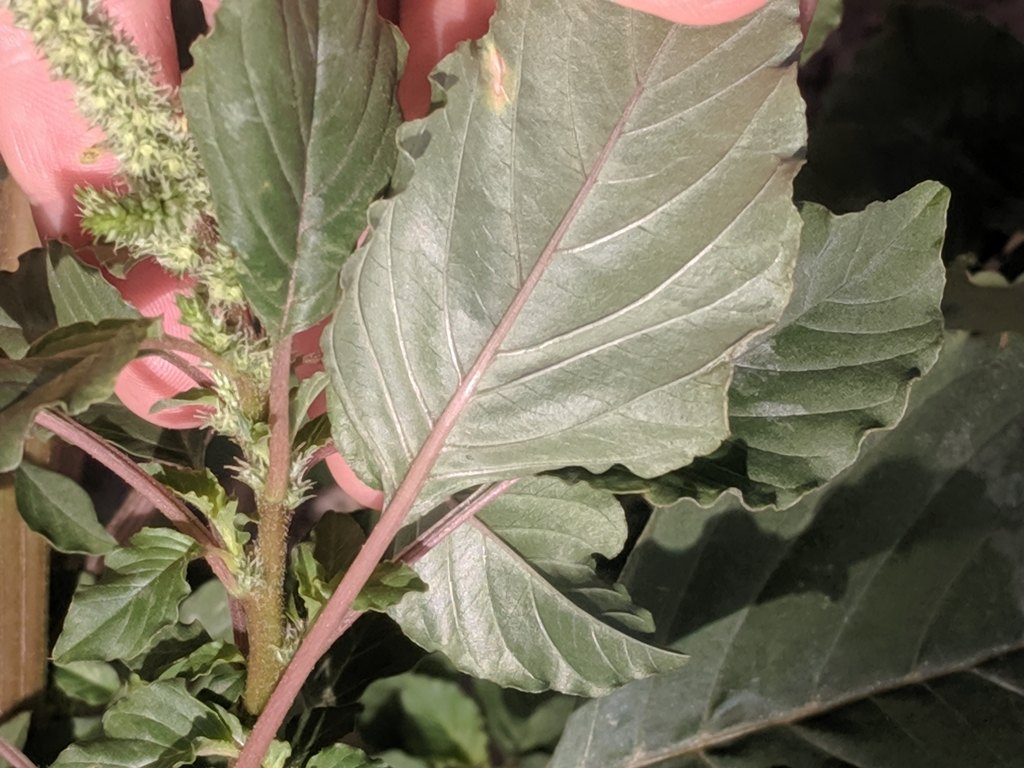
It is an annual of 60 to 90 cm with deep purple flowers in dense terminal heads, and leaves that may be green, red, yellow or variegated depending on the cultivar. The species is native to South and South-East Asia and is cultivated across the warm world, so it has a name in every market: bireum in Korea, tampala and tandaljo in India, callaloo in the Caribbean, xiancai in China.
The English name Joseph’s coat refers to the Biblical coat of many colours, and it is used for the ornamental forms rather than the vegetable ones. A bed of the variegated cultivars in full sun is as bright as anything in a bedding scheme, and it costs a packet of seed.
Science & Biotechnology
The colour comes from betalains, not anthocyanins. Amaranthaceae belong to the Caryophyllales, an order that lost the anthocyanin pathway and uses betacyanins and betaxanthins instead, and betacyanin is water-soluble. That is why a red leaf bleeds into the cooking water and why the colour of a stir-fry turns pink.
The plant is a C4 species, so it grows so fast in heat and why it is a useful crop in the tropics. It also accumulates oxalates, and there is a specific nutritional note attached to the Bengali forms: the plant may inhibit calcium retention in rice-based diets, which matters where rice is the staple and the vegetable is eaten daily.
That is not a reason to avoid it, and it is a reason to cook it. Oxalate is reduced by boiling and discarded with the water, which is how the green and red forms are prepared in Bengal as notey shaak and laal shaak. A plant that has fed a region for centuries has usually been worked out by the people eating it.
Uses & Benefits
As a vegetable it ranks among the fastest crops in the garden: sow in May, cut in June, and cut again from the regrowth. The leaves and stems are eaten as a salad when young and cooked when older, stir-fried with garlic in China, steamed as a side dish in Japan, and used as a namul in Korea, where the small-leaved red-stemmed form is foraged rather than planted.
As an ornamental it is grown for the foliage, and the named strains are selected for leaf colour rather than flavour. The two uses have diverged: a plant bred for a purple head is not the one to pick for the kitchen, and a plant bred for tender leaf is not the one to put in a bedding scheme.
It appears on the coat of arms of Gonville and Caius College, Cambridge, where it is called flowers gentle. That is a strange afterlife for a tropical pot herb, and it is a reminder that the plant has been in Europe long enough to become a symbol, as well as a vegetable and a bedding annual. The same family turns up again in Amaranthus palmeri, Amaranthus cruentus and Atriplex hortensis.
Growing from Seed
Sow direct once the soil is warm, or indoors three weeks before the last frost. The seed is small and needs light, so press it into the surface and water gently. Germination takes five to ten days at 20 to 25 °C, and it is fast and even, which makes the plant a good first crop for a child.
Thin to 20 cm for leaf production and 30 cm for seed heads. The plant responds to nitrogen with leaf and to crowding with a long stem and few leaves, so the spacing matters more than the feeding. Water in dry spells; a check at the seedling stage costs a week and shows for the rest of the season.
For seed, let a few plants stand until the heads dry and the lower leaves fall, then cut and hang them over a sheet. The seed shatters readily and a windy day will take half of it, so handle the heads inside a bag. The seed keeps for several years in a cool dry jar and germinates well after five.
Our Take
It is the most useful plant in this catalogue and the least regarded. A packet of seed gives a vegetable in six weeks, a bedding display in eight, and a seed crop in twelve, and it does it on any warm soil with no attention at all.
Grow the green form for the kitchen and the red form for the front of a border, and do not confuse the two. The vegetable strains are tender and mild; the ornamental ones are coarse, bitter and beautiful. Both are the same species, and that is the most interesting thing about it.
Related Reading
More species in the same orbit as Elephant-head Amaranth: