


Puccinellia tenuiflora Seeds | Alkali Grass
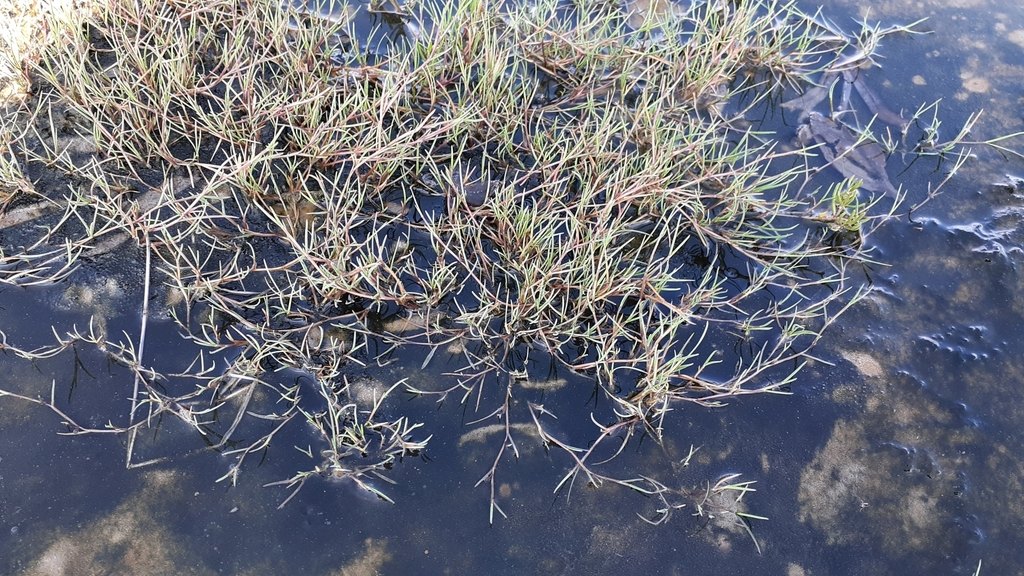
LATIN NAME: Puccinellia tenuiflora
COMMON NAME: Alkali Grass
Plant Profile
Puccinellia tenuiflora is the grass that makes a living where the chemistry turns hostile. Described from Grisebach’s material by Scribner and Merrill in 1910, it is a densely tufted perennial of the saline steppes, running from the Caspian and Iran across Kazakhstan and Mongolia to the soda flats of the Songnen Plain in northeastern China.
The plant builds tight clumps twenty to sixty centimetres tall, with fine bristly leaves half folded along the stem and a delicate, half-nodding panicle whose branches carry small purple-tinged spikelets from May into July. The loose, glistening seed heads are the source of its Chinese name xing xing cao, the star grass.
Its habitat is the solonchak and the solonetz: ground where sodium salts accumulate until the surface cracks and the soil reaction pushes toward a pH that excludes nearly every other grass. Field records from Inner Mongolia, Qinghai and Manchuria show the pattern, with scattered stations west to Iran and north to Lake Baikal country.
On the Songnen Plain it has a working title beyond botany: the first grass seeded onto abandoned saline farmland, planted in strips by the thousand hectares, where its job is to start a sward on ground that had been written off as wasteland. Fellow Poaceae members here: Puccinellia distans, Setaria faberi and Axonopus compressus.
Science & Biotechnology
The salt story is one of exclusion and secretion working together. The roots filter most of the sodium before it reaches the shoot, the leaf surfaces carry salt glands that push what gets through back out as crystals, and the remaining load is diluted in succulent tissue, a three-layer defence suited to soda-dominated soils.
That combination, unusual even among salt-tolerant grasses, is why the species tolerates ground where salinity and high alkaline pH arrive together, a pairing that defeats plain salt-excluders. Studies on the soda soils of northeastern China rank it among the most alkali-tolerant forage grasses available for seeding.
Research on its establishment has produced practical findings: germination is sensitive to surface salt at sowing, but a shallow leaching wash moves the salts down just long enough for seedlings to root below the crust, after which the stand maintains itself. The trick is to get through the first month, and the plant handles every month after.
Uses & Benefits
As forage it is moderate but reliable, grazed by sheep and cattle on alkaline ranges where richer grasses are absent, with decent crude protein and the great virtue of persistence. Hay from pure stands is cut in Inner Mongolia, and the grass regrows after grazing better than most of its associates.
In restoration the species is the standard answer to the soda-alkali problem. Chinese programmes seed it on salinized grassland and abandoned paddy margins, where a closed sward shades the crust, adds organic matter and gradually improves the surface for less tolerant species to follow, changing the ground it grows on.
Its ecological service extends to water tables and roads. Stands lower the capillary rise of salty groundwater beneath them, and the turf is used to green verges and airfields on salt-affected ground where conventional turf grasses would fail within a season, a working plant rather than a showpiece.
Growing from Seed
The seed is very small, with a thousand-seed weight around a tenth of a gram, and that drives every sowing rule. Seed must sit near the surface, half a centimetre deep at most, because deeper sowing fails almost completely, and a firm, fine seedbed matters more than fertility ever will.
Sow in spring as the ground thaws, when moisture is high and surface salt is at its annual low, or in early autumn. Where the ground is genuinely saline, irrigate lightly but repeatedly through the first weeks, each wash leaching the crust a little, and expect the seedlings to look slow for a month before they run.
Once rooted the stand is durable and self-replacing, seeding itself into gaps each summer. Cut or graze no lower than five centimetres, avoid trampling on wet alkaline ground, and the tufts thicken year by year until the sward closes and the salts stay below it.
Our Take
The plant solves a problem most gardeners never meet and farmers in the saline belt cannot escape. Wherever ground is too salty and too alkaline for the usual grasses, this is the species that has already passed the trial at scale.
Sow in spring on a firm, finely raked seedbed, barely cover the dust-fine seed, and leach the surface with repeated light washes through that first critical month. After that the stand asks nothing, closes rank a little more each year, and quietly reclaims ground that the salt had claimed first.
Related Reading
Gardeners who grow Alkali Grass often pair it with these related subjects: