


Senna sulfurea Seeds | Smooth Senna
LATIN NAME: Senna sulfurea
COMMON NAME: Smooth Senna
Plant Profile
Senna sulfurea is a small tree of tropical Asia with flowers the colour of a school bus, a comparison its epithet already made: sulphur-yellow. The species was described by Augustin de Candolle’s circle in the 1820s, and Howard Irwin and Rupert Barneby moved it from Cassia to Senna in 1982.
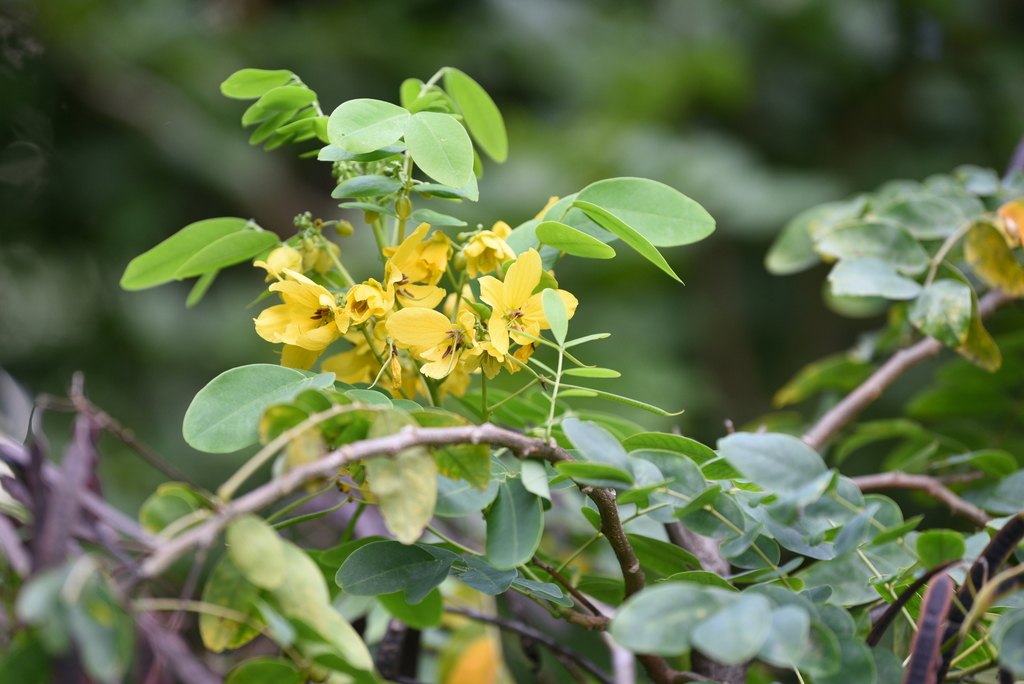
The tree grows three to six metres, often with several stems from the base, carrying pinnate leaves of four to six pairs of oval leaflets that close slightly at dusk. The flowers hang in axillary corymbs, five petals of pale clear yellow, and open in flushes rather than all at once.
Its range runs from India and the Himalaya through Myanmar, Thailand, Laos, Cambodia and Vietnam to northern and eastern Australia, and it is planted well beyond that in tropical streets and gardens, where it flowers on the dry-season rhythm, with peaks recorded in November and around April.
What follows the flowers is a long flat pod, thirty centimetres or more, hanging in clusters and rattling when the wind takes it. The pods turn brown and persist well into the dry season, when the tree is briefly deciduous and the yellow flush stands out against bare branches.
Science & Biotechnology
The flowers are asymmetric, and the asymmetry is functional. One or two stamens are long and fertile, projecting beyond the petals, while the rest are shorter and often sterile, and the whole flower is tilted so that a visiting bee is pressed against the long anthers from one side only.
The anthers open by pores rather than slits, which means pollen will not simply fall out. A bee has to grip the anther and vibrate its flight muscles, the behaviour called buzz pollination, to shake the pollen loose. Only certain bees can do it, and the flower’s architecture is built to place them precisely against the fertile stamen.
Taxonomically the species is one of the large group of Cassia relatives that Irwin and Barneby divided into Senna, Chamaecrista and Cassia proper, a rearrangement based on floral symmetry, anther morphology and chromosome numbers, and now supported by molecular evidence. The medicinal sennas sit in the same genus but not in the same section, so the similarity of names misleads so many people. Fellow Fabaceae members here: Senna alata, Thermopsis lanceolata and Lupinus pubescens.
Uses & Benefits
Despite the generic name the tree is not a drug plant. The laxative sennosides that made senna famous come from other species, chiefly the Alexandrian and Tinnevelly sennas, and this one has no place in that trade, a distinction worth keeping when the Latin names look so similar.
In the tropics it is a street and garden tree: fast, small enough for a courtyard, tolerant of poor soil and dry seasons, and generous with flower over a long period. It is also grown as a green manure and shade plant in plantations, where its nitrogen fixation and quick growth are useful.
The flowers feed carpenter bees, honeybees and butterflies, and the tree is a host for several sulphur butterflies whose larvae take the leaves. In frost-free climates it can become weedy along disturbed ground, so planting it near intact vegetation deserves a second thought.
Growing from Seed
Senna seed is hard-coated and benefits from scarification. Nick the coat or pour hot water over the seed and soak for a day, then sow at twenty-five to thirty degrees, covered lightly, and germination follows in one to three weeks, often very unevenly as the coats give way at different times.
Seedlings are fast and hungry for light. Grow them in full sun, pot them on quickly, and plant out once the root has filled the container, since the tree establishes best when young. Flowering can begin within a year or two from seed, which is fast for a tree.
Prune after the main flowering flush to shape the crown and remove the spent pods, and water through the first dry season only. In tropical gardens the tree may self-sow freely; in subtropical ones it usually behaves, and a light frost will cut it back to resprout from the base.
Our Take
The tree’s charm is the combination of clear yellow and a dry-season calendar, with pods rattling above a hot street when little else is in flower. The buzz-pollination mechanism is worth watching with a hand lens and some patience, because the bee’s grip and the anther’s pore have to meet exactly.
Scarify the seed, raise it hot and fast, and plant it out where winters are kind. Prune after flowering, keep it away from intact bushland where it might spread, and the sulphur-yellow flush will come round again every dry season without fail.
Related Reading
If Smooth senna appeals to you, these related plants are worth a look: