


Geum montanum Seeds | Alpine Avens
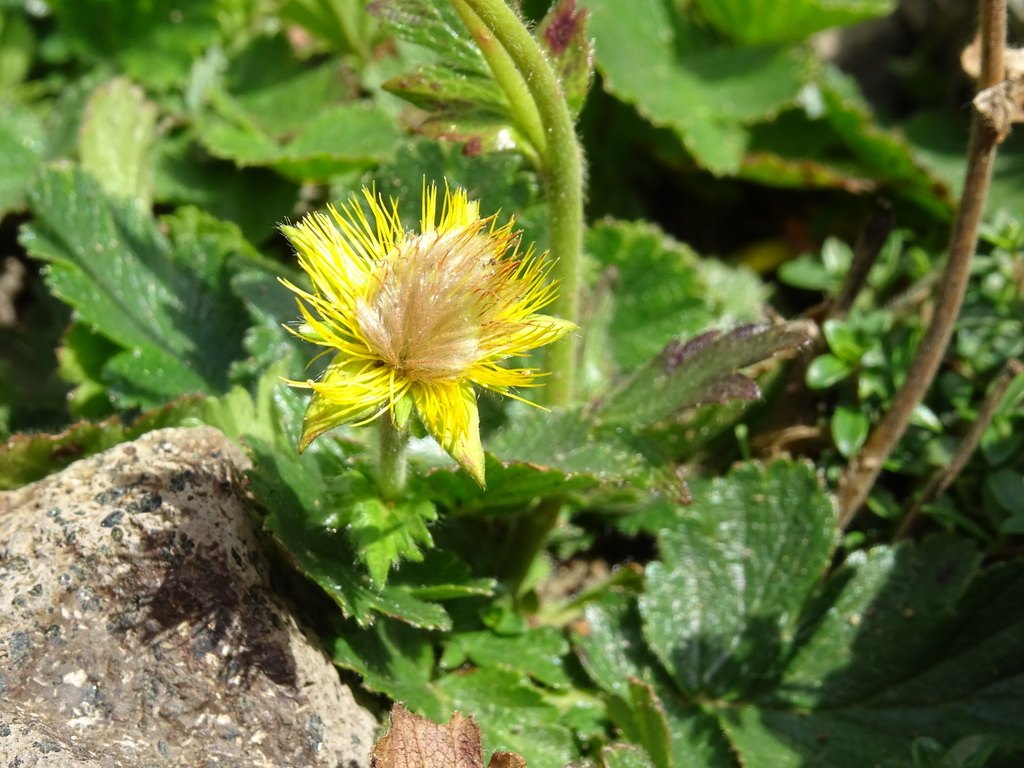
LATIN NAME: Geum montanum
COMMON NAME: Alpine Avens
Plant Profile
Alpine avens is the mountain rose of the high grasslands: a low perennial with buttery yellow flowers held singly on upright stems above a rosette of wrinkled, pinnate leaves. It flowers in late spring and early summer across the Alps, the Carpathians and the Balkan ranges, usually within a stone’s throw of lingering snow.
The flowers have the constructed look of the rose family, five broad petals around a boss of stamens, and they open with the sun like most high-mountain dwellers. After bloom the seed heads form small spherical clusters that dry to a russet burr, ornamental in their own right for a few weeks.
The European distribution reads like an itinerary for a summer walking holiday. The species is widespread in the Alps between roughly 1430 and 2300 metres, dipping as low as 700 metres in the Centovalli and climbing to 3500 on Monte Rosa, and it reappears in the Pyrenees, the Cantabrians, the Massif Central, the Black Forest and the Sudetes.
East of the Alps the range continues through the whole Carpathian arc, including the Tatras at 900 to 2500 metres, into the northern Apennines, onto Corsica, and across the Balkans: the mountains of Bosnia and Herzegovina, Montenegro, North Macedonia and Albania, the Accursed Mountains of Kosovo, northern Greece, eastern Serbia, and the Bulgarian ranges from the Stara Planina to the Rhodopes between 1600 and 2700 metres.
Science & Biotechnology
A range spread across so many separate massifs invites questions about how a low, flightless-seeded plant crossed the gaps. The accepted picture is glacial survival: cold epochs pushed the species down and apart, warm ones left relict populations scattered on the summits, and the modern distribution is a map of refugia rather than of recent travel.
Altitude is the organising fact of its biology. Plants at 3500 metres on Monte Rosa and at 700 metres in an Italian valley are the same species running different calendars, with flowering compressed and pollinator windows narrowed at the top. In cultivation the same flexibility shows as tolerance of both mountain and lowland gardens.
The root chemistry is real. Traditional Austrian medicine prepared the root as a tea against rheumatism, gout, infections and fever, and the tannin-rich rhizomes justify the astringent reputation. Like most folk medicines the efficacy is uneven and the dosage uncontrolled, so the practice is best read as history rather than prescription.
Uses & Benefits
In gardens the species holds the Royal Horticultural Society’s Award of Garden Merit, an award earned in exactly the conditions it dislikes least: cool, moist, well-drained and sunny. It suits the rock garden, the crevice bed and the front of a scree, where its rosettes knit into mats over a few seasons.
Its garden virtue is temperament. The plant is long-lived, tolerates temperatures that kill border perennials, and shrugs at snow cover. In lowland gardens the enemy is heat and stagnation, not cold, so summer drainage and a mulch of grit matter more than any winter protection ever could.
Ecologically it anchors high-altitude turf. The mats stabilise thin alpine soils, the flowers feed early flies and butterflies that work the snowmelt margins, and the seed heads are picked apart by finches descending from the ridges. In a garden context these roles translate simply: plant it where insects need an early high-season source. Fellow Rosaceae members here: Geum aleppicum, Prunus dulcis and Prunus cerasifera.
Growing from Seed
Seed germinates unevenly without a cold period, and the species makes you work for even results. Sow in autumn and leave the tray outdoors for the winter, or give a month of refrigeration before spring sowing. Surface-sow on a gritty mix and keep the tray shaded from drying sun.
Seedlings are slow but decisive. They build a small rosette in the first season, sometimes flower in the second, and make a solid cushion by the third. Pot them on before the taproot turns at the bottom of the cell, because a checked root shows for years in a slow plant.
Plant out into lean, stony soil with the crown set high, and water only through establishment. Once rooted, the plant asks for nothing except cool feet and open sun; rich soil produces lax growth and fewer flowers, and standing water at the crown finishes the argument quickly.
Our Take
Alpine avens is a gardener’s plant in a botanist’s landscape: a modest yellow cushion whose real biography is written in glaciers, refugia and apothecaries’ ledgers. In the garden it asks for a scree and a cool summer, and it pays back decades of quiet flowering.
Sow more seed than you need, be patient through the first winter, and plant the survivors in the stoniest pocket you own. The species’ whole character is patience rewarded, and a cushion that opens its first flowers three years from a packet is a better bargain than most instant colour.
Related Reading
More species in the same orbit as Alpine Avens: