


Phacelia campanularia Seeds | Desert Bluebells
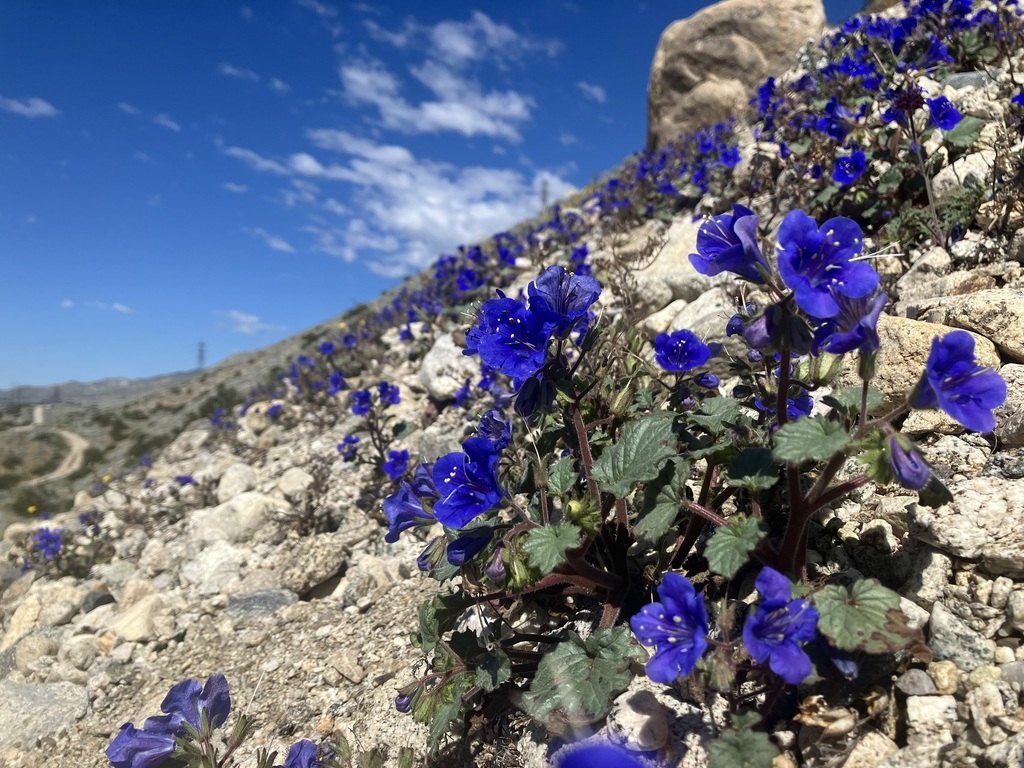
LATIN NAME: Phacelia campanularia
COMMON NAME: Desert Bluebells
Plant Profile
Desert bluebells is an erect annual up to 70 cm, covered in glandular hairs, with somewhat rounded, toothed leaves and a loose, open cyme of flowers. The corolla is a strong blue, up to 4 cm long, bell-shaped or funnel-shaped or round and flattened depending on the form, and often marked with white spots in the throat.
The stamens and the style protrude beyond the mouth, up to 4.5 cm long, standing out dark against the blue. The genus is also called scorpionweed, for the uncurling flower spike, and the young cyme does coil like a scorpion’s tail before it straightens. The fruit is a capsule up to 1.5 cm. It grows in dry, sandy places below 1,200 m, and its native range lies inside California, in the Mojave and Sonoran Deserts.
Two varieties are recognised: var. campanularia, limited to the Sonoran Desert, and var. vasiformis, more common and wider ranging, sometimes with larger flowers. They intergrade where they meet, so a seed packet may contain anything between the two, and the distinction is a matter of geography more than gardening.
Science & Biotechnology
The blue has a name. An anthocyanin pigment called phacelianin was isolated from these flowers and is responsible for the colour, and the same pigment produces the blue of Evolvulus pilosus, a distant relative in a different family. Two unrelated plants arriving at the same molecule is a good lesson in how few chemical routes there are to a true blue.
The family has moved as well. The phacelias sat for a century in their own family, Hydrophyllaceae, the waterleaves; molecular work folded them into the borage family, Boraginaceae, where their scorpioid, uncurling flower spikes and their hairy leaves always suggested they belonged.
Like the rest of the genus, the plant handles desert conditions by speed: germinate after winter rain, grow fast, flower, set seed, and die before the heat. The capsule releases seed that waits in the sand for the next wet year, and a display of desert bluebells after a good winter is a spectacle that the seed packet cannot promise but the desert reliably delivers.
Uses & Benefits
Its use is a sunny, well-drained bed or a gravel garden, sown in drifts, where the blue in early summer is as intense as any hardy annual provides. It is also a first-rate bee plant, and in its native range it ranks among the staples of the spring desert bee economy. Its better-known cousin, Phacelia tanacetifolia, is grown on a field scale as a green manure and honey plant, and anything that good for insects is good for a garden border.
The sap and the glandular hairs can irritate skin and cause a rash, so gloves are worth wearing when cutting it back or clearing it. The irritation is not severe, but it is real, and it is the one hazard note the plant carries.
It is not a plant for clay or shade, and it is short-lived by design: an annual, done by midsummer. Sow it with orange and yellow Californian annuals, Eschscholzia above all, and the blue and orange combination is the reason those seed mixes sell. The catalogue keeps Phacelia tanacetifolia, Nemophila maculata and Myosotis sylvatica from neighbouring families.
Growing from Seed
Sow where it is to flower, in spring, on bare, raked ground, barely covering the seed. In mild climates autumn sowing works and gives earlier, stronger plants, but the seedlings will not survive a really cold wet winter, so spring sowing is the safe route everywhere north of the Mediterranean.
Germination takes one to three weeks in soil around 15 to 20 °C. The seedlings are quick, and the whole life cycle runs about twelve weeks: a fast, clean annual that does not need staking, pinching or feeding. Thin to 20 cm and water only until establishment.
Do not transplant it if you can avoid it; the root is a taproot and resents moving. Let the capsules dry on the plant and cut the whole stand when the seed rattles, then either bag it or rake the stems over the bed and leave the seed where it fell.
Our Take
It is the bluest flower you can grow from a packet, and that is nearly the whole review. The blue is not the soft powdery blue of most annuals but a saturated, almost electric colour that photographs as if retouched.
Give it sand, sun and a spring sowing, wear gloves when you clear it, and let it seed itself. A garden that has grown it once tends to find it again every year in the same corner, which is the usual bargain with desert annuals and a good one.
Related Reading
Continue exploring with these related plants: