


Chenopodium quinoa Seeds | Quinoa
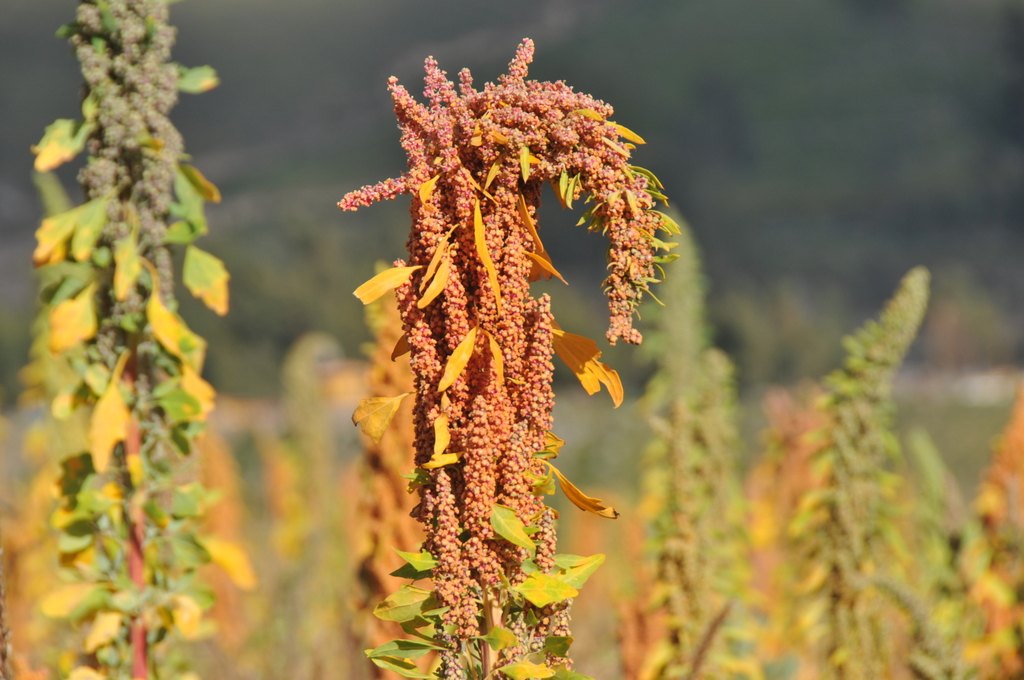
LATIN NAME: Chenopodium quinoa
COMMON NAME: Quinoa
Plant Profile
Quinoa is not a cereal, and the distinction matters more than it sounds. It belongs to the amaranth family, which puts it closer to spinach and to Amaranthus than to wheat or rice, and it is classed as a pseudocereal: a plant grown for starchy seed that happens to sit outside the grasses. The seed carries protein, dietary fibre, B vitamins, and more potassium and magnesium than most true grains. The leaves are eaten as a green vegetable in the Andes, cooked much like spinach.
It grows 1 to 2 m tall on a stout, often reddish stem, with broad, lobed leaves covered in a powdery bloom. The seed heads are large and heavy, and they ripen unevenly, which is the practical difficulty that has shaped how the crop is harvested for thousands of years.
The plant comes from the Andean region of north-western South America. It was first used as livestock feed somewhere between 5,200 and 7,000 years ago, and for human food between 3,000 and 4,000 years ago in the Lake Titicaca basin, on the border of what is now Bolivia and Peru. It shares the family with Chenopodium album, Halogeton arachnoideus and Atriplex hortensis.
Science & Biotechnology
Quinoa is an allotetraploid with the genome formula AABB, meaning it carries two complete sets of chromosomes from two different ancestral species that hybridised at some point in the distant past. A 1979 study put the likely ancestor as either the North American C. berlandieri or the Andean C. hircinum. More recent work suggests Andean and Mexican quinoas were domesticated independently, both from wild C. berlandieri.
The seed coat carries triterpenoid saponins, bitter compounds that deter birds and insects and taste unpleasant to people. They have to be removed before the grain is edible, either by washing in water or by abrasive polishing, and the washing uses a great deal of water in places where water is scarce. Breeding lines with low saponin have been developed, and genetic work has pushed further, targeting sweetness through saponin inhibition.
The crop’s real advantage is tolerance. It handles salinity, drought, frost and thin air at 4,000 m, a combination almost nothing else edible manages. That has made it a target for improvement programmes looking at heat tolerance, yield and resistance to biotic stress.
Uses & Benefits
In the kitchen the seed is cooked like rice, about fifteen minutes, and it throws a pale spiral germ that is the sign it is done. It goes into flour, flakes, soups and salads, and it is gluten-free, which drove much of its adoption outside South America.
The social story is less comfortable. Demand from North America, Europe and Australasia tripled the price between 2006 and 2014, a boom and bust that helped some Andean growers and hurt others, and encouraged monoculture in the native range. Combined with climate change in the high Andes, that pressure has caused measurable environmental damage.
Almost all production in the Andean region still comes from small farms and cooperatives. Outside it, cultivation has spread to more than seventy countries, including Kenya, India, the United States and much of Europe. The United Nations General Assembly declared 2013 the International Year of Quinoa, in recognition of the Andean practices that kept the crop alive. The attention worked, then overshot: imports peaked, growth slowed from 2016, and prices fell as production spread to new countries.
Growing from Seed
Sow after the last frost, once soil is above 10 °C, at 1 cm deep and 45 cm between rows. Quinoa germinates fast and evenly in warm soil, usually within a week, and the seedlings are vigorous enough to outrun early weeds.
Thin to 15 cm within the row when the plants are 10 cm tall. They are not fussy about soil as long as it drains, and they yield best at moderate fertility: too much nitrogen produces tall plants that lodge under the weight of the seed head.
Harvest is the awkward part. The heads ripen from the top down and from the outside in, over several weeks, so commercial crops are left until about 80 per cent of the seed is mature and then cut and dried in shocks. For a garden row, cut individual heads as they colour and finish drying them indoors.
Our Take
Grow it for the seed head as much as the seed. A row of quinoa in September, with the heads turning crimson and gold, is more ornamental than most things sold as ornamental. The grain is a bonus, and the saponin washing is a chore, but a small patch is worth the trouble once. It is also the only crop in this catalogue that will produce something edible on poor, salty ground.
Related Reading
Readers interested in Quinoa frequently explore these as well: