


Iberis umbellata Seeds | Garden Candytuft
LATIN NAME: Iberis umbellata
COMMON NAME: Garden Candytuft
Plant Profile
Garden candytuft is a herbaceous annual of 30 to 50 cm, with erect leafy flowering branches and a stem that twists at the base. The leaves are green, linear to lance-shaped, only 15 to 25 mm long, and the flowers sit in flat heads shaped like an umbrella, which is what the name says: the epithet comes from the Latin for umbel.
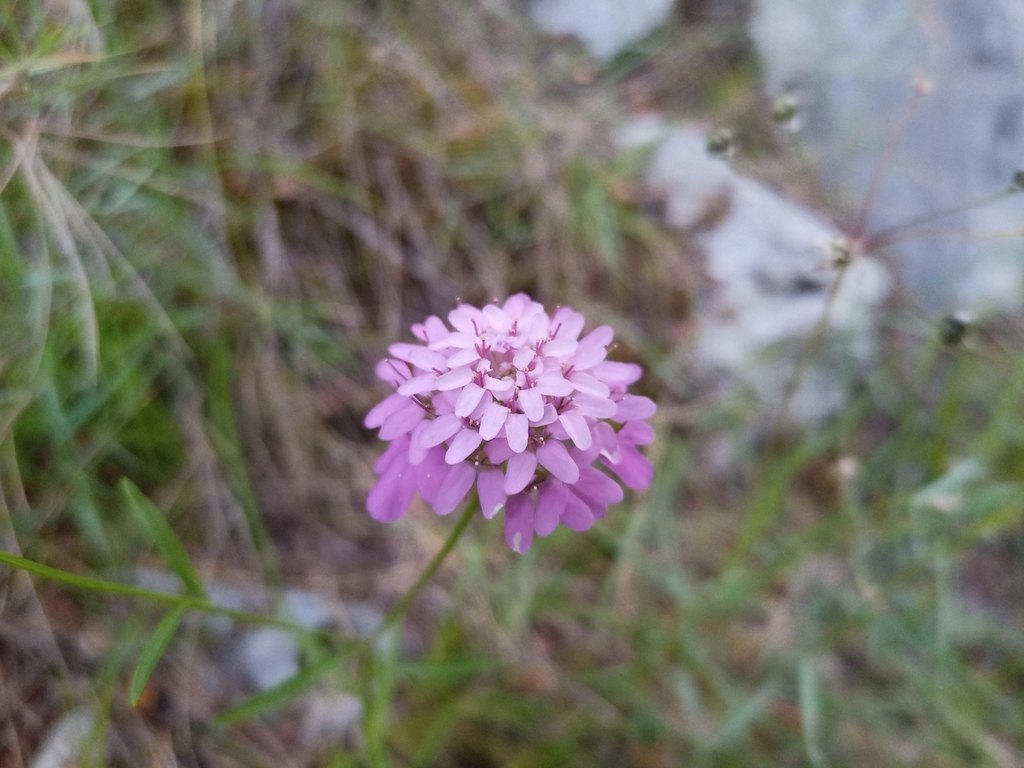
Each flower has a violet calyx behind a corolla of four petals, white, pink or purple, rounded at the tips. The two petals on the outside of the head are enlarged into a banner 8 to 10 mm long, noticeably bigger than the inner pair, and the colour shows through from behind. Flowering runs from May into June.
The genus name comes from Iberia, the old name for Spain, and the plant is Mediterranean: dry rocky hillsides, scrub and clearings, almost always on lime, from sea level to 1,300 m. Most of Europe now has it along coasts, and it has reached North America as an escape from gardens. It shares the family with Iberis amara, Erysimum allionii and Aubrieta deltoidea.
Science & Biotechnology
The unequal petals are the botanical point. Most of the cabbage family builds radially symmetrical flowers, four petals of the same size in a cross. Candytufts are one of the exceptions: the two outer petals are swollen into a banner, which makes each flower bilaterally symmetrical and points every landing surface towards the same side of the head.
That asymmetry pays off with pollinators. Bees and butterflies work the flat corymb from the outside in, and a flower that faces the visitor presents its banner like a signboard. The flowers are hermaphroditic, and the fruit that follows is a silique 7 to 10 mm long, flat and papery, in the family style.
The biological form is a hemicryptophyte, which is a formal way of saying the overwintering buds sit just below the soil surface and the flowering stalk is more or less bare. In practice it means the plant can survive a mild winter and behave as a short-lived perennial in the south, though everywhere north of the Alps it is grown as an annual.
Uses & Benefits
Its use is the front of a spring bed, an edge along a path, or a trough, where the flat heads of white, pink and purple sit above small foliage and do their work for six weeks. It ranks among the few annuals that combines cleanly with bulbs, because it is at its best in May when the tulips finish.
Do not confuse it with its perennial relative, Iberis sempervirens, the evergreen candytuft sold as a subshrub for walls. Both are called candytuft, both are white-flowered in some forms, and the annual is taller, softer and dead in the autumn. The packet should say which, but check the height: 40 cm is the annual, 20 cm the perennial.
It is a plant for lime and for lean soil. In rich ground it grows leafy and loose, and in acid soil it sulks. Given a calcareous gravel and full sun it stays compact and flowers hard, and the colour range in a mixed packet is wider than most annuals offer.
Growing from Seed
Sow in spring where it is to flower, on raked and firmed ground, barely covering the seed. Germination takes one to three weeks in soil at 15 °C or so, and the seedlings are distinct: narrow leaves on a visible line, easy to tell from weeds after the first week.
Thin to 20 cm apart. The plants branch from the base, and a crowded row gives tall stems that flop in the first heavy rain. In short-season climates an earlier start under cover helps, but the seedlings dislike root disturbance, so use modules and plant them young.
Water until established, then leave them alone. Let the last siliques dry on the plant and collect the seed, which keeps well for a couple of years, or leave the patch to self-sow in gravel. A self-sown colony drifts in colour over the years, which is part of the charm and part of the reason to keep a line of it.
Our Take
It is an honest, unfashionable annual, and the unfashionableness is the argument for it. Nobody has bred the character out yet: the violet calyx behind the petals, the banner bigger than its pair, the six weeks of flat colour above lean ground.
Sow it with tulip bulbs in autumn planning, in the sunniest limey corner you have, and let it repeat itself. The only way to fail with it is to plant it in rich acid shade, where it will give you leaves and a shrug.
Related Reading
Gardeners who grow Garden Candytuft often pair it with these related subjects: