


Euphorbia myrsinites Seeds | Myrtle Spurge
LATIN NAME: Euphorbia myrsinites
COMMON NAME: Myrtle Spurge
Plant Profile
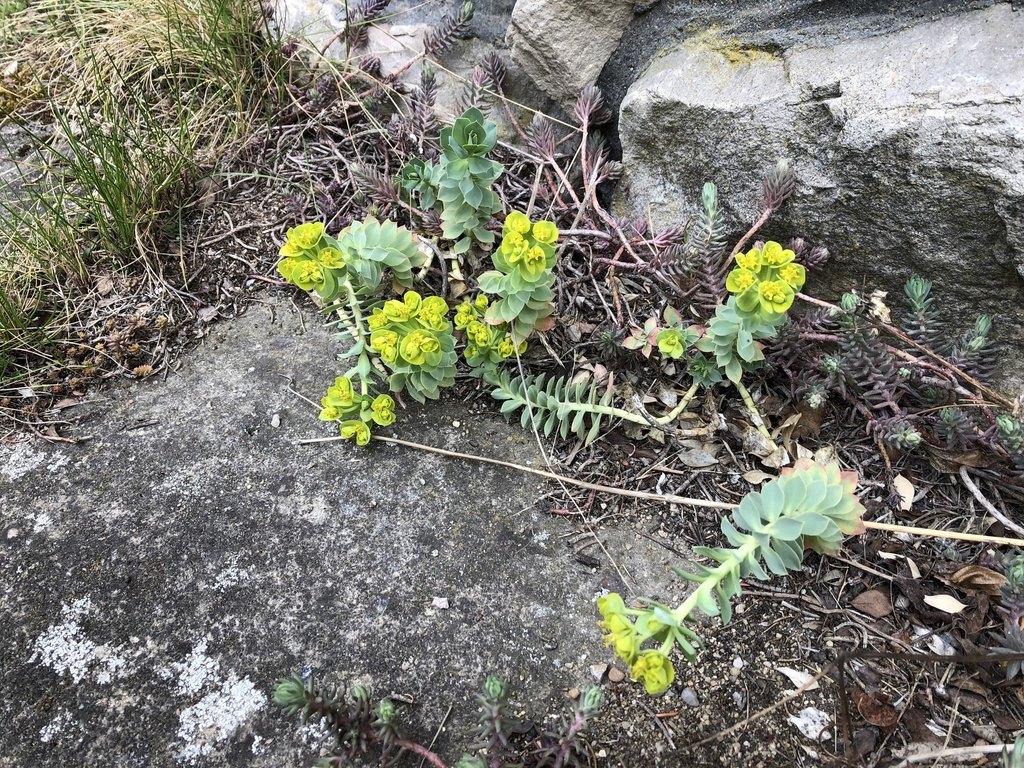
Myrtle spurge is an evergreen perennial with sprawling stems 20 to 40 cm long that radiate from a central crown and lie on the ground rather than rising. The leaves are spirally arranged, fleshy, pale glaucous blue-green, 1 to 2 cm long, and they overlap like scales along the stem. The whole plant looks as though it were cast in pewter.
The flowers are insignificant, but each cluster is cupped by sulphur-yellow bracts that do the work of petals, and in the cultivar Washfield those bracts are tinged red. They appear in early spring, before most perennials have started, and they last for a month. Cut a stem and it bleeds white latex at once.
It is native from the Balearic Islands and Italy east through the Balkans to Crimea, Turkey, the Caucasus and Iran, with a second subspecies, subsp. rechingeri, confined to Crete. The epithet comes from Dioscorides, who thought it looked like myrtle, and it does, in the same way a stone pine looks like a mushroom.
Science & Biotechnology
The seed is ballistically dispersed. The capsule splits explosively when it dries and throws the seed up to 4.6 m, which is how a plant that does not run at the root still colonises a gravel drive in a decade. Any account of its weediness that does not mention the range of that throw is missing the mechanism.
The latex is the other mechanism, and it is a serious one. The sap causes significant skin and eye irritation, and contact with the eye can cause blindness; it is not a matter of sensitivity, it is a chemical burn. Ingestion brings nausea, vomiting and diarrhoea, and children are more susceptible than adults, so the advice is to keep play areas clear of it.
Gardeners who remove it wear goggles and gloves, not because they are timid but because they have read the case reports. The sap is under pressure in the stem, so it does not drip, it spurts, and a stem cut at waist height will reach an eye. Wash tools and gloves afterwards, and do not rub your face.
Uses & Benefits
Where it is allowed, it ranks among the best plants for a hot, dry, windy place: a gravel garden, a wall top, a south-facing bank, a pot that bakes. The blue foliage holds all year, the yellow bracts arrive in March, and the plant asks for nothing except drainage and sun. It has held the Royal Horticultural Society’s Award of Garden Merit for decades.
It is also, in some places, illegal. Colorado classifies it as a Class A noxious weed and prohibits cultivation, and landowners are legally obliged to control it. Parts of Utah and other western states run the same campaign. The plant that wins awards in Britain is a pest in the American west, which says more about climate than about the plant.
The case against it is not that it is ugly or useless; it is that it escapes into rangeland, forms dense mats that exclude everything else, and is difficult and dangerous to remove. Where that has happened, the garden value is irrelevant. The Euphorbiaceae thread continues with Euphorbia larica, Euphorbia marginata and Euphorbia polychroma.
Growing from Seed
Sow in autumn or early spring, 5 mm deep, at 18 to 22 °C. Germination is uneven: some seeds come up in a fortnight, others after a cold spell, so leave the tray for two months before giving up. Fresh seed germinates best, and the seed keeps poorly, so buy it in the year you intend to sow.
Plant out into sharp drainage in full sun. Add grit to the planting hole and set the crown slightly proud; water once and then leave it. On wet clay it rots in its first winter, and no amount of gravel mulch will save a plant sitting in a sump.
Handle seedlings with gloves from the first potting, because even a small plant bleeds. If you must move a mature clump, do it in autumn, cut the stems short first, and cover your arms. Do not compost the cuttings where children or dogs go; put them in the green waste and wash the knife.
Our Take
It is a superb plant in the right place and a menace in the wrong one, and the right place is narrower than it looks. If you garden in a dry climate where it is listed as a noxious weed, do not grow it, however good it looks on a wall, because the escape is not hypothetical.
Where it is legal and contained, it earns its space: twelve months of blue foliage, six weeks of acid yellow in early spring, and no watering. Wear glasses when you prune it, keep it away from the sandpit, and it will outlive the fence.
Related Reading
More species in the same orbit as Myrtle Spurge: