


Pennisetum setaceum Seeds | Fountain Grass
LATIN NAME: Pennisetum setaceum
COMMON NAME: Fountain Grass
Plant Profile
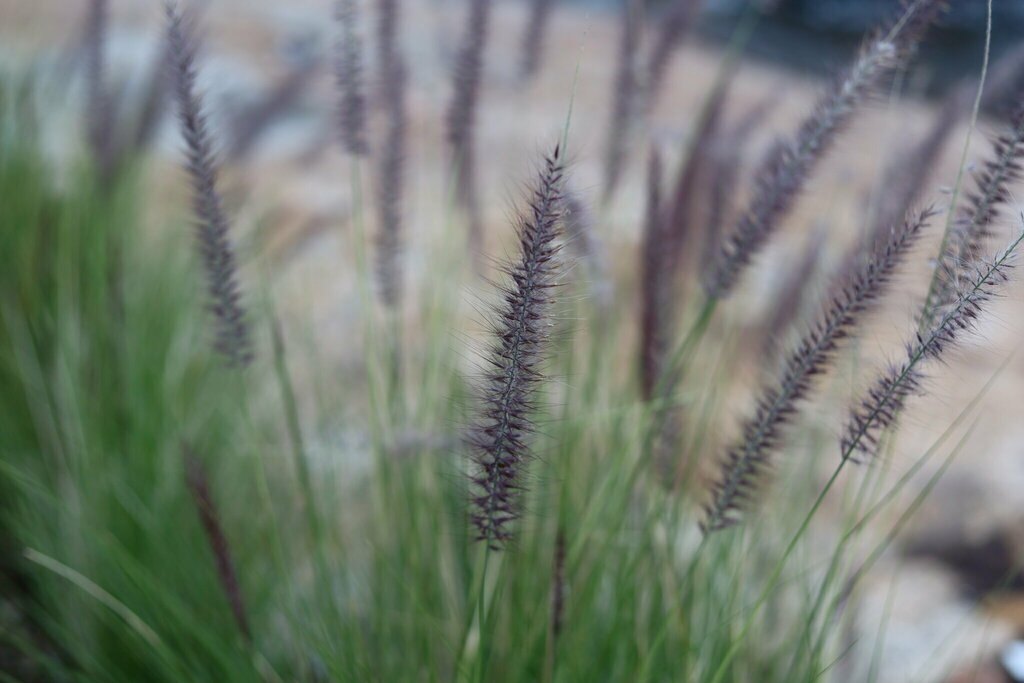
Crimson fountaingrass is still sold as Pennisetum setaceum, though the accepted name has moved to Cenchrus setaceus. Whatever the label, the plant is unmistakable: a dense perennial bunch grass of about a metre and a third, with flat blades, erect stems and long, plumose flower spikes that open purple and fade to buff as the seed ripens.
In its native range it grows on rocky hillsides and dry stony plains in grassland, from roughly 600 to 3000 metres, across eastern and tropical Africa, the Middle East and southwestern Asia. The combination of altitude range and stony ground tells you most of what the species needs: sun, drainage, and no competition from lush neighbours.
The inflorescence is the reason the plant travelled. Each spike carries a dense brush of bristles around the seed, giving the soft, feathered look that made it a fixture of Mediterranean-style planting and municipal roundabouts from California to Queensland. The same bristles make the seed easy to carry on wind, water and machinery.
It is a C4 grass, one of the carbon-concentrating plants that photosynthesise efficiently in heat and bright light while losing less water. That metabolic advantage is the root of everything that follows: the species grows fast, tolerates drought, recovers from grazing and fire, and outcompetes C3 neighbours on warm, dry ground.
Science & Biotechnology
The C4 pathway is a pump: carbon dioxide is concentrated around the enzyme that fixes it, so the plant can keep its stomata nearly shut in the heat of the day and still grow. In a warming climate that is an enormous advantage, and it explains why fountaingrass holds its ground where native grasses wilt.
The species also drives a fire feedback. It produces standing biomass that dries to a flammable straw, burns hot and fast, and resprouts from the base within weeks, while native shrubs and trees are killed outright. Each fire favours the grass and removes its competitors, so the landscape converts, one burn at a time, into a monoculture that burns more often.
Recognition of that cycle has produced hard law. Since 2017 the species has been on the European Union’s list of Invasive Alien Species of Union concern, which means it cannot be imported, cultivated, transported, sold, planted or deliberately released anywhere in the Union. A garden plant with a legal prohibition attached is a rare thing, and the listing is the most important fact about it.
Uses & Benefits
Its garden value was genuine: fountaingrass brought movement and backlight to dry plantings, held its shape through heat, and needed no irrigation once established. On a windy terrace its spikes catch the low sun better than any native grass of comparable hardiness, which is exactly why it spread along every warm coastline with a garden centre.
Outside the European Union, in cold-winter gardens where it cannot survive the frost, the plant can still be grown as an annual for one season of purple plumes, provided the flower heads are cut before seed sets and the debris is bagged rather than composted. That is a narrow legitimate use, and it depends on the gardener’s discipline rather than the plant’s manners.
For wildlife the picture is bleak. In invaded habitats it replaces the seed and insect resources native fauna depend on, and its fire regime destroys the structure that birds and reptiles need. There is no honest way to present it as a pollinator plant: it is a grass that takes ground, and the taking is the point. It sits among Pennisetum alopecuroides, Pennisetum orientale and Axonopus compressus, all Poaceae.
Growing from Seed
Seed germinates readily at warm room temperature, sown on the surface of a free-draining mix and pressed in without covering, since light helps. Keep the tray at about twenty to twenty-five degrees and evenly moist; seedlings appear within a fortnight, often faster, and grow with the urgency of a plant built for open ground.
Pot the seedlings on early, because the root system fills a cell quickly, and harden them gradually before planting out after the last frost. In a cold-climate garden they will flower by late summer and die with the first hard freeze, which is the intended outcome; in a mild climate the same vigour becomes the problem.
Where the species is legally permitted, site it in full sun and sharp drainage, water only through establishment, and never feed. Cut the spikes as they fade, before the bristled seed loosens, and dispose of the material in sealed waste rather than the garden compost, which is how the plant travels between sites in the first place.
Our Take
Crimson fountaingrass is the clearest case in this catalogue of a plant whose beauty and whose harm come from the same trait. It is drought-proof, fast, luminous in low light, and it eats landscapes. The European prohibition is not bureaucratic fuss; it is the accumulated cost of planting it.
Grow it only where winters kill it and where local rules allow, treat it as a disposable annual, and cut the plumes before they seed. Or choose a native grass with the same silhouette and none of the file. A gardener can admire this species without giving it ground.
Related Reading
More species in the same orbit as Fountain Grass: