


Hedysarum multijugum Seeds | Many-leaved Hedysarum
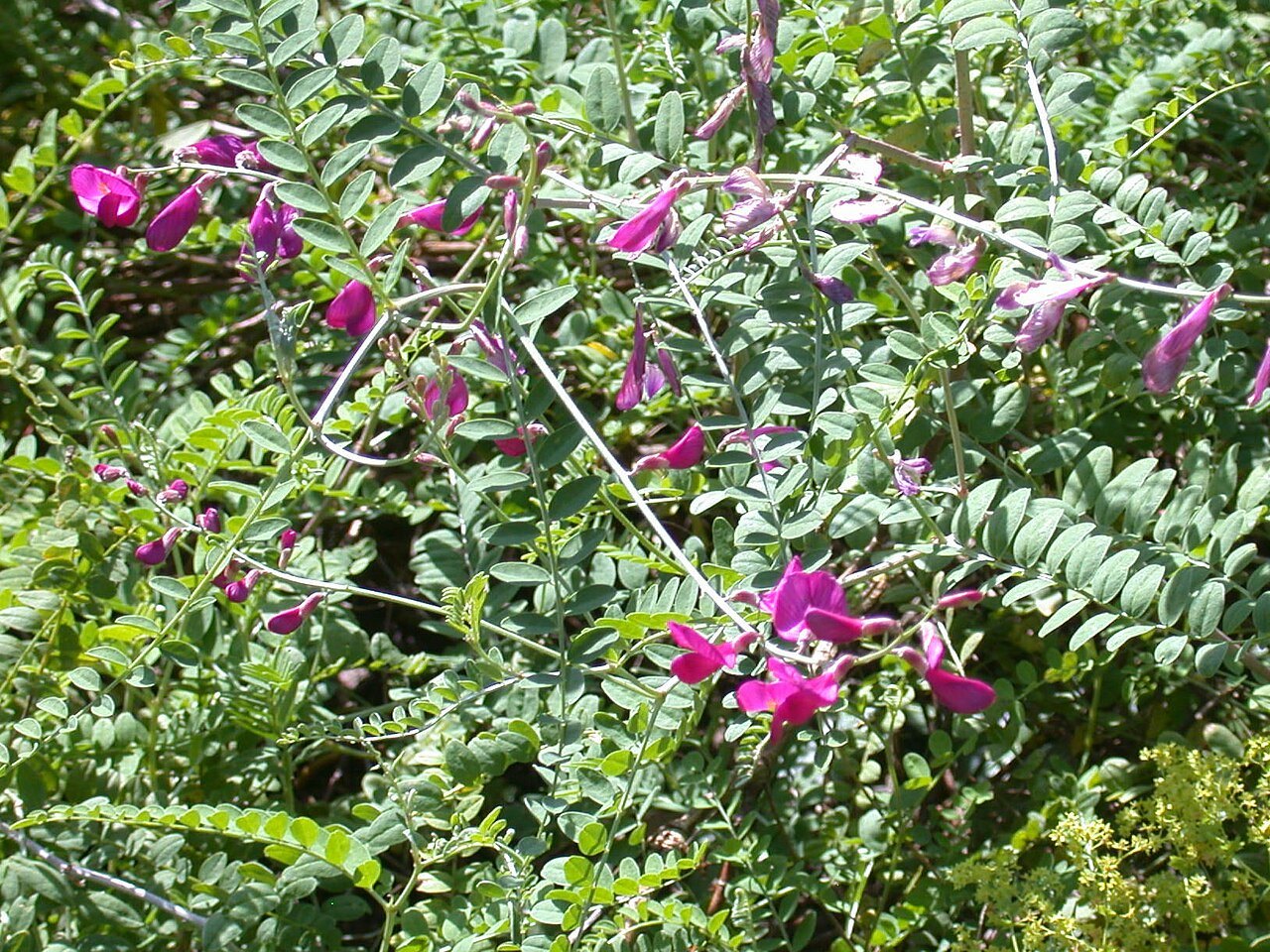
LATIN NAME: Hedysarum multijugum
COMMON NAME: Many-leaved Hedysarum
Plant Profile
Hedysarum multijugum is a subshrub of the northern Chinese steppe with an improbable number of leaflets and a colour that stops people on the path. Karl Maximowicz described it in the late nineteenth century, and the epithet says it plainly: many-yoked, many-paired, a leaf made of a dozen or more pairs of small oval leaflets.
The plant grows fifty centimetres to a metre and a half tall from a woody base, with upright stems that die back partway each winter. In June and July it carries short racemes of magenta-red pea flowers, packed densely enough that a single stem reads as a wand of colour against grey-green foliage.
After flowering come the genus’s characteristic loments, flat pods that break into one-seeded segments, each segment in this group edged with small spines or bristles that catch in fur and clothing and carry the seed away from the parent plant.
Its range is the dry north and west of China, from Inner Mongolia and Shanxi through Shaanxi and Gansu into Qinghai and Tibet, on dry slopes, steppe and gravel terraces. It has been grown in European gardens for a century and appears in the record as an introduction in Germany. Its Fabaceae company here includes Hedysarum mongolicum, Thermopsis lanceolata and Lupinus pubescens.
Science & Biotechnology
The genus has been taken apart in recent decades. Molecular work showed that the old Hedysarum was not one group but several, and the many-leaved Asian species were moved into Corethrodendron, a genus separated on pod anatomy, leaflet arrangement and chromosome evidence, so the plant now travels under two names.
As a legume of dry steppe it lives on nitrogen fixed in root nodules by rhizobia, a partnership that lets it colonise gravel and thin soil where the nitrogen supply is close to nil. The deep taproot reaches moisture far below the surface, and the woody crown survives both severe frost and summer drought.
Its pollination is the standard pea arrangement, with the keel acting as a trigger that deposits pollen on the backs of visiting bees when they land. The reward is nectar, the flowers are large enough to exclude small insects, and the result is a short list of reliable pollinators, mostly long-tongued bumblebees and solitary bees that will travel between widely spaced shrubs.
Uses & Benefits
On the steppe the plant is grazed by sheep and goats, particularly in spring when the new shoots are soft, and cut for hay in mixed swards. Its feed value is moderate, but its drought persistence and its ability to hold ground make it a useful component of rangeland rather than a crop in its own right.
In the garden it ranks among the best dry-border legumes available: a subshrub with a long season of magenta flower, fine-textured foliage, and a constitution that tolerates drought, wind, poor soil and hard frost without complaint. It associates naturally with grasses and silver-leaved steppe perennials.
Its nectar is valuable to bumblebees in early summer, and the seed pods feed nothing much but the plant self-sows modestly on open gravel. Roots fix nitrogen, so the soil around the plant improves over the years, which is a quiet benefit in a poor border.
Growing from Seed
The seed coat is hard and germination is unreliable without help. Scarify with sandpaper or a brief dip in hot water, then sow in spring at warm temperatures in a free-draining mix, covering the seed lightly, and expect seedlings in two to four weeks once the coat has been breached.
Young plants grow slowly at first while the taproot descends, so grow them on in deep pots for a season and plant out where they are to stay. Flowering begins in the second or third year, and the shrub reaches its full spread in about four, after which it resents being moved.
Cut the old stems back to the woody framework in early spring, before growth starts, to keep the plant compact and the flowering wood young. Site it in full sun on sharp drainage, avoid rich soil and summer watering, and it will live far longer than the same plant given kindness.
Our Take
Magenta flower on grey foliage, in the driest weeks of early summer, from a plant that wants nothing but sun and gravel. There are not many shrubs that deliver that combination and fewer still that also fix their own nitrogen.
Scarify the seed, raise it in a deep pot, and plant it out on a hot bank with no compost. Prune the old wood in March, resist watering it, and the wand of pea flowers will come back every June for a decade or more.
Related Reading
More species in the same orbit as Many-leaved Hedysarum: