


Sedum rupestre Seeds | Reflexed Stonecrop
LATIN NAME: Sedum rupestre
COMMON NAME: Reflexed Stonecrop
Plant Profile
Reflexed stonecrop wears more country names than leaves: Jenny’s stonecrop, blue stonecrop, stone orpine, prick-madam and trip-madam among them. It is a succulent perennial of Europe, typically no more than ten centimetres tall, with sprawling stems that lay down roots as they wander and form a tight grey mat over anything hospitable.
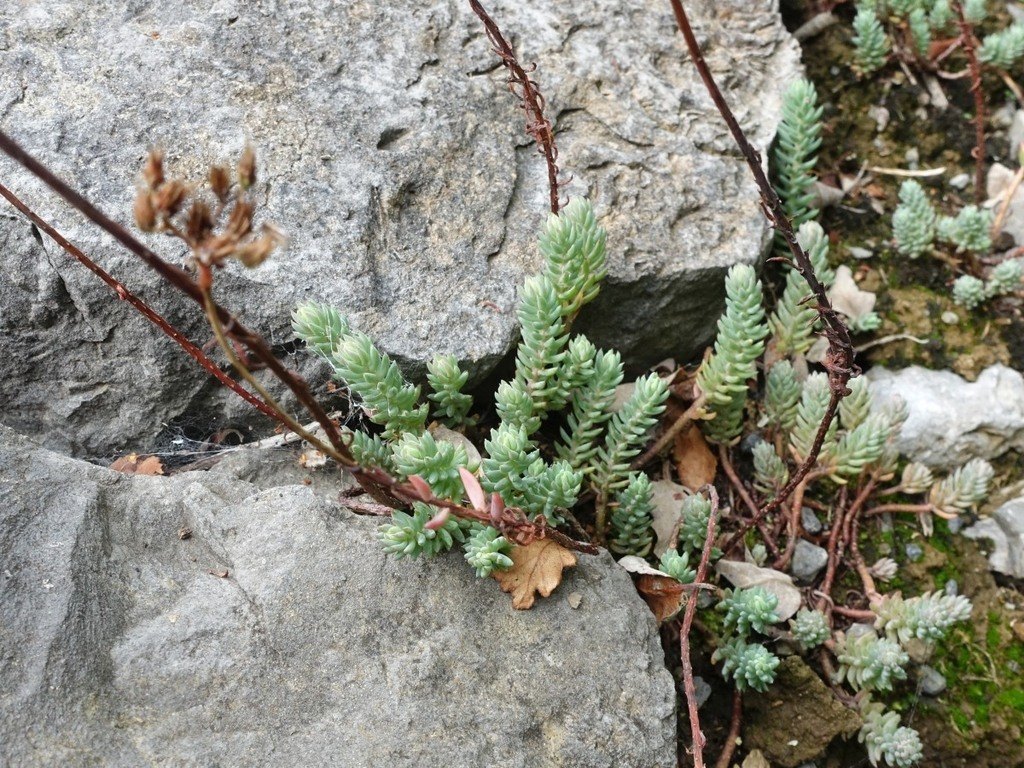
The foliage explains the odd nickname spruce branches without softness: the stiff, needle-tipped leaves crowd the stems exactly like a miniature conifer, coloured blue-grey to grey but ranging into light greens and yellows in sun. In early and midsummer the mats carry flat heads of yellow flowers that pull in a working day’s worth of bees.
Naturally the species grows on walls, shingle and warm grassy places over sandy soils, and it avoids acid ground, a preference recorded wherever it has settled. Naturalised in Britain for centuries, it belongs to that class of plants whose European range and human architecture have grown into each other until neither can be separated from the other.
In the kitchen it has a small, honest role: the fleshy leaves are occasionally used as a salad herb in Europe, including Britain, with a slightly astringent, sour bite. A few leaves sharpen a sandwich the way sorrel does; more than that, and the plant’s own chemistry makes the argument for restraint.
Science & Biotechnology
As a stonecrop it runs the crassulacean metabolism playbook, opening its stomata at night to bank carbon dioxide and closing them by day to hold water. That machinery, plus the water-storing leaf tissue, is why a mat survives on a sun-baked wall where a fortnight without rain would finish a conventional perennial.
The species is mildly famous for fasciation, the growth accident that flattens and fans a stem into a cristate, cactus-like crest with irregular curves. Collectors prize these forms, but the plant reverts easily, and anyone keeping a cristate specimen must remove every normal offshoot quickly or the ordinary growth outpaces the curiosity.
Vegetatively it is a master of the fragment. Any piece of stem with a node roots readily, so the trade propagates it by cuttings and why a discarded scrap at the edge of a path becomes a new colony within a season. The wandering stems that give the plant its prostrate habit are also its main reproduction strategy.
Uses & Benefits
In gardens the plant covers the ground nobody else wants: dry walls, gravel edges, the crowns of raised beds, and green roofs of the small domestic kind. Drought tolerance is complete, and once rooted the mat needs nothing beyond an occasional tug of weed seedlings that land in the gaps.
Named cultivars extend the range, including variegated forms and the widely grown ‘Angelina’, whose needle foliage turns from yellow-green to orange in cold weather. All share the species’ indifference to poverty and its habit of walking politely rather than rampaging, though it will cross a path if the path is not maintained.
Two cautions belong in the notes. Although not poisonous, eating large quantities causes a stomach upset, which settles the salad question. And for pollinators the yellow flowers are a genuine resource, drawing honeybees and small wild bees through the dry weeks when little else in a lean garden is open. The other Crassulaceae in the catalogue are Sedum aizoon, Sedum lineare and Sedum forsterianum.
Growing from Seed
Seed is fine and surface-sown: scatter on a gritty compost in spring, press in without covering, and keep just moist and bright. Germination is erratic across a few weeks, a typical stonecrop hedge, and the seedlings start as barely visible green specks that should not be fussed over.
Grow the young plants lean and bright, pot them on once, and set them out into full sun and sharp drainage after the last frost. Establishment is quick, and a spring-sown plant can form a flowering mat by the following summer. The species avoids acid soils, so a little lime suits it where the ground is sour.
Aftercare is the art of neglect: no rich feeding, no shade, no standing water. Shear the mats lightly after flowering to keep them tight, and take cuttings freely, since every stray piece is a plant in waiting. In wall crevices simply push a stem into the gap and water once.
Our Take
Reflexed stonecrop is the sensible choice for the dry, mean, beautiful spots where gardening usually fails: old walls, gravel, roof edges and path margins. It asks to be ignored, repays the neglect with a grey carpet and a yellow June, and tastes pleasantly of sour green things in passing.
Sow it once, keep the seedlings honest with light and grit, and then let the plant do what it has done on European walls for centuries: spread, flower, feed the bees, and occasionally surprise its owner with a cactus-shaped crest that no one ordered and no one should remove.
Related Reading
Gardeners who grow Reflexed Stonecrop often pair it with these related subjects: