


Helianthemum nummularium Seeds | Common Rock-Rose
LATIN NAME: Helianthemum nummularium
COMMON NAME: Common Rock-Rose
Plant Profile
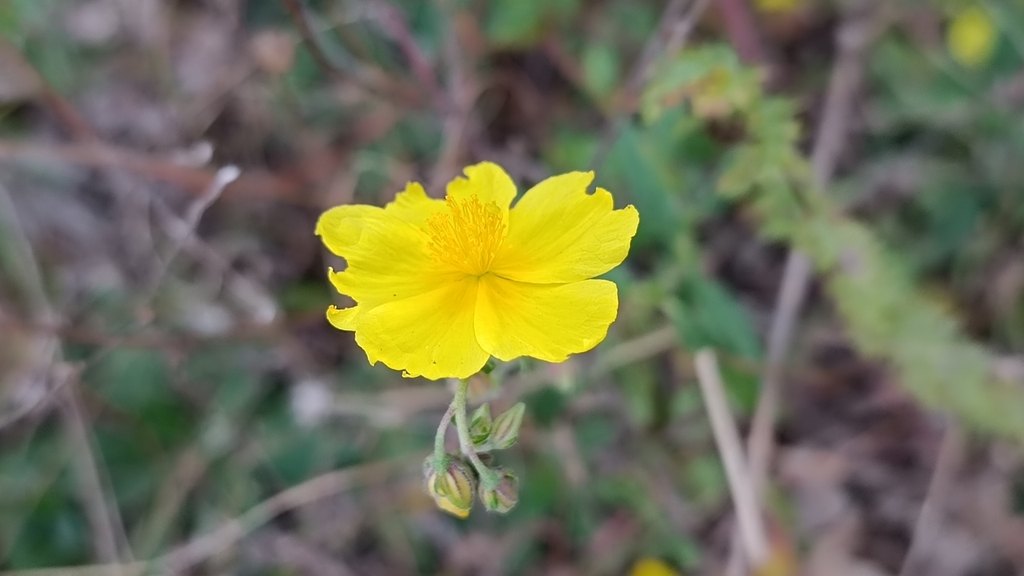
Common rock-rose is an evergreen trailing subshrub of the rock-rose family, mat-forming on chalk downs and dry, base-rich grassland across most of Europe. The wild flowers are bright yellow, saucer-shaped, in loose clusters at the shoot tips; garden varieties run from white through every shade of yellow to deep red.
Each bloom lasts a day, and the plant makes up for it by arithmetic: a mass of flowers from May to July, opening whenever the sun is out and closing the show in a dull week. The Latin name says as much, Helianthemum being built on the Greek for sun-flower, and the habit matches the label exactly.
The centre of the flower holds a tight cluster of orange stamens that are sensitive to the touch. Brush them and they spread outwards, revealing the tall stigma standing in the middle. The mechanism is visible from standing height on a calm day, and it ranks among the small dramas that make this species worth kneeling for.
Its native range runs from the British chalk downs through most of Europe into North Africa and western Asia as far as Iran, on basic grassland and scrub up to 600 metres. Two subspecies are currently accepted, the widespread nummularium and kerneri, with grandiflorum and obscurum recognised in some treatments. The catalogue keeps Abelmoschus sagittifolius, Hibiscus grandiflorus and Abutilon from neighbouring families.
Science & Biotechnology
Stamens that move on contact sit oddly in a European wildflower, and their job is pollination housekeeping: flaring outward clears the approach to the stigma, separating the pollen and the receiving surface of one flower in space. The touch-response runs through the rock-rose family, and this species does it neatly enough to watch.
Ecologically it is a working plant. It is a good pollen source for bees, several species of small beetle feed on the foliage, and it serves as the larval food plant of a list of moths and butterflies that includes the silver-studded blue, Plebejus argus. A chalk bank with rock-rose on it is not decoration; it is catering.
Hardiness is rated around USDA zone 5 to 8, and the evergreen mats carry grey-green leaves through winter on lean ground where nothing else holds. The garden colour forms are simple selections of the wild species rather than deep hybrids, so their behaviour stays close to the plant on the downs.
Uses & Benefits
Its garden use is the south-facing rockery, the top of a dry wall, a gravel scree or a chalk meadow: anywhere dry, sunny and unimproved. The trailing mats knit stone and soil together, and the yellow saucers sit exactly at eye level when the plant is given a wall to lean over.
In restoration work it ranks among the indicator species of lowland chalk grassland, sown deliberately in downland and lime-scree mixes both for its own show and for the insects that depend on it. Few native shrubs of the European flora carry that much caterpillar traffic per square metre.
The honest caveat is the flower itself: an individual bloom is over in a day, so the display is a rolling one that depends on sun. Plant it where you pass at midday rather than where you look once a week, and it will never disappoint.
Growing from Seed
Sow in spring on the surface of gritty compost or directly onto raked, firm, limey ground, covering the seed only with a whisper of grit. Germination is improved by a few weeks of cold, so an autumn sowing left to winter works as well as a refrigerated spring one.
The seedlings are small and slow at first; grow them on lean and dry, and plant out into full sun with sharp drainage. This is a plant for the poorest south-facing corner you have, and rich moist soil will grow a loose, short-lived version of it that flowers badly and collapses in the first wet winter.
Once established it needs nothing beyond a light trim after flowering to keep the mats tight. Do not mulch it, do not feed it, and resist watering. On the right wall it will seed itself into the joints and renew its own colony without help.
Our Take
Rock-rose is the argument for growing precise little natives in the exact conditions they evolved for: on chalk, in sun, with no kindness, it outperforms anything bred for the purpose and feeds a food chain while doing it. The garden varieties never quite match the original, and the original is on the packet.
Sow it into the driest, sunniest, most useless pocket of ground you own and stop tending it. The flowers open by the calendar of the sun, the mats thicken every year, and the stamens will flinch for you if you get close enough. Everything else you were going to plant there would have wanted watering.
Related Reading
If Common Rock-Rose appeals to you, these related plants are worth a look: