


Cynoglossum amabile Seeds | Chinese Forget-me-not
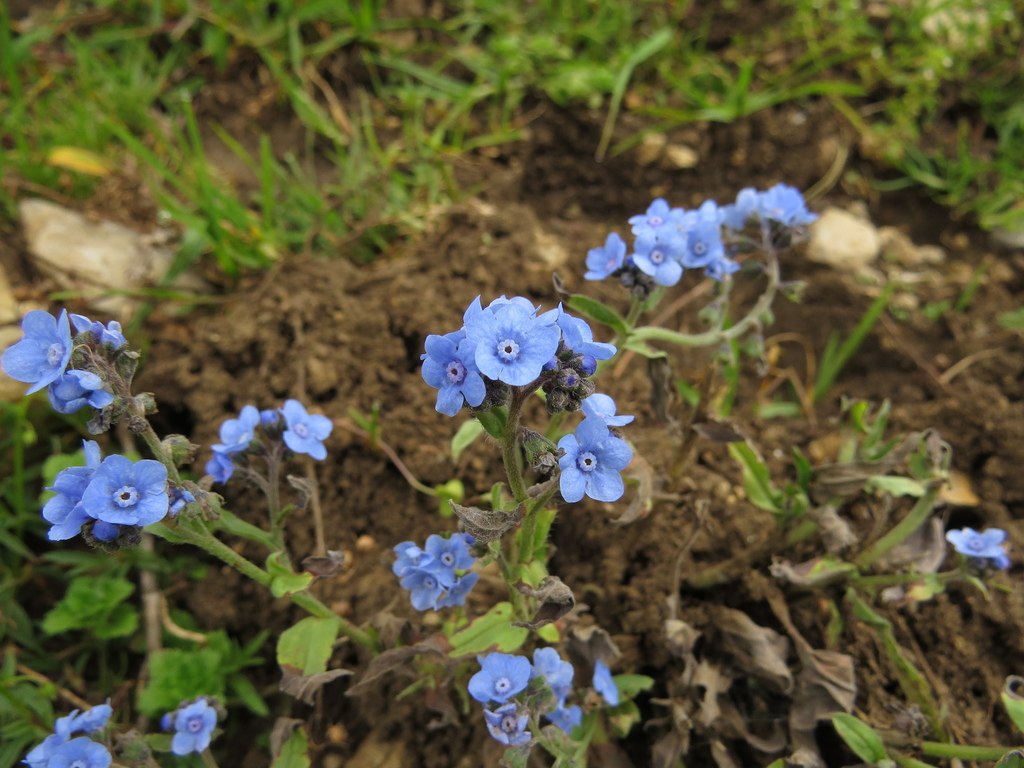
LATIN NAME: Cynoglossum amabile
COMMON NAME: Chinese Forget-me-not
Plant Profile
Cynoglossum amabile comes from the mountains of southwestern China, from Yunnan and Sichuan into Tibet, where it grows on grassy slopes and roadsides at 2,000 to 3,000 m. It is a hardy annual 40 to 50 cm tall, with soft, hairy, grey-green leaves and loose cymes of sky-blue flowers in late summer.
The flowers are small, five-lobed and forget-me-not blue, but they are carried in much larger and looser sprays than the garden forget-me-not, and a well-grown plant makes a cloud of blue a metre across. Each flower has a white or yellow eye, and the buds are pink before they open, which gives the plant three colours at once.
The genus name means dog’s tongue, from the shape and texture of the leaf, and the common name hound’s tongue has followed it into English. The seed is the reason for the other half of the name: each nutlet is covered in hooked bristles that catch in fur and clothing, which is how the plant spreads along paths and grazing land. For more of the Boraginaceae, the list offers Cynoglossum officinale, Nemophila menziesii and Myosotis sylvatica.
Science & Biotechnology
Cynoglossum is a genus of about 80 species, most of them biennial or perennial, and it sits in the Boraginaceae alongside forget-me-not, borage and comfrey. Several species in the genus contain pyrrolizidine alkaloids, the liver toxins found across the family, and C. amabile has been implicated in livestock poisoning where it grows in pasture.
The blue colour is a delphinidin-based anthocyanin, and it is unusually pure for a flower pigment, so the plant reads as blue rather than violet. The white eye is a region without pigment, and it functions as a nectar guide, directing small bees to the centre of the flower.
The burrs are a dispersal mechanism, not a defence: the hooks are stiff enough to grip fur but flexible enough to release when pulled, which is the same principle as Velcro, invented in 1941 after George de Mestral examined burdock burrs under a microscope. Cynoglossum nutlets are a textbook example of the same adaptation.
The species was described in 1906 from material collected in Yunnan, and it reached European gardens early in the twentieth century, where it was taken up for the border and for cutting. It has since naturalised in parts of North America and in the Netherlands, always on disturbed ground and always near gardens.
Uses & Benefits
It is grown for the colour, which is a true sky blue and lasts for weeks in late summer, at a time when most blue annuals have finished. Use it in the middle of a border, in a cutting garden, or naturalised in grass, where it will seed itself and come back year after year.
It is a good cut flower if picked when half the flowers on a stem are open, and it lasts five or six days in water. The stems are stiff enough to hold without support, and the colour holds without fading, which is more than most blue flowers manage.
The plant is not edible, and the foliage is mildly toxic to livestock, though the risk is low because the leaves are unpalatable. The burrs are the main nuisance: they attach to wool, to dog fur and to socks, and they are difficult to remove, so the plant is not welcome in a pasture.
Growing from Seed
Raise the plants indoors from late winter, six to eight weeks before the frosts end, at 18 to 21 °C, and cover the seed thinly. The seed comes up in roughly a fortnight. The seed is large and easy to handle, and germination is usually reliable.
Prick out into 7 cm pots and grow on at 15 °C. Plant out after the last frost, 30 cm apart, in full sun or light shade. The plant tolerates poor soil and needs little feeding; rich soil produces soft growth that flops.
Flowering begins about twelve weeks from sowing and continues into autumn. Deadhead to keep it going, or leave the last stems to set seed and shake them where you want the plant next year. In a mild climate it self-sows freely, sometimes too freely, and seedlings will appear in gravel and in the cracks of paving. Pull the ones you do not want before the burrs form.
Our Take
This is the best blue annual for late summer, and it ranks among the easiest to grow. It is also a plant with a sting in the tail, since the burrs get into everything and the seedlings appear where you least want them. Grow it if you can live with that, and cut the heads before they set if you cannot. Use it in a cutting garden rather than a formal border, where its loose habit and self-sowing are assets rather than faults. The blue is worth the trouble.
Related Reading
Readers interested in Chinese Forget-me-not frequently explore these as well: