


Melinis nerviglumis Seeds | Ruby Grass
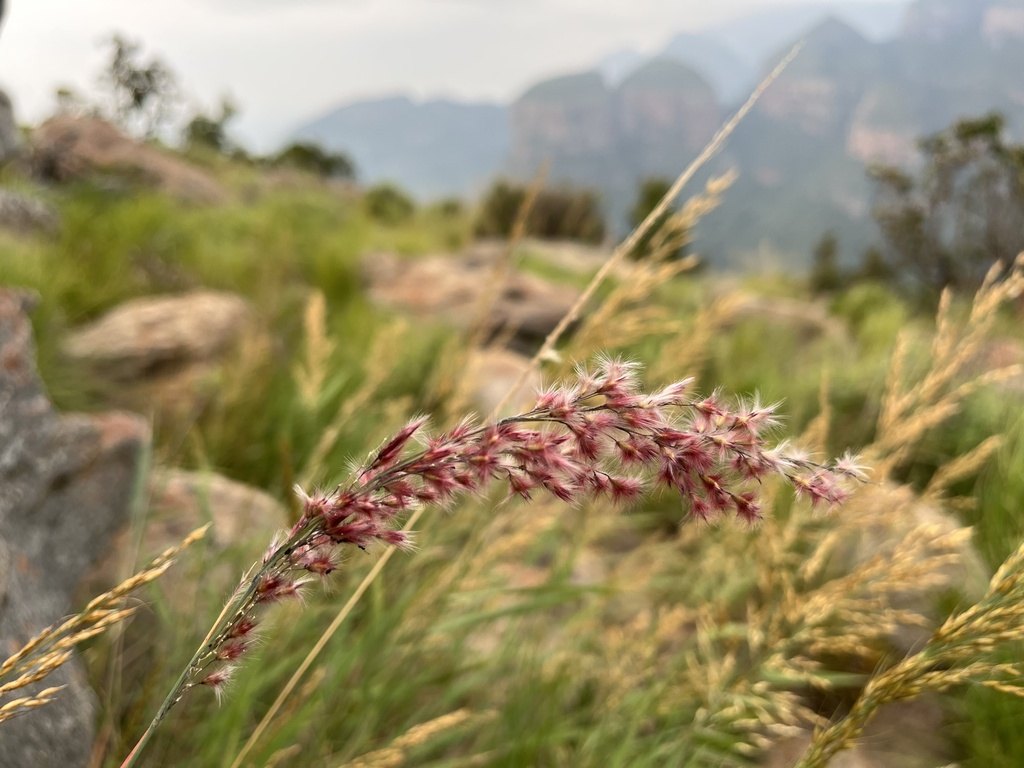
LATIN NAME: Melinis nerviglumis
COMMON NAME: Ruby Grass
Plant Profile
Melinis nerviglumis is sold as ruby Grass or mountain red top, and it ranks among the few ornamental grasses whose colour changes are worth planning for. The plumes open a deep purple-pink in summer and bleach to near white as the seed matures, so a single clump carries two seasons of colour.
It is a dense tufted grass with unbranched, flexible culms between thirty and ninety centimetres tall, and a hanging inflorescence forty to a hundred and fifty millimetres long. The spikelets are small, three and a half to five millimetres, and the leaf blades are blue-green, rolled, and concentrated at the base. Because the foliage sits low, the plant reads as a tuft on stems rather than as a leafy clump, and that is what gives it its airy outline.
The name describes the glume: nerviglumis means veined glume, and the veins are visible with a hand lens along the small scales that enclose each seed. The genus name comes from the Greek for millet, a reference to the seed heads of the type species.
Its native range is enormous and mostly African, running from Ethiopia and the Congo south to the Cape and Lesotho, with outlying populations on the western Indian Ocean islands and in Indochina. That spread across two continents and an ocean is unusual for a grass of this habit. The same family turns up again in Melinis minutiflora, Achnatherum extremiorientale and Lagurus.
Science & Biotechnology
The flexibility of the culms is the design feature. In the gravelly soils of stable veld the plant is exposed to wind and to grazing, and a stem that bends rather than snaps survives both. The hanging inflorescence follows from the same logic: a plume that swings sheds water and seed without breaking.
It is a C4 grass, so it performs in heat and why it stalls in a cool summer. The photosynthetic pathway concentrates carbon dioxide before fixation, allowing the stomata to stay partly closed, and the result is growth at temperatures where C3 grasses have already stopped.
Flowering is described in the literature as year-round but mostly in summer, and the records bear that out with a strong peak in November and December, the southern-hemisphere summer, and a secondary one in April. Seed set follows quickly, and the colour change from purple to white is the harvest signal. In a cool summer it still flowers, but the plumes are shorter and the purple is weaker.
Uses & Benefits
In a garden it works as a mid-border grass with a distinctly soft outline: the hanging heads move in the slightest air, and the purple-to-white sequence gives two looks from one plant. It is at its best planted in a block of five or more, where the heads read as a haze. In the middle of a border that movement is worth as much as the colour, drawing the eye away from whatever has finished.
Dry ground suits it, and that is the practical reason to grow it rather than a miscanthus. It tolerates poor gravelly soil, needs no irrigation once established, and does not run, because it forms a tight tuft rather than spreading by rhizome.
The seed heads are good in a vase, fresh or dried, and they hold their shape for months. Cut them when the colour has gone fully white and the stems are still green, hang them upside down in a dark room, and they will keep until the following summer.
Growing from Seed
Sow in late winter or early spring at eighteen to twenty-two degrees, on the surface of a free-draining mix, and cover lightly. Germination is usually quick and even, within two to three weeks, and the seedlings are vigorous from the start.
Prick out into deep cells, because the roots go down fast and a shallow tray produces a matted plant that never establishes well. Grow them on cool and bright, water moderately, and do not feed heavily, since soft growth makes the culms flop.
Plant out after the last frost, in full sun and any soil that drains. Space them forty centimetres apart, water through the first summer only, and leave the stems standing through winter for the seed heads and for the frost. Cut back to the base in early spring, before the new shoots appear.
Our Take
Red top is the sort of grass that sells itself in August and disappoints nobody afterwards, which is not true of most purple grasses. The purple is real rather than a trick of the light, and the fade to white extends the season by another two months.
Grow it where you can see it move. A single plant in a border reads as a curiosity; nine of them along a path read as a design decision. The only mistake is rich soil, which produces floppy stems and fewer heads.
Related Reading
Gardeners who grow Ruby Grass often pair it with these related subjects: