


Hibiscus grandiflorus Seeds | Swamp Rose Mallow
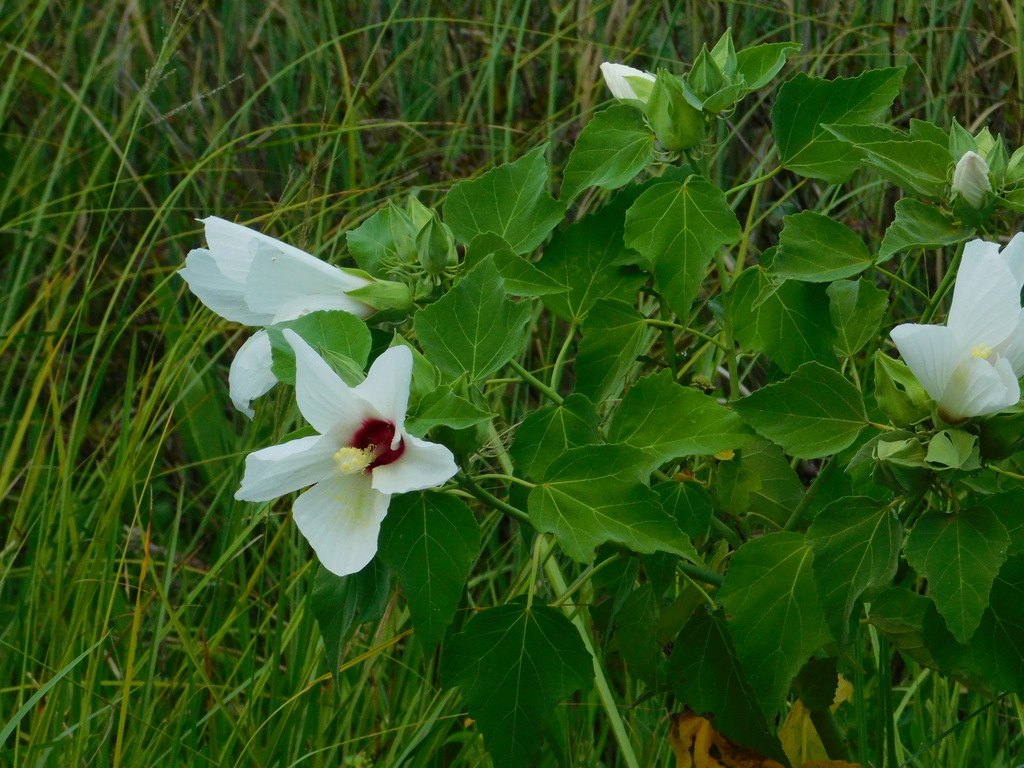
LATIN NAME: Hibiscus grandiflorus
COMMON NAME: Swamp Rose Mallow
Plant Profile
Hibiscus grandiflorus grows where few garden plants will: in tidal marsh, on lake shores and in wet pine savanna across the southeastern United States, from southeast Texas through Louisiana and Florida, with a disjunct population in western Cuba. It has been recorded historically from South Carolina, where it is now rare.
It is a herbaceous perennial that dies to the ground each winter and returns in late spring to build a woody-based clump 2 to 2.5 m tall, with broad, velvety, three-lobed leaves 15 to 25 cm long. The stems are stout and the whole plant is covered in a soft stellate pubescence that gives it a grey-green cast and makes it feel like felt.
The flowers are the largest in the genus in North America, up to 25 cm across, soft pink with a crimson eye, opening in succession from midsummer into autumn. Each lasts a single day and closes by late afternoon, but a well-grown plant opens several a day for two months. The fruit is a five-valved capsule 2 to 3 cm long, splitting to release kidney-shaped seeds about 3 mm across.
Science & Biotechnology
The genus Hibiscus is enormous, some 300 species, and the North American swamp mallows form a group of closely related species that hybridise freely where they meet: H. grandiflorus, H. moscheutos, H. coccineus and H. laevis. The garden plants sold as hardy hibiscus, with flowers 20 to 30 cm across in white, pink and red, are mostly complex hybrids of these species, bred in the twentieth century for larger flowers and hardier crowns.
Flower size in this group is under simple genetic control that breeders have pushed hard. The wild H. grandiflorus has petals 8 to 10 cm long; selected hybrids have petals nearly twice that, achieved by increasing cell number rather than cell size, so the petals of a large-flowered hibiscus feel thicker and more substantial than those of the wild plant.
The crimson eye is an anthocyanin spot at the base of each petal, and it functions as a nectar guide, directing pollinators to the centre. In some hybrids the eye bleeds outward into the petal, producing the flushed or star-eyed forms that are popular in the trade. The species also shows a form of late-acting self-incompatibility, so that a single clone sets little seed and two different plants are needed for a good crop.
Uses & Benefits
This is a plant for a wet spot, a pond margin, a bog garden or a ditch that stays damp, where its size and flowering make it a centrepiece. It also grows in an ordinary border if it is watered in dry spells, but it will be shorter and it will flower less freely, and in a drought year it may not flower at all.
The flowers are a magnet for bees and for hummingbirds, which hover at the crimson eye and push their bills into the base of the petals. The plant is a larval host for several moth species, and the seeds are eaten by finches and by waterfowl in autumn.
It is not edible, and the sap can irritate skin. In cold climates the top growth dies in the first frost and the crown needs a mulch of leaves or straw to survive a hard winter; in USDA zone 6 it will come back, but late, and it will flower only in a long, hot summer. North of zone 6 it is a conservatory plant or a gamble.
Growing from Seed
The seed has a hard coat and germinates unevenly without help. Nick the coat with a file or a pair of nail clippers, or soak the seed in water at 50 °C for an hour and then leave it in room-temperature water for 24 hours. Sow at 21 to 27 °C, barely covered, and expect germination in 14 to 30 days; some seeds will wait until the following spring.
Sow indoors in late winter, eight to ten weeks before the last frost, in a free-draining compost. Grow the seedlings on in bright light and keep them wet; this is not a plant that tolerates drying out at any stage. Pot on as the roots fill, and plant out after the last frost, setting the crown at or just below soil level.
In the first year the plant builds roots and a modest clump and may not flower until August. In the second year it reaches full size. Cut the stems to the ground after the first hard frost and mulch the crown; in wet winter soil, a collar of gravel around the crown prevents rot. Divide clumps in spring every four or five years, when the centre begins to die out.
Our Take
If you have a wet corner that defeats everything else, this is the plant for it. The flowers are genuinely astonishing at 25 cm, and a clump in August, with a dozen open at once and hummingbirds working them, is one of the sights of a late-summer garden. It is also one of the few large-flowered plants that asks for wet feet rather than resenting them.
The catch is the water. In a dry border it survives but disappoints, and in a cold climate it dies back so late that the season is half over before it starts. Grow it where the ground stays damp, give it full sun, and be patient in spring. It is worth the wait.
Related Reading
Continue exploring with these related plants: