


Pericallis hybrida Seeds | Florist’s Cineraria
LATIN NAME: Pericallis hybrida
COMMON NAME: Florist’s Cineraria
Plant Profile
Cineraria takes its name from ash, cinis, and refers to the grey-white down on the leaves rather than to the flowers. The garden plant is Pericallis × hybrida, a cross between P. cruenta and P. lanata, both endemic to the Canary Islands and both confined there in the wild. The hybrid was first raised in the British royal gardens in 1777 and has been in cultivation continuously since.
The naming has been unstable. It was described as Cineraria × hybrida, and the genus Cineraria still exists, but it is now restricted to a group of South African species. The Canary Island plants were moved to Pericallis. Some botanists prefer to sink the whole group into a broad Senecio, which is defensible on the DNA and useless in a garden catalogue.
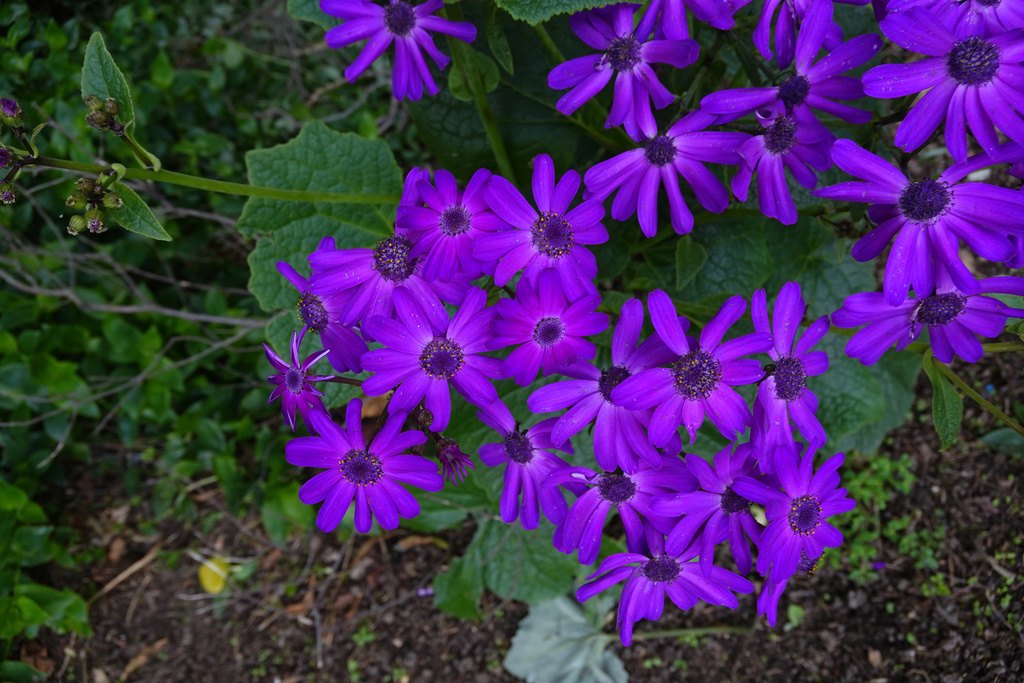
What you buy is a rosette of soft, round, slightly fleshy leaves beneath a dome of daisy heads, each about 5 cm across, in magenta, blue, white or a bicolour with a pale eye. The vegetatively propagated forms sold under the trade name Senetti are the same hybrid selected for compact habit and a longer flowering window.
Science & Biotechnology
Two island endemics crossing in a glasshouse produced a plant that is only partly fertile. Seed-raised cineraria segregates, so catalogues sell colour mixtures and why a named colour has to be maintained from cuttings. The commercial Senetti types are propagated vegetatively for exactly this reason: seed would give back a range of magenta and blue that nobody ordered.
The flower colours come from anthocyanins held in the vacuole, and the pale eye is simply a zone where pigment is not expressed. That is why the eye reads as white or cream against every colour in the range, and why the effect survives in shade, where the petal colour itself goes flat. The grey foliage is a separate mechanism: dense trichomes that scatter light and reduce water loss.
The plant sits in Senecioneae, a tribe in which pyrrolizidine alkaloids are widespread, and cineraria is not an exception. Those compounds protect the plant against generalist herbivores and cause liver damage in grazing animals when eaten in quantity. It is a reason not to let livestock browse discarded plants, and a reason the plant has never been treated as fodder. Near kin on the list: Centaurea dealbata and Arnica chamissonis.
Uses & Benefits
It is a winter pot plant, not a house plant, and the distinction is the whole of its culture. In a warm living room it produces soft, drawn growth, pale flowers and a leaf covered in the whitish tunnels of the chrysanthemum leaf miner. On a cool porch, in a cold greenhouse or on a windowsill above a draughty sash, it performs for two months.
Timing is controllable. Seed sown in early spring and grown on cool will flower by Christmas if kept at 5 to 7 °C at night with a little more warmth by day. A sowing in April or May follows in early spring, at 4 to 5 °C at night. The two batches stretch the display from December into April, which is the point of growing it yourself.
As a cut flower it is disappointing. The heads are heavy for the stem and collapse within a day of cutting, and the foliage wilts before the flowers do. It is a plant to be enjoyed where it grows, on a bench at eye level, which is also the height at which the flower colour reads best.
Growing from Seed
Sow thinly on firmed compost, three parts loam to two of leaf mould with a sixth part sand, and cover with fine soil pressed flat. The seed is small and needs a firm bed, not a deep burial. Germination is quick at 18 to 21 °C, and the tray should be shaded from strong midday sun from the moment the seedlings are up.
Prick out when the first true leaves are large enough to handle, into pans of similar compost, then pot singly into 10 cm pots using a mix slightly less sandy. Keep them cool and airy and never let them dry out completely. A plant that wilts hard at this stage never recovers its shape; it flowers on a bent stem and looks wrong for the rest of its life.
When the roots fill the pot, move to 15 cm and start liquid feeding at half strength. In winter, shift to a pit or cold house where a little heat is available on freezing nights, stand the pots on a moist bottom, and keep them out of draughts. Warmth above 10 °C is the main cause of failure, and leaf miner follows it.
Our Take
This is a plant that rewards a cold conservatory and punishes central heating, and most of the disappointment around it comes from ignoring that. Buy it in flower in January, keep it below 10 °C, and it will last six weeks. Bring it into the sitting room and it will be in decline inside ten days.
Raising it from seed is worth doing once, because the colour range from a packet is wider than anything on a bench, and the pleasure of a December plant you grew yourself is real. After that, most people buy plugs. There is no shame in it: the hybrid has been maintained by division and cutting for two and a half centuries, and it has no intention of stabilising now.
Related Reading
Gardeners who grow Florist’s Cineraria often pair it with these related subjects: