


Fragaria vesca Seeds | Alpine Strawberry
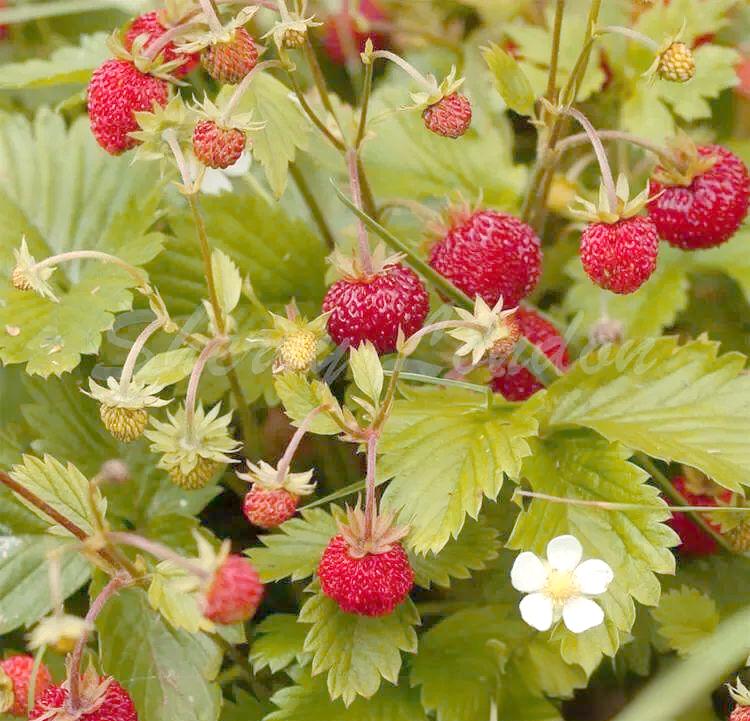
LATIN NAME: Fragaria vesca
COMMON NAME: Alpine Strawberry, Wild Strawberry
Plant Profile
The woodland strawberry is the small, intensely aromatic wild strawberry of European hedges, woodland edges and old lawns, and it runs freely. It grows across Europe, western Asia and North America in open woods, scrub and grassy banks, spreading by long runners that root at a node and make a new plant within a season. The leaves are trifoliate, bright green and softly hairy, in a low rosette that stays green through winter in mild districts. The flowers are white with a yellow centre, held above the leaves in spring, and the fruit that follows is small, cone-shaped and deep red, with the seed on the surface rather than embedded. It is the strawberry of fairy tales and cart tracks, and its flavour is far stronger than that of the supermarket fruit, though the yield is a fraction of the size.
Science & Biotechnology
Fragaria vesca is diploid, with 14 chromosomes, while the garden strawberry is an octoploid with 56, and that difference is why the wild species has been the model for strawberry genetics. Its genome was sequenced in 2011, the first in the rose family, and it has since been used to map the genes behind flavour, disease resistance and flowering time. The red fleshy part is not a fruit at all: it is a swollen receptacle, and the true fruits are the tiny achenes on its surface, each with a seed inside. The species is self-fertile and sets fruit without a pollinator, though bees improve the set. It produces runners in response to long days and flowers in response to warmth, and some selections, the everbearing alpines, have lost the day-length requirement and flower continuously. Wild plants vary enormously in flavour, and the aroma comes from a complex of esters and furanones that the cultivated fruit has largely diluted.
Uses & Benefits
The fruit is eaten fresh, and it is the best strawberry for jam, liqueur and ice cream, since the aroma survives cooking better than that of the large cultivated kinds. The leaves are dried for tea, a traditional remedy for stomach complaints, and they contain tannins and a little vitamin C. The plant is used as a ground cover in orchards and under trees, where it tolerates shade and half-shade better than most fruit, and it holds bare soil on banks. It is a good plant for a forest garden, since it fruits in the second year from seed and spreads without help. In parts of Europe it is gathered from the wild, and in others it is grown in pots on a balcony. It has no timber value and is not a commercial crop, but it is one of the most useful small plants a garden can hold.
Growing from Seed
Sow on the surface of a moist seed compost in late winter, since the seed needs light, and keep at 18 to 20 degrees; germination takes three to four weeks and is uneven. Do not cover the seed. Prick out the seedlings when they have two true leaves and grow them on in a shaded frame for their first summer. Plant out in autumn or the following spring, 25 cm apart, in soil that has been enriched with compost but is still free-draining. Water through dry spells in the first year, and mulch with straw to keep the fruit clean. Cut off runners if you want a compact clump, or let them root to make a mat. Replace the plants every three years, since they decline as the crown becomes woody.
Our Take
The wild strawberry of hedges and old lanes, with small fruit and more flavour than anything in a punnet. Let it run.
Related Reading
More species in the same orbit as Alpine Strawberry: