


Thymus serpyllum Seeds | Wild Thyme
LATIN NAME: Thymus serpyllum
COMMON NAME: Wild Thyme
Plant Profile
Wild thyme, Thymus serpyllum, is the low, mat-forming cousin of garden thyme, native across the heaths and grasslands of Europe from the lowlands to the alpine zone. Where English thyme makes a small bush, this species makes a carpet, and the carpet is what releases the famous smell when walked on or brushed by grazing animals.
The plant is a trailing evergreen sub-shrub whose slender stems lie along the ground and root where they touch. Unlike the upright T. vulgaris, it never makes a tidy bush; instead it spreads as a living cushion that tolerates being stepped on. That habit made it a traditional lawn herb and a ground cover for paths where little else will grow.
Each stem is thin and wiry, lined with tiny oval leaves that are rolled under at the edge. The leaves are smaller and greyer than those of garden thyme, and the whole plant stays flat, rarely more than five centimetres above the soil. New roots form at the leaf nodes, so a single plant can colonise a wide patch over a few seasons.
Wild thyme thrives on poor, stony, sharply drained ground and tolerates both drought and cold that would kill a tender herb. It is a classic species of chalk and limestone grassland, and among the plants that signal healthy, unfertilised meadow. In gardens it is unsurpassed for the rock garden, the gap between paving, and the green roof.
Science & Biotechnology
The oil of wild thyme is built on the same phenolic pair as garden thyme, thymol and carvacrol, though often in a different balance and at lower concentration. That chemistry is why the plant copes with harsh, exposed sites: the same compounds that fight microbes in a laboratory also help the leaf resist the bacteria and fungi of a wet, cool climate.
Uses & Benefits
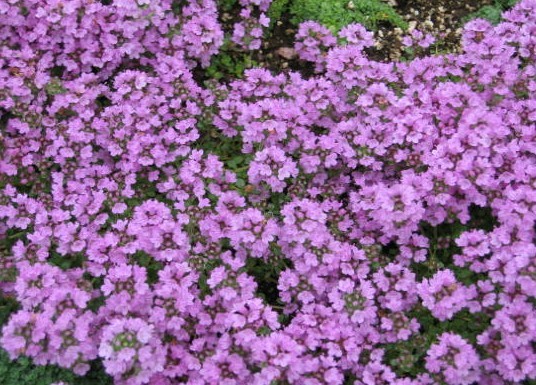
Through summer the mat is covered with dense rounded clusters of rose-purple, two-lipped flowers held just above the foliage. They are rich in nectar and draw a wide range of bees, butterflies, and hoverflies. The colour can vary from deep magenta to near white, and in some regions the plant is gathered as a honey source of real local value.
Planted between flat stones, wild thyme forms a fragrant step that flowers for weeks and feeds pollinators in a corridor that links the wider garden. It is a favourite in naturalising schemes and in the traditional cottage path, where the release of scent underfoot is part of the pleasure of the plant.
Growing from Seed
Because the mat stays low and the leaves are small and rolled, water loss is minimal even in full sun on a south-facing slope. Once rooted it asks for almost nothing, which is precisely why it suits spots where irrigation is impractical and where richer plants would flop or rot.
Press the fine seed into the surface of gritty compost and press it in without covering, since light aids the start. Keep the tray just moist in a bright spot until sprouts appear, then move young plants to a cold frame. Wild thyme is slow to make a mat in its first season, so patience pays when establishing a carpet from seed.
Set the young plants in the open ground when they reach about six centimetres tall, spacing them fifteen to twenty centimetres apart so the mats meet within a season or two. On a slope or a wall top, tuck them into pockets of lean soil and let them spread to cover the gaps between stones.
Mats can thin in the centre after several years, so lift and replant the outer rooted runners every third spring to refresh the patch. Avoid rich feeding, which pushes soft growth that is prone to winter rot; a gritty top-dressing is all this plant asks for to stay dense and fragrant.
Our Take
Wild thyme is the plant to choose where you want scent underfoot rather than a clipped bush. Compare it with French thyme and English thyme to see how one genus fills two very different garden roles, and add Mongolian thyme for a tougher eastern cousin.
Related Reading
Readers interested in Wild Thyme frequently explore these as well: