


Nageia nagi Seeds | Bonsai
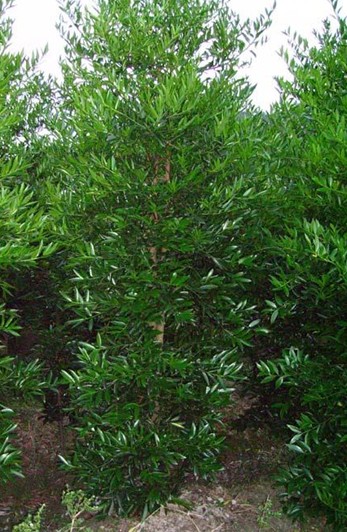
LATIN NAME: Nageia nagi
COMMON NAME: Nagi
Plant Profile
Nageia nagi is an evergreen tree that reaches twenty to thirty metres in old forest, with a straight trunk and smooth bark that flakes in small plates. Its leaves are set in opposite pairs, elliptic to lanceolate, thick and glossy, and their numerous fine parallel veins run from base to tip — a architecture shared with no other podocarp genus and the main character that justified separating Nageia from Podocarpus. In shaded forest the leaves broaden; in full sun or on exposed crowns they narrow, which is the source of the two leaf forms on one tree.
The sexes are usually carried on separate trees. Instead of cones with woody scales, the female tree bears single seeds, each wrapped at the base in a fleshy covering called an epimatium; as the seed ripens, the whole structure swells into a greenish-purple, plum-like fruit that birds swallow and disperse. This is the podocarp solution to seed dispersal, convergent on the strategy of flowering plants, and it is why you so often find nagi seedlings beneath bird roosts rather than under parent trees.
Male trees carry their role quietly, producing small, catkin-like pollen cones among the leaf axils in spring; a wind-pollinated species, it releases pale dust from these structures on dry mornings. Because the sexes split across individuals, growers who want fruit on a specimen tree plant a male nearby, and the two-to-one female bias of nursery stock often surprises new growers expecting berries from a single plant.
Science & Biotechnology
For propagators the interesting science is structural: the epimatium and the oily seed beneath it behave differently from the dry seed of a pine or spruce, and growers who strip the flesh and sow promptly achieve the most even emergence. The seeds are also a case study in zoochory, the dispersal of plants by animals, and the contrast between the fleshy seed and the leafy tree makes the species a favourite illustration in conifer biology courses.
Uses & Benefits
The chemistry of the Podocarpaceae has drawn attention for decades. The family produces distinctive diterpene resins — compounds of the totarane and ferruginol groups — whose antimicrobial activity is documented in laboratory screening, and leaf distillates of Nageia nagi, like those of its relatives, are dominated by monoterpene hydrocarbons. Researchers examine such oils for insect-repellent and antifungal leads, though no commercial extraction industry depends on the species.
Growing from Seed
In Japan and southern China the nagi has long been planted around temples and shrines, its clean evergreen foliage suited to sacred ground, and the wood — pale, even and easily worked — has served for cabinetwork, carving and interior joinery. Its tolerance of salt wind makes it a classic coastal shelter tree in warm-temperate regions, and avenues of nagi survive in old parks near the sea where more delicate evergreens fail.
Bonsai growers prize it for exactly what makes it unusual: broad, dense foliage that can be pad-pruned like a broadleaf, combined with the slow, patient habit of a conifer. A container-grown nagi reads as a miniature forest tree rather than a needle pine, and pairs handsomely in collections with true needle conifers for contrast. In landscape work it functions as a clipped screen, a shade tree for courtyards, or a specimen on a lawn where winter greens matter.
Sow cleaned seeds about two centimetres deep in a mix of loam, leaf mould and coarse sand, kept warm and evenly moist; pot each seedling on singly, holding the root ball intact. Young plants tolerate shade well but colour best with morning sun, and they want a soil that never dries to dust nor sits in water.
Transplant to open ground when saplings stand about forty centimetres, spacing five metres apart for screens or giving a specimen twice that room. Feed lightly in spring, water deeply in dry spells, and clip screens with secateurs rather than shears to preserve the big leaves’ edges. Scale insects and the sooty mould that follows their honeydew are the usual complaints, cured by early intervention and airflow. In bonsai, wire the older, hardened shoots with care because the bark is smooth and marks readily; better still, build shape by pinching.
Our Take
Give a nagi the long view: it is a slow, dignified evergreen that rewards a decade of small adjustments. Compare it in cultivation with the classic Podocarpus macrophyllus, its former stablemate, or with the same species under its older name at Podocarpus nagi for a lesson in how taxonomy changes hands. For another warm-region conifer with edible-looking fruit, see Torreya nucifera. Keep the foliage clean of scale and the tree will do the rest on its own schedule.
Related Reading
More species in the same orbit as Nagi: