


Malva sylvestris subsp. mauritanica Seeds | Mauritian Mallow
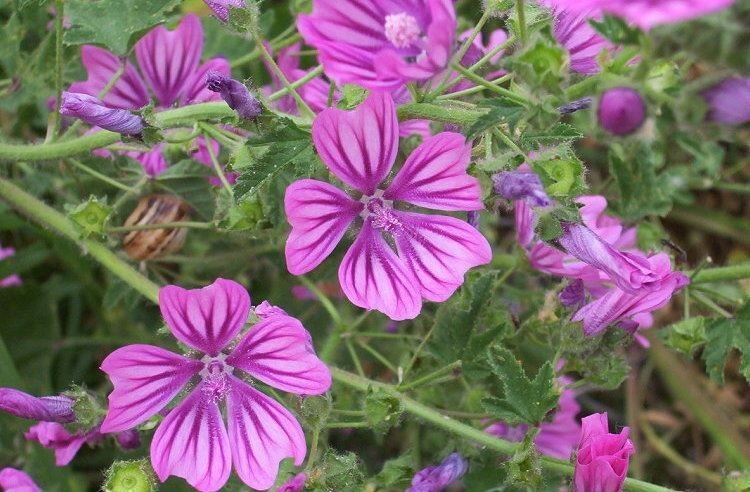
LATIN NAME: Malva sylvestris subsp. Mauritanica
COMMON NAME: Mauritian Mallow
Plant Profile
Mauritanian mallow is the boldest form of the common hedgerow mallow, with flowers twice the size and a colour that runs from deep violet to near-black purple, veined in darker ink. Plants reach 1-1.5 m on stems that are woody at the base and herbaceous above, with rounded, lobed leaves and a loose, informal habit.
Flowering runs from May to September, and the plant keeps producing new stems from the crown as old ones finish, so a single clump stays in bloom for months. Each flower lasts a day, opening in the morning and closing by evening, but the quantity makes up for the brevity.
The subspecies comes from the western Mediterranean, Morocco and the Iberian peninsula, and it is cultivated far more than it is wild-collected. In mild gardens it behaves as a short-lived perennial; in cold ones it is grown as a biennial or an annual, and it self-sows reliably enough to persist without being planted twice.
Science & Biotechnology
All mallows are rich in mucilage, long-chain polysaccharides held in specialised cells that swell into a slick gel when the tissue is soaked. That gel is the basis of the plant’s soothing reputation in cough syrups and poultices, and it is why mallow tea feels thick on the tongue.
The flowers contain anthocyanins that shift with pH, and the deep purple of this subspecies comes from a high concentration of delphinidin derivatives rather than from a different pigment class. Extracts have shown antioxidant activity in vitro, and the plant is one of the species screened in the search for natural colourants.
Malva sylvestris is also a well-studied ruderal: it colonises disturbed ground quickly, produces seed within a season, and carries a long-lived seed bank. That biology is what makes it a weed in some places and a reliable cottage-garden plant in others.
Uses & Benefits
This is a plant for the back of a loose border, a fence line or a wild corner, where its height and its long flowering season can be used without asking it to be tidy. It works well with grasses, with verbascums and with the taller salvias, and it looks better in a mixed planting than in a formal one.
The flowers are edible and are used to garnish salads and to colour sugar; the young leaves can be cooked as a vegetable, though the texture is slimy and the flavour mild. Bees and hoverflies work the flowers steadily. Herbal use centres on the mucilage as a demulcent, and mallow is still a standard ingredient in European cough teas.
Growing from Seed
Sow in spring at 18-20°C; germination is quick, usually seven to fourteen days, and the seed needs no pretreatment. The seedlings grow fast and should be potted on before they become leggy. Direct sowing in May also works well, since the plant establishes quickly in warm soil and flowers within the same season.
Set out at 45 cm apart in sun or light shade, in any soil that is not waterlogged. Water through the first month; after that the taproot finds its own supply. Stake only in exposed sites. Cut the stems to the base in late autumn, or leave a few to ripen seed for next year’s seedlings, which will appear in gaps without any help.
Our Take
A generous, slightly unruly mallow that flowers for months and asks for nothing, best used where a little wildness is welcome. Let it seed into gravel and it will place itself better than you would.
Related Reading
Readers interested in Mauritian Mallow frequently explore these as well: