


Eucalyptus citriodora Seeds | Lemon Eucalyptus
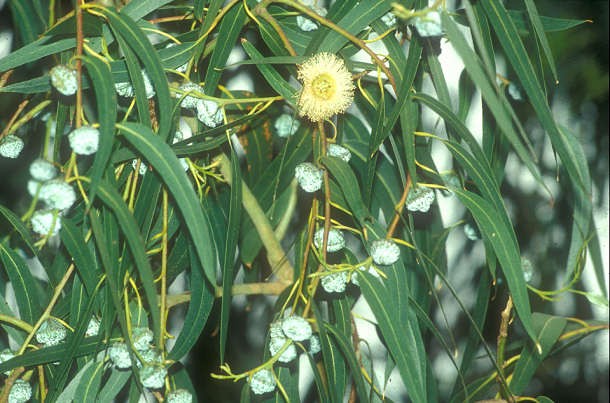
LATIN NAME: Eucalyptus citriodora
COMMON NAME: Lemon Eucalyptus
Plant Profile
Crush a leaf of lemon eucalyptus and the air fills with a clean lemon scent that has nothing to do with citrus. The cause is citronellal, which dominates the leaf oil of this species, often reported as the large majority of the volatile fraction, with citronellol, geraniol and a little citral rounding out the profile. That single compound is why the tree was moved out of Eucalyptus and into Corymbia by Hill and Johnson in 1995, grouped with the other spotted gums on fruit and bark characters rather than scent alone, a reclassification that still trips up older field guides.
The tree is a tall, straight myrtle with the characteristic smooth, cream-to-grey bark that sheds in patches to leave a mottled spotted trunk. The adult leaves are narrow, lance-shaped, glossy and held pendulously, strikingly distinct from the round juvenile foliage of some eucalypts. It is frost-tender, a subtropical native that sulks below a light chill and will not survive a hard freeze, so outside the tropics it is grown as a container specimen or a summer foliage crop brought under cover for the cold months. In its home range it is a forest tree that can top thirty metres.
Oil of lemon eucalyptus, distilled from this species, is the plant-derived basis for p-menthane-3,8-diol, a synthesised derivative that is the active ingredient in a recognised class of mosquito repellents. The natural oil and the refined compound are distinct products, but both trace back to the citronellal-rich leaf, which is what makes lemon eucalyptus a genuine phytochemical crop rather than merely an ornamental. Field trials have compared the repellent against synthetic standards, which is why the species appears in applied entomology papers as well as in perfumery catalogues.
Science & Biotechnology
The leaf oil is recovered by steam distillation of harvested foliage, and because the tree grows fast the biomass is renewable within a few seasons in its native range. Beyond repellents, the oil enters soaps, cleaners and aromatherapy for its bright lemon note, and the cut foliage is sold in floristry as a fragrant filler that lasts well in a vase. The timber, pale and straight-grained, is also used locally in construction and flooring, so the species is valued both for what it yields above ground and for what it yields from the leaf.
Gardeners sometimes confuse lemon eucalyptus with the cold-hardy silver-dollar gum; they are distinct species. Lemon eucalyptus wants warmth year-round, and any planting outside the subtropics must assume winter protection or a pot that comes indoors. A young plant dropped to near freezing will defoliate and often fail to recover, so the cold limit is the deciding factor in where it can be grown out, and a greenhouse is the safer home in cooler zones.
Uses & Benefits
Where the climate allows, the tree is grown for timber, shade and its clean scent, and in cooler zones it is a conservatory or patio plant prized for the leaf. It is also a useful bee tree in flower, though less garden-relevant where it cannot be planted out, and the aromatic foliage deters a few browsing animals that dislike the strong smell. A potted specimen by a doorway lets you crush a leaf whenever you want the lemon hit without stepping outside. In its home range the young leaves are used sparingly to scent curries and teas, though the distilled oil is far too strong for casual kitchen use and is kept for the laboratory and the perfume bench.
Growing from Seed
Sow the seed very lightly covered on a free-draining, acidic mix and keep it warm and moist; eucalypt seed is tiny and needs light, so press it in rather than bury it, and move seedlings once they carry several true leaves. Grow on in full sun and set out only where winters stay mild, spacing trees widely for their eventual height. Water young plants regularly through the first dry season but let established trees dry between soakings, and feed little; rich, wet ground softens the wood. In cold climates keep the tree in a large container, cut it back to control size, and move it under cover before the first cold nights, then resume watering sparingly indoors until the warmth returns.
Our Take
Lemon eucalyptus is the frost-tender cousin of the cold-hardy silver dollar eucalyptus, and a distinct species from Eucalyptus globulus and the apple eucalyptus. For a Mediterranean aromatic leaf compare rosemary.
Related Reading
Continue exploring with these related plants: