


Eucalyptus gunnii Seeds | Silver Dollar Eucalyptus
LATIN NAME: Eucalyptus gunnii
COMMON NAME: Silver Dollar Eucalyptus
Plant Profile
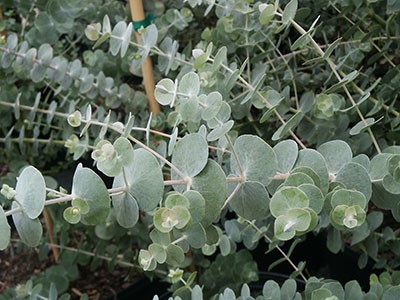
Silver dollar eucalyptus is the plant that tricks the eye twice. As a young tree it wears round, silvery leaves shaped like coins that florists love, but as it matures the same tree swaps them for long, sickle-shaped blades of grey-green, a clean shift from juvenile to adult foliage that few garden trees make so dramatically. The species is Eucalyptus gunnii, the cider gum, and that second name comes from the sweet sap that Tasmanian settlers fermented into a rough drink.
The switch in leaf shape is the plant’s signature. Juvenile leaves are opposite, round to heart-shaped, and thickly coated with a white wax that gives the blue-grey sheen. Adult leaves are alternate, lance-shaped, and hang in narrow curves. Both carry the oil glands in the leaf, but the oil differs between the stages, which is why distillers specify which foliage they harvest.
In summer the tree opens clusters of small white flowers in umbels, each followed by a woody, cup-shaped capsule, the gum nut, that holds the tiny seed. It is easily told from the taller blue gum, Eucalyptus globulus, by its rounder young leaf and its cold tolerance; both share the myrtle family’s aromatic bark.
Because the tree regrows fast from a stump, it is studied for short-rotation biomass and for pulp, and for capturing leaf oil on a cycle. Coppiced stools produce the most valuable round juvenile foliage for both floristry and distillation.
Set young trees 2 to 3 m apart where a screen is wanted, or plant a single specimen and coppice it to the stool every year or two once the stem is 1 to 1.5 m, which keeps the round foliage coming. In a small garden, grow it in a large container and cut it back hard each spring.
Science & Biotechnology
Steam distillation of the foliage yields eucalyptus oil led by 1,8-cineole, eucalyptol, with alpha- and beta-pinene and phellandrene in support. Cineole is the compound behind the cooling, camphor note and is the standard marker for oil quality; the juvenile and adult foliage give different cineole levels, so harvest age matters.
Cineole-rich oil is used in cough and throat preparations and as an antiseptic and scent in cleaners, and it is screened for antimicrobial and insect-repellent action. The compound also flavors candies and mouth products. Among eucalypts, the oil chemotype is heritable, so selection fixes a high-cineole line.
Uses & Benefits
Fresh silver-dollar stems are a florist staple for bouquets and dried wreaths; the round leaf holds its shape and greys nicely as it dries. Strip a few leaves into a hot bath or a steam tent for the scent.
Plantings near apiaries yield a light, clear honey; the leaf is the source of home-distilled or commercial cineole oil. In the landscape the tree is a fast screen or windbreak where there is room.
Crushed leaf has a long place in steam inhalation for the chest; a cultural use, not a medical claim.
Growing from Seed
Eucalyptus gunnii is native to the central highlands of Tasmania, where it grows as a straight-trunked tree on cold, exposed sites, which is why it is among the few eucalypts that stand hard frost. It was named for Ronald Gunn, the Tasmanian naturalist and explorer who collected for Joseph Hooker. In the wild it reaches tall canopy heights; in gardens it is usually kept short by coppicing for foliage.
Dust the dust-fine seed over the surface of a sterile, open seed mix and press it in without covering, since it needs light; keep the tray humid under cover and warm. Thin the seedlings as they grow so each has space.
Give a mulch of compost and steady water in the first year; established trees are drought-tolerant. The Tasmanian origin makes it the eucalyptus to try in cold gardens, but shelter the youngest shoots from the hardest frosts until the bark hardens.
Our Take
Silver dollar gum is the eucalyptus I grow for the vase, coppicing it so the round leaves never stop. Plant it for winter hardiness among its kind, and harvest the young foliage for both scent and stem.
Other eucalypts to know: Blue Gum (E. globulus), River Red Gum (E. camaldulensis), and Rose Gum (E. grandis).
Young plants benefit from protection from drying winds, but established specimens should not be kept constantly wet. In a container display, rotate the pot so the rounded leaves receive even light, and prune only after a flush of growth has hardened.
Related Reading
Continue exploring with these related plants: