


Cardiospermum halicacabum Seeds | Balloon Vine
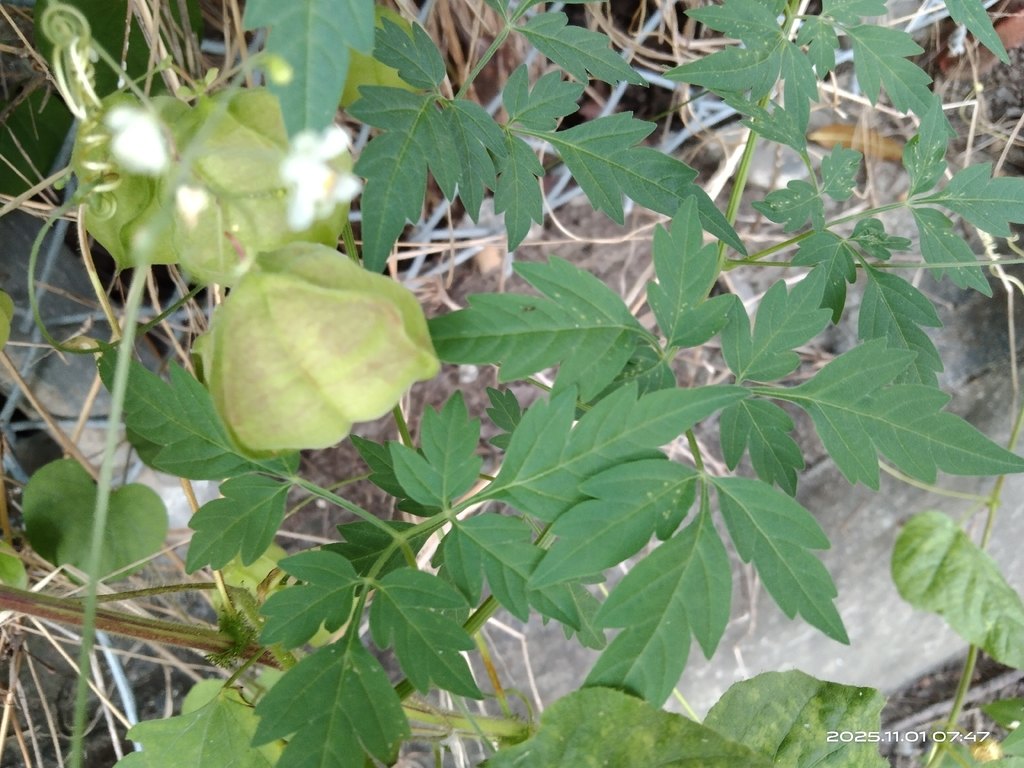
LATIN NAME: Cardiospermum halicacabum
COMMON NAME: Balloon Vine
Plant Profile
The lesser balloon vine is a scrambling climber from the tropics and subtropics of three continents, and it behaves like one: it runs over fences, hedges and riverside scrub, reaching 10 m where it has support, and flowering when it is only 25 cm high. The stems are slender, grooved and sparsely downy.
The leaves are twice divided and 5 to 6 cm long overall, with opposite leaflets 1 to 2 cm long and a terminal leaflet 4 to 6 cm long, and the margins are sharply serrated. Two coiled tendrils sit on each flower stalk, which is how the plant holds on to anything within reach without any assistance.
The fruit is a papery, almost spherical capsule 3 to 5 cm across, light green and fluffy at first, brown and brittle when ripe, with three chambers and one seed in each. The seed is black with a large pale heart-shaped scar, and that mark is the whole reason for the generic name. For more of the Sapindaceae, the list offers Acer calcaratum, Acer pseudowilsonii and Acer duplicatoserratum.
Science & Biotechnology
The heart-shaped scar is an aril, a fleshy attachment that is missing here but whose footprint remains. In related genera the aril attracts ants, which carry the seed away and bury it. Whether it still does so in this species is uncertain, and the question has not attracted much study.
The flowers are functionally unisexual and fourfold, with two outer sepals that are rounded and fringed and two inner ones that are longer and smooth. The upper two petals carry woolly scales; the lower two carry leaf-shaped scales and two glands. Male flowers have eight stamens in two rings, female flowers eight staminodes and a three-part stigma.
The whole plant is mildly toxic and has been used as a medicine in several traditions, which is a combination worth noticing. Saponins and alkaloids have been reported from the leaves and roots, and the plant is not something to add to a salad on the strength of a common name that sounds like a pudding.
Uses & Benefits
In Kerala it ranks among the ten sacred flowers, the dasapushpam, used in temple ritual and in traditional preparations. In Tamil it is mudakathan, a name that means clears rheumatism, and the leaves are cooked into a broth with pepper and cumin for that purpose. The reputation is old and the evidence is thin.
As a garden plant it is grown for the balloons, which appear in late summer and persist into autumn, and for the speed with which it covers a frame. It is also, in warm climates, a weed of riverbanks and roadsides, and it seeds itself with enthusiasm in any garden that gives it water.
The names are better than the plant. Love in a puff, heartseed, heart pea and winter cherry all describe the same small object, and all of them oversell it. It is a modest green vine with a clever fruit, and that is enough for most people who grow it.
Growing from Seed
Sow in spring at 20 to 24 °C. The seed coat is hard; nick it or soak it overnight, then sow 1 cm deep in a free-draining mix. Germination takes one to three weeks. The seedlings climb almost immediately, so give them a stick before they find the neighbouring pot and make a mess of it.
It wants sun and steady water, and it will tolerate poor soil, so it does so well on riverbanks. Too much feeding produces a mass of leaf and few flowers. In a cold climate, treat it as an annual and sow again each spring; in a warm one, cut it back hard in winter. A vine this fast moves a lot of water, so a plant in a pot dries out far quicker than the compost suggests.
The vines are strong but light, and a tripod of canes is enough. Tie the first shoot in and the tendrils do the rest. Deadhead if you do not want seedlings, and be thorough about it: a single capsule holds three seeds and each one germinates.
Our Take
It is a plant for a child’s garden or a quick screen, and it earns its place on speed rather than beauty. The flowers are small and greenish white, the leaves are ordinary, and the fruit is the only thing anyone remembers. That is fine. Not everything has to be a rose.
In warm climates, think before you plant. A vine that naturalises along watercourses and seeds itself in gravel is not a gift to a garden near bushland. Keep it in a pot, cut the capsules, and enjoy it for one season.
Related Reading
More species in the same orbit as Balloon Vine: