


Calendula officinalis ‘Erfurter Orangefarbige’ Seeds | Erfurter Orange
LATIN NAME: Calendula officinalis ‘Erfurter orangefarbige’
COMMON NAME: Erfurter Orange Calendula
Plant Profile
Erfurter is the working sibling of the genus: less glamorous than the bedding forms, more productive than the wild one, and bred for the jar rather than the border. Knowing which calendula you are growing decides how you should treat it.
Historically the petals coloured butter and cheese; today the same harvest feeds skin-care formulations where the triterpene esters are the active interest. The dye use and the salve use are the two ends of one long human relationship with the flower.
Science & Biotechnology
The name Erfurter points to a German horticultural tradition of growing calendula not as a pretty bedder but as a field crop for the herb trade. ‘Erfurter Orangefarbige’ is a selection kept for a deep, even orange petal and a high load of the compounds that the dried-flower market wants, rather than for a tidy border shape.
Where most garden marigolds are judged by the flower, Erfurter is judged by the petal mass it yields per plant and by how cleanly that petal dries. Growers in the herb trade favour it because the colour holds through drying and the chemistry is consistent from one field to the next.
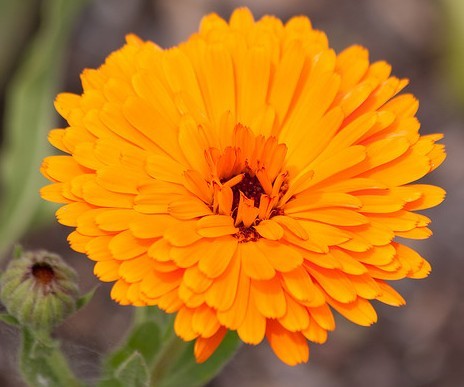
The flowers are a uniform orange, with little of the gold-and-apricot mix seen in cottage types. That single colour matters for the dried product, because a blend of shades looks muddy once the heads are stripped and bagged for tea and salve making.
Erfurter puts more of its energy into the flowering head and less into a branching, sprawling habit. The result is a plant that is easier to harvest by hand or machine and that returns more usable petal from the same area of ground than a showy bedding cultivar would.
Because the harvest is the product, the timing of the cut matters more than it would for an ornamental, and the whole field is often brought in over a short window so the chemistry stays even from one batch to the next.
Beyond the carotenoid colour, Erfurter petals concentrate triterpene chemistry built on oleanolic acid and its glycosides, along with the faradiol-type esters shared across the species. These are the fractions that herbal manufacturers measure when they standardize a calendula extract.
The heads are taken when the ray florets are fully open but before the disc browns, then dried quickly in shade and cool air. Picking on a dry day keeps the moisture down and protects the colour, which is the part the buyer is paying for.
Dried Erfurter petals are graded by colour and by how little green or disc material they contain, because a clean orange product commands a better price than a mixed one. That grading step is part of why the cultivar is grown as a crop and not merely as a garden flower.
Compared with the weedy Calendula arvensis, the cultivated Erfurter carries a richer, more predictable petal chemistry and a larger flower. Selection over many seasons has pushed the pigment and triterpene load up while keeping the plant easy to raise in a field.
Uses & Benefits
Dried Erfurter petals move through the herb and cosmetic supply chains, and the seed is traded by the kilogram to growers who contract for petal. This is a crop with a buyer before it is sown, which is rare among marigolds.
That forward market also shapes how the seed is sold, often in larger packets aimed at the field rather than the backyard, and the plants are priced accordingly by the trade.
Growing from Seed
The seed is fine, flattened, and slow to get moving in cold soil, so it is pressed onto a moist, fine surface and kept lightly covered only by a sieve of grit. A cool but not cold bed gives the best and most even stand.
When the little plants reach a workable height the patch is thinned so each has room to branch, because a crowded calendula stays small and flowers poorly. Thinning also opens the canopy to air and lowers the mildew risk.
A lean soil keeps the colour deep, while too much nitrogen pushes soft leaf at the cost of petal. Once flowering begins a light feed keeps the long bloom window open from late spring until the first hard cold.
Our Take
If you want calendula for the jar rather than the vase, Erfurter is the honest choice. Read about the plain pot marigold and the wild field marigold, and see the showy Calypso series for the bedding side.
Related Reading
Gardeners who grow Erfurter Orange Calendula often pair it with these related subjects: