


Amaranthus caudatus Seeds | Love-lies-bleeding
LATIN NAME: Amaranthus caudatus
COMMON NAME: Love-Lies-Bleeding
Plant Profile
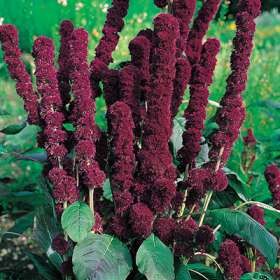
Love-lies-bleeding is an Andean grain grown for eight thousand years and a garden annual for about four hundred, and it does both jobs with the same plant. Amaranthus caudatus makes an upright stem 1-1.5 m tall, clothed in soft, ovate leaves, and from midsummer produces long, drooping crimson tassels that can reach 60 cm and hang like rope.
The tassels are the inflorescence, and each is made of hundreds of tiny flowers that set thousands of seed. That is the reason the plant is both a striking ornamental and a subsistence crop: the same structure that makes it decorative makes it productive. Green forms and pale-seeded forms exist, and the ornamental trade has selected for tassel length while the grain trade selected for seed yield.
Science & Biotechnology
Amaranth grain has an amino acid profile that stands out among cereals: it is high in lysine, the limiting amino acid in wheat, rice and maize, which is why nutritionists have taken an interest in it as a companion crop rather than a replacement. The seed also contains squalene in the oil fraction, a compound otherwise sourced mainly from shark liver and now used in vaccines and cosmetics.
The plant is a betalain producer, one of the families that make red and yellow pigments from betalamic acid rather than anthocyanins, and the deep crimson of the tassels comes from that pathway. Betalains are water-soluble, stable across a wide pH range and have been studied as natural food colorants, which gives the ornamental form an industrial connection that few bedding plants can claim.
Uses & Benefits
In the border the plant is used for height and for the strange, hanging movement the tassels make in wind. It works at the back of a hot border with grasses and dahlias, and it is one of the few annuals that looks better in September than in July.
As food, the seed is popped, ground into flour or boiled as a porridge, and the leaves are eaten as a green in India, Africa and the Caribbean. The nutritional claims are real but should be kept in proportion: amaranth is a good food, not a medicine, and the traditional use as a mild astringent is modest.
Growing from Seed
The seed is small and needs light, so surface-sow onto a fine, moist mix, press it down and leave it uncovered. Hold at 18-22°C; germination takes seven to fourteen days and is usually strong. Direct sowing works once the soil is warm, and is easier than transplanting if you have space.
Thin or plant out to 30-40 cm apart in full sun. The plant tolerates poor soil and drought but responds to water with much larger tassels. It is heavy and top-prone, so plant it among sturdier neighbours or stake the tallest forms. Seed is easy to save: let a few tassels dry on the plant and rub them out.
Our Take
Grow it for the tassels, eat a little of the seed, and leave the rest for the birds, which work the heads systematically in autumn. It is one of the most generous annuals for the space it takes, and it self-seeds without becoming a nuisance.
Related Reading
Readers interested in Love-Lies-Bleeding frequently explore these as well: