


Abies firma Seeds | Momi Fir
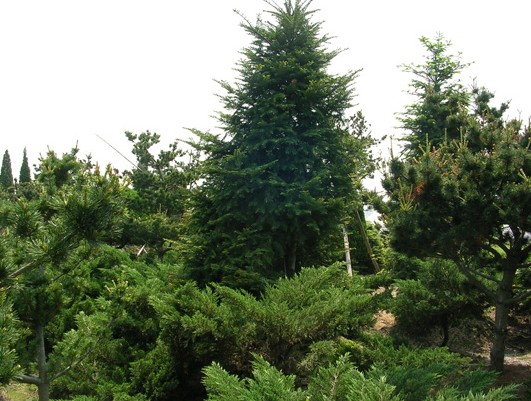
LATIN NAME: Abies firma
COMMON NAME: Momi Fir, Japanese Fir
Plant Profile
Two characters settle the identification. The needles, flattened and glossy green with two whitish bands of stomata below, end in a distinctly forked or notched tip — unique among Japanese firs — and the cones, standing upright on the highest branches, carry those exserted, reflexed bracts. At maturity the cones disintegrate in place, scales and seeds tumbling away to leave a bare central axis, the classic fir method of seed release.
In Japan momi is planted around temples and graves, grown as a timber tree in managed stands, and used as a Christmas tree domestically. In the garden it works as a stately screen or a single specimen with soft, deep-green foliage that casts a gentle shade; unlike spiny spruces it is pleasant to touch, a virtue where children play. The broad needles also cut traffic noise better than fine-needled conifers, a small but real advantage beside roads.
Its range of service extends to coastal-plain plantings in warm-temperate regions where other firs sulk, and to mixed windbreaks on deep soils. Designers pair it with pines for winter structure and with deciduous azaleas for a spring understorey, and its tolerance of a humid summer suits the American Southeast, parts of China and lowland Europe better than most of its genus.
Within the fir family its lineage is isolated enough that taxonomists gave it and its few relatives a section of their own, and several Japanese firs once treated as separate species have been folded into it over time. Field identification away from the cones still comes back to the forked needle tips, and plant hunters in the mountains of Shikoku rely on exactly that character when fog hides everything larger than a branch.
Science & Biotechnology
The tree’s heat tolerance has made it the nurseryman’s secret weapon. Grafting stock of choicer but heat-sensitive firs onto Abies firma rootstock confers endurance of warm soils and drought that the scion could never manage on its own roots, a practice now common wherever Mediterranean and East Asian firs are grown at the warm edge of their climatic range. Rootstock trials continue into resistance to soil-borne pathogens as well, since fir roots on their own species frequently suffer in heavy, wet ground.
The bark blisters exude a fragrant oleoresin, and chemical work on fir resins shows the usual Pinaceae cocktail of monoterpenes and diterpene acids, with composition shifting between species and provenances. Researchers examine these profiles for chemotaxonomic fingerprints and for antimicrobial leads, while distillers note that the needles and twigs of momi yield a clean, green essential oil used in Japanese aromatics. No figure-bearing claims are needed here — the honest summary is that the chemistry is real, studied, and still being mapped.
Uses & Benefits
In the forest the species is the lowland fir of Japan, happy in summer heat and humidity that would wilt alpine relatives, and mature trees build a broad, rounded crown over a tall, clean trunk. Old bark turns grey and breaks into plates. Height records push past thirty metres in favoured valleys, and the timber, traded as momi, has long been part of Japanese construction. Botanists value the species as evidence of how firs adapted to the warm-temperate edge of the family’s range, a lineage holding on where most of its kin retreated to cold mountains.
Growing from Seed
Collect cones just as they begin to fall apart and shake out the winged seeds; a spell of cold stratification in moist sand helps even out the start, after which seeds are sown about one centimetre deep in beds of gritty, acid compost. Shade the beds for the first summer and keep them evenly moist — fir seedlings resent drying as much as they resent waterlogging. Pot on with the root plug intact once true needles lengthen.
Line out when saplings stand twenty to thirty centimetres, spacing nursery rows half a metre apart, and set permanent trees four to six metres apart in full sun and deep, moisture-retentive, slightly acid soil. Feed sparingly; firs are light feeders and lush growth snaps in snow. Watch for adelgids and aphids on new shoots and for root rots on heavy ground, and prune only to remove dead wood or double leaders, cutting back to live wood in spring.
Our Take
If firs have failed for you in a warm, humid garden, this is the species to try before giving up on the genus. For contrast in a conifer collection, the Korean Abies koreana with its purple cones, the delicate Abies veitchii of the Japanese mountains, and the Caucasian Abies nordmanniana each show a different face of the family. And remember those bracts: a cone in the hand settles every identification question faster than any needle count.
Related Reading
Gardeners who grow Momi Fir often pair it with these related subjects: