


Chonemorpha grandiflora Seeds | Frangipani Vine
LATIN NAME: Chonemorpha grandiflora
COMMON NAME: Frangipani Vine
Plant Profile
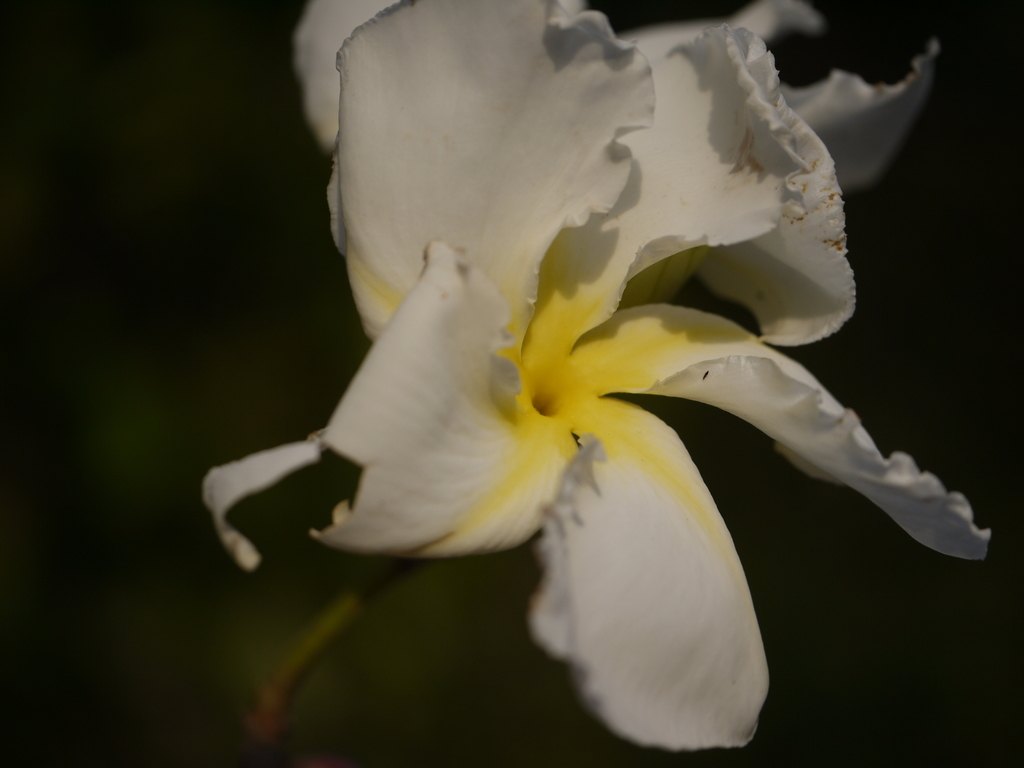
Chonemorpha grandiflora is a large woody climber of the dogbane family, with opposite, broad leaves, a milky latex in every broken stem, and flowers the size of a saucer, cream-white with a yellow eye, produced in loose clusters at the ends of the shoots. In flower it ranks among the most conspicuous vines of the Asian tropics.
The flowers are salver-shaped, with a long narrow tube that opens into five broad, overlapping lobes, and the mouth of the tube carries five small scales. The buds are twisted in a way that is characteristic of the family, and they open over several weeks, so a single vine is in flower for a long time.
Its range is enormous: from southern China, Nepal and India through Myanmar, Thailand, Laos, Cambodia and Vietnam into Malaysia, Sumatra, Borneo, Java, the Philippines and Sulawesi. It grows in moist deciduous and evergreen forest, along streams and forest edges, and it climbs into the canopy and flowers there. In parts of the range it is also planted around villages, which blurs the line between native and naturalised.
The genus name comes from the Greek for funnel and form, a description of the corolla, and the species epithet simply means large-flowered, which is fair. Some databases treat this name as a synonym of Chonemorpha fragrans, the species more often seen in cultivation, and the distinction between the two is not settled. It shares the family with Asclepias tuberosa, Asclepias verticillata and Oxypetalum caeruleum.
Science & Biotechnology
The family’s pollination apparatus is the reason the flowers are worth a close look. In the milkweed subfamily the pollen is packed into pollinia, and the visitor that picks one up must place it precisely into a receptacle on the next flower. The mechanism is a precise fit, and it fails more often than it succeeds.
The latex is the family’s other defence. Every part of the plant bleeds white when cut, and the sap contains cardiac glycosides, alkaloids and rubber-like hydrocarbons. The toxicity is real: the plant is not eaten by livestock, and the sap is a skin irritant. Handling it is best done with gloves and away from the eyes.
The seeds are borne in a pair of long follicles and carry a plume of silky hair, and they are dispersed by wind in the same way as the milkweeds of temperate regions. A fruiting vine in the dry season releases a cloud of silk that catches on everything and is one of the memorable sights of the tropical forest edge.
Uses & Benefits
The stems yield a strong, pale bast fibre that has been used for cordage, rough cloth, fishing line and paper, and in parts of India and Southeast Asia it was a household material before synthetic rope. The fibre is extracted by retting and is said to be durable in water, which suited it to fishing gear.
In local medicine the root and stem are used, usually in decoction, for fevers and skin complaints, and the plant appears in several regional pharmacopoeias. The cardiac glycosides make dosage a serious matter, and the plant is not one to use casually, whatever the tradition says. The latex is also applied externally, in small quantities, for ringworm and similar infections.
In the garden it is a tropical vine for a large pergola in a frost-free climate, and it is grown for the flowers and the scent, which is strongest in the evening. It needs space, strong support and heat, and it will not flower in cool summers whatever the size of the plant.
Growing from Seed
Fresh seed germinates without difficulty at warm temperatures, twenty-five degrees or so, and it should be sown as soon as the follicles open, because viability falls quickly. Cover lightly, keep humid, and expect seedlings in two to four weeks. The seedlings are vigorous and need a support almost at once. Soak the seed for a few hours before sowing to soften the coat.
Cuttings are the usual method in the tropics: take half-ripened shoots with a node, dip in rooting hormone, and keep them in a humid, shaded bed. They root in a month or so, and a cutting will flower in two or three years, much sooner than a seedling. Wear gloves, because the latex will stain and irritate.
Plant in deep, fertile, well-drained soil in full sun, with a strong structure to climb on. Water well in the growing season and sparingly in the dry one, and prune after flowering to keep the vine within bounds. Frost will cut it to the ground, and it may or may not return. In a cool climate it is a conservatory plant, and a large one.
Our Take
This is a vine for people who have the climate and the space, and for the rest of us it is a plant to look at in other people’s gardens. In flower it is extraordinary: the flowers are huge, the scent is heavy, and the whole canopy disappears under cream. It is also, unavoidably, a plant that demands respect for its latex.
Grow it on a strong frame, away from paths where the sap can reach an eye, and give it the heat it wants. Then, for a few weeks in the dry season, it will do something that no temperate vine can match. The rest of the year it is a coarse, rampant climber, and that is the price.
Related Reading
More species in the same orbit as Frangipani Vine: