


Paspalum vaginatum Seeds | Seashore Paspalum
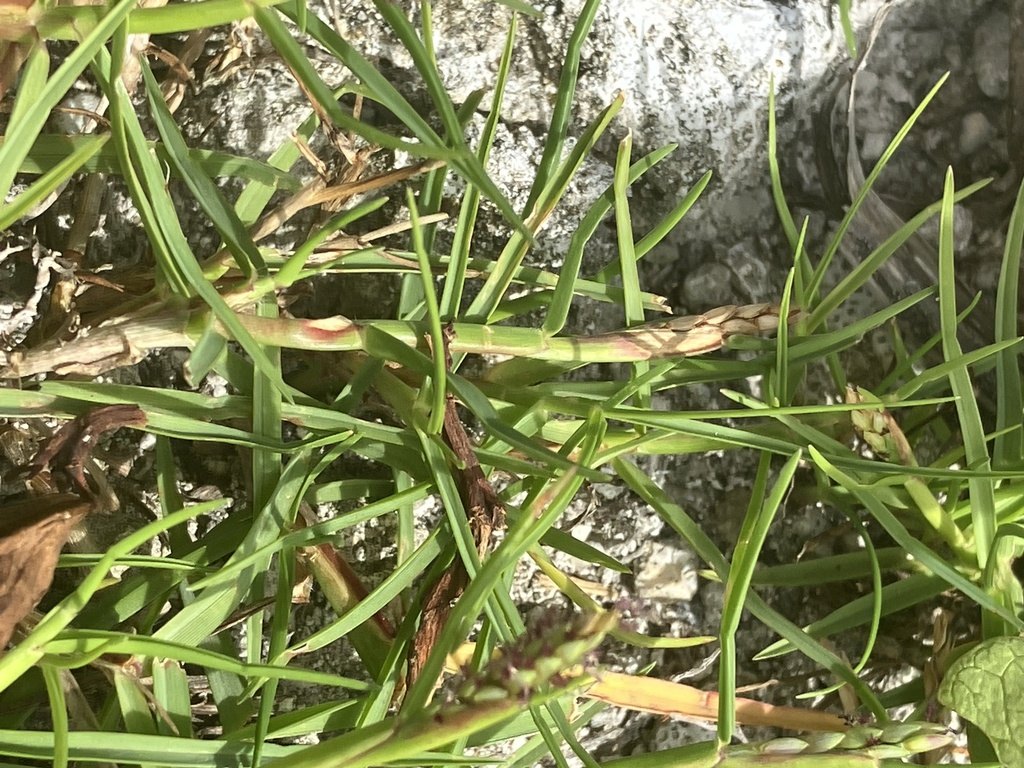
LATIN NAME: Paspalum vaginatum
COMMON NAME: Seashore Paspalum
Plant Profile
Seashore paspalum is a perennial of the Poaceae native to the coastal dunes and salt marshes of tropical and subtropical America, and it is now found on warm coasts around the world. It forms a dense sward 10 to 30 cm high from stout stolons and short rhizomes, with fine to medium leaves that are soft and slightly glossy. The seed heads are two slender racemes, held together in a V.
Its defining trait is salt tolerance that exceeds every other turf species in common use. Established swards are irrigated with diluted seawater on some golf courses, and with treated effluent on many others, and they keep colour where bermudagrass would die. That single property has moved the grass from the dunes into the most expensive turf market in the world.
It is a C4 grass of warm seasons and it wants heat, water and fertility to perform. In a cool climate it behaves as a summer annual, and below about 10 °C it stops growing altogether. It is also an aggressive spreader, and in wetlands outside its range it is a weed.
Science & Biotechnology
The salt tolerance is structural. The leaves carry bicellular salt glands that excrete sodium and chloride onto the surface, where they are washed off by rain or irrigation. That keeps the concentration inside the tissue below the level that would poison the enzymes of photosynthesis, and it is a trick shared with mangroves and with a handful of other grasses.
Breeding has concentrated on turf quality rather than on yield, and the commercial cultivars are mostly fine-textured, dense and dark, selected for greens and fairways. Sea Isle 2000 and Salam are two of the names that appear on golf courses in the Gulf states, and the difference between them is measured in leaf width and in cold tolerance rather than in salt tolerance, where they are all similar.
The species is also a host of ergot and of several Paspalum-specific diseases, and its thatch builds up faster than bermudagrass under heavy nitrogen. Both problems are manageable, and both are reasons why a seashore paspalum course costs more to run than its reputation suggests. For more of the Poaceae, the list offers Paspalum wettsteinii, Achnatherum extremiorientale and Lagurus.
Uses & Benefits
It is the turf of choice where water is brackish, saline or reclaimed: coastal golf courses, sports fields, parks and lawns, and the landscaping of new cities on desert coasts where fresh water is desalinated and expensive. In the Gulf it has become the default grass for exactly that reason.
It is also used for erosion control on saline and inundated land, and for stabilising the edges of treatment ponds and lagoons. Its root system holds sand, and its tolerance of flooding lets it grow where few other grasses will establish.
For a garden it is only worth considering if the irrigation water is poor. Where fresh water is plentiful, a fine bermudagrass or a zoysia will give a better surface for less trouble, and the salt tolerance is a solution to a problem you do not have.
Growing from Seed
Seed is available but establishment from it is slow and uneven, and most turf is planted as sprigs or as sod. If you do sow, use a fresh lot, broadcast at 5 to 10 g/m² on a levelled bed, and keep the surface damp until the seedlings tiller. Do not let the seed dry out after sowing, and do not sow before the soil is warm.
Sprigging is the professional route: 5 to 10 m³ of washed stolons per hectare, pressed into a moist surface and kept wet for ten days. The grass knits quickly in heat, and a sprigged field can be playable in six to eight weeks.
Once established it needs regular mowing at the height the surface demands, and it needs thatch control. Verticut in the growing season, topdress with sand, and watch the salt crust that forms on the surface when irrigation water evaporates. Water quality matters as much as water quantity. The grass tolerates salt, but it does not tolerate poor aeration, and a sward kept permanently wet in a heavy soil will thin at the roots while the leaves still look green. Let the surface dry between irrigations, and flush the profile once a year with fresh water if you can spare it.
Our Take
Seashore paspalum is a technical answer to a water problem, and it is a good one. It is not a better grass than bermudagrass; it is a grass that will grow where bermudagrass will not, which is a different claim. If your water is brackish, plant it and be grateful. If your water is clean, plant something else and keep your budget.
Related Reading
More species in the same orbit as Seashore Paspalum: