


Panicum virgatum Seeds | Switchgrass
LATIN NAME: Panicum virgatum
COMMON NAME: Switchgrass
Plant Profile
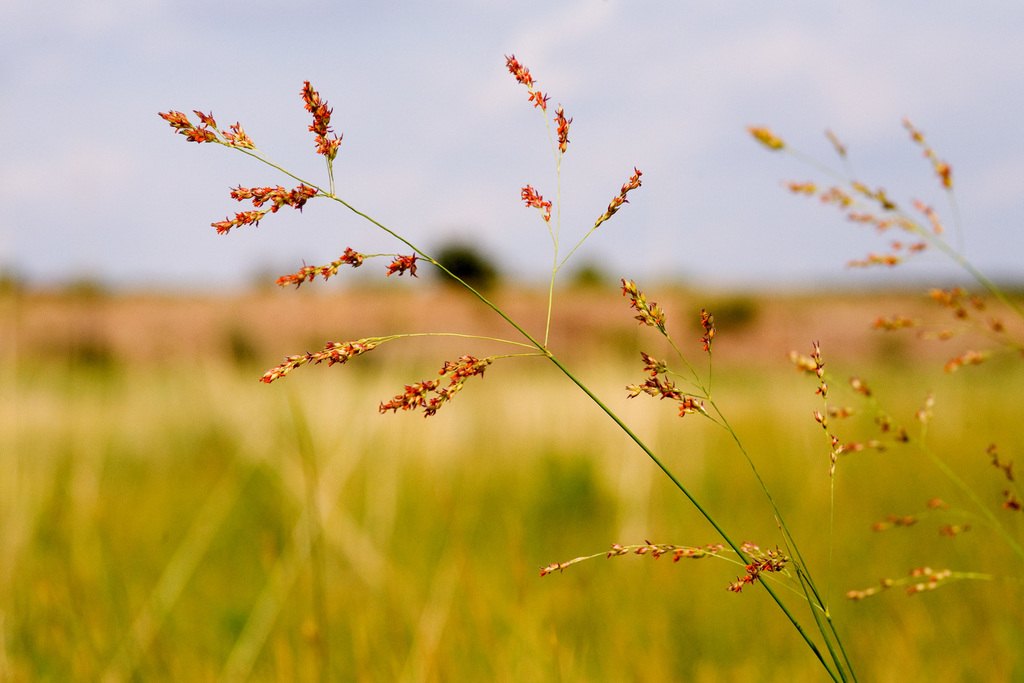
Switchgrass is a bunch-forming warm-season grass of the Poaceae, native to the tallgrass prairie of central North America and still one of its dominant species. It grows one to two metres tall, with upright stems, blue-green to green blades that redden in autumn and a large, open, airy panicle that carries fine wind-borne seed. In a remnant prairie it grows beside big bluestem and indiangrass, and the three together are the backbone of what the plains looked like before the plough.
It is deep-rooted, with roots that can reach three metres, and long-lived, spreading slowly within the clump by short rhizomes. The root mass is most of the plant: the top growth that gets cut in autumn is a fraction of what is underground, and that ratio is the reason the species is interesting to soil scientists.
Two ecotypes are recognised in the trade. Lowland types are taller, coarser, later and more productive on wet, fertile ground; upland types are shorter, earlier, finer and more drought-tolerant. The named cultivars are built on that division, and choosing the wrong one for a site is the commonest mistake made with this grass.
Science & Biotechnology
Switchgrass comes in a polyploid series, with chromosome counts from 18 up to well over 100, and the lowland types are mostly tetraploid while the upland types are mostly higher polyploids. The ploidy difference helps keep the two ecotypes distinct even where they meet, and it complicates breeding, because crosses between them often fail.
The species was chosen in 1991 by the United States Department of Energy as the model herbaceous energy crop, and most of what is known about perennial grass biomass agronomy comes from the plots planted after that decision. It can be burned, fermented to ethanol, gasified, or converted to butanol, and the cellulose and hemicellulose that make it hard to digest are the same fractions the industry has spent thirty years learning to break.
Its other talent is below ground. A stand of switchgrass puts carbon into the soil for decades, improves infiltration on compacted ground and holds banks that would otherwise move, so it appears in conservation plantings as often as in energy ones. Growers who plant it for carbon are paid for the same ground twice, once in the contract and once in the soil. Alongside it in Poaceae: Panicum turgidum, Lolium multiflorum and Elymus trachycaulus.
Uses & Benefits
As forage it fills the summer slump, when the cool-season grasses have gone dormant and the pasture is short. Quality is best before the panicle opens and falls away fast after that, so the timing of the cut decides whether you have hay or bedding.
As a garden plant it ranks among the best structural grasses available, with cultivars selected for blue foliage, red autumn colour, upright habit and compact height. It stands through the winter, holds snow, and gives a border something to look at in January, which is more than most perennials manage.
It is also used for game cover, for phytoremediation on contaminated ground, and for erosion control on strip-mine spoil. In each case the same two properties do the work: a deep root system and a tolerance of poor soil. Neither property is fashionable, and both are hard to replace.
Growing from Seed
The seed is chaffy and dormant, and fresh seed germinates poorly without a cold, moist period. Stratify it for four to six weeks, or sow in late autumn and let the winter do the work. Buy seed by pure live seed rather than by weight, because the chaff and the empty florets can be half the bag.
Sow at 5 to 10 kg/ha of pure live seed, no deeper than a centimetre, and expect nothing to happen until the soil is properly warm. Switchgrass seedlings are slow and small for the first six weeks, and a flush of weeds will beat them if you let it.
In a garden, raise plants in deep pots for a season and plant out in early summer. The first year goes into the roots, the second into the clump, and the third into flower. After that the clump is permanent, and the only work in the year is the winter cut. Cutting the stand back in late winter rather than autumn leaves the crown protected and the seed heads for the birds.
Our Take
Switchgrass is asked to be three things at once, a forage crop, an energy crop and a garden ornamental, and it does all three well enough to be worth the space. For a garden in a cold climate it is the most reliable tall grass there is. For a farmer it is a long-term commitment, because a stand takes three years to pay back the establishment, and the contract had better last longer than that.
Related Reading
Gardeners who grow Switchgrass often pair it with these related subjects: