


Euphorbia tirucalli Seeds | Pencil Cactus
LATIN NAME: Euphorbia tirucalli
COMMON NAME: Pencil Cactus
Plant Profile
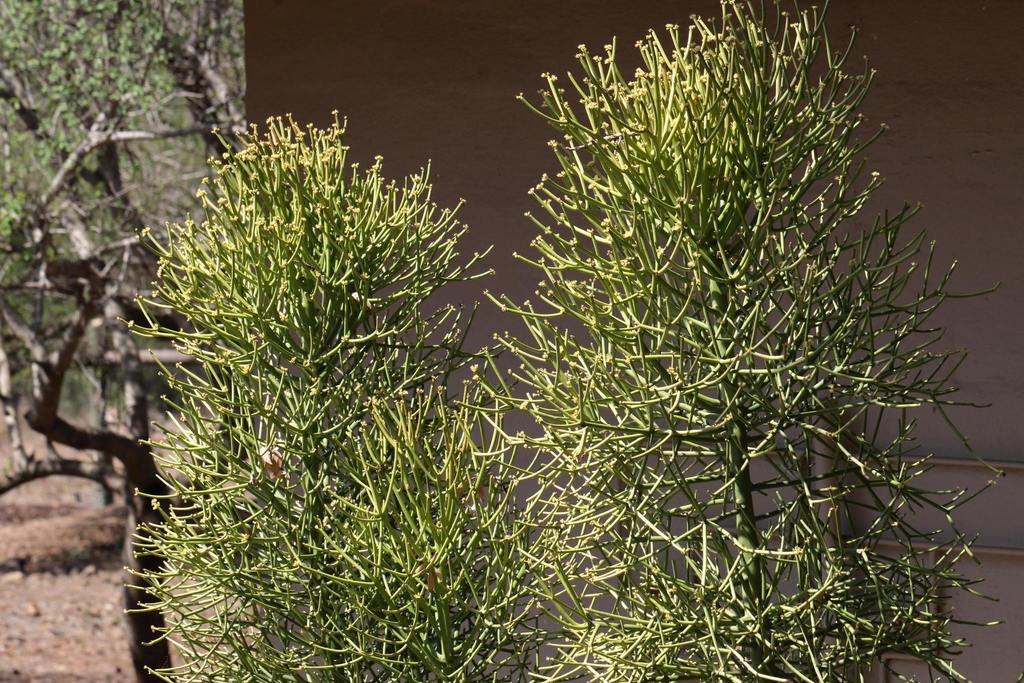
Pencil tree is a shrub or small tree to 7 m, with pencil-thick green branches 7 mm across, smooth, faintly striped lengthwise and produced in whorls. There are no spines and almost no leaves: the oval ones are 1 to 2.5 cm long and 3 to 4 mm wide, and they fall early, leaving the green stems to do the photosynthesis. The effect is of a bundle of green sticks.
The flowers are small and yellow, at the ends of the branches, and they are insignificant against the architecture. What most people notice is the colour: in dry cold the tips take on a red flush, so it is sold as fire stick in some markets and why a stressed plant looks better than a comfortable one.
It is native to semi-arid tropical Africa, mainly the north-east, centre and south, on black clay soils, and it may also be native in parts of the Arabian Peninsula. It has been carried to Brazil, India, Vietnam, the Philippines and Ghana, and it grows in dry savanna where little else will.
Science & Biotechnology
The latex is the whole caution. It is milky, under pressure, corrosive and toxic: on skin it causes severe irritation and a burning sensation, in the mouth it burns the lips and tongue, and in the eye it can cause temporary blindness. Gloves and eye protection are not optional when pruning, and the sap does not wash off with water alone.
It is a hydrocarbon plant, and that phrase has been taken further than the plant deserves. The chemist Melvin Calvin proposed growing it for oil, since the latex is rich in terpenes that could in principle be cracked to fuel. The idea recurs every time oil prices rise, and it has never become a crop.
The medicinal reputation is worse than useless. It has been promoted as an anticancer agent across Brazil, India, Indonesia and Malaysia, while the research shows the opposite: it suppresses the immune system, promotes tumour growth, and is associated with Burkitt’s lymphoma as a cofactor rather than a cure. The gap between the two claims is the gap between tradition and evidence. Near kin on the list are Euphorbia pekinensis, Euphorbia myrsinites and Euphorbia marginata, all Euphorbiaceae.
Uses & Benefits
In its native range it is planted as a living hedge, and it is close to perfect for the job: dense, thornless but unpleasant to push through, drought-proof, and cheap from cuttings. A row of it will keep cattle out of a vegetable plot without wire or posts, so it is everywhere along roadsides in East Africa.
As a garden plant it is a talking point rather than a beauty, and in temperate climates it lives in a pot and spends winter indoors. Given sun and sharp drainage it grows quickly and needs little; given shade and water it makes soft growth and rots. It will reach 2 m in a large pot in a decade.
It has a place in a dry-climate planting scheme as a sculptural accent, and it earns it. The corollary is a rule: keep it out of reach of children, do not put it where someone will brush past it, and never cut it without covering your eyes.
Growing from Seed
Seed is rarely available and cuttings are the normal route, which is just as well because the plant roots from any piece of stem. Cut a 15 cm section, let it dry in the shade for a week until the cut calluses, and push it into dry grit. Water sparingly until roots appear; rotting is the usual failure.
If you do have seed, sow in spring at 25 to 30 °C on a free-draining mix, barely covered, and expect two to four weeks. The seedlings are slow and look like tiny green pins for months. Pot them on into gritty compost and keep them dry at the root, wet at the leaf, which is not a combination most people manage.
Grow it in full sun in a pot of gritty compost, water when the compost is dry, and feed once in spring. In winter keep it at 10 °C or above and almost dry. Repot every third year, wearing gloves, and wash your hands afterwards with soap and plenty of water.
Our Take
It is a plant with a strong silhouette and a real hazard, and both facts are usually understated in the same catalogue entry. As a houseplant it is easy, architectural and dull for eleven months, and then it flushes red at the tips and earns its place.
Grow it if you have the light and the space, and treat the sap as you would treat a chemical: gloves, glasses, no exceptions. The fuel story is a curiosity, the cancer claims are wrong, and the hedge is what it is actually good at.
Related Reading
Gardeners who grow Pencil Cactus often pair it with these related subjects: