


Nigella sativa Seeds | Black Cumin
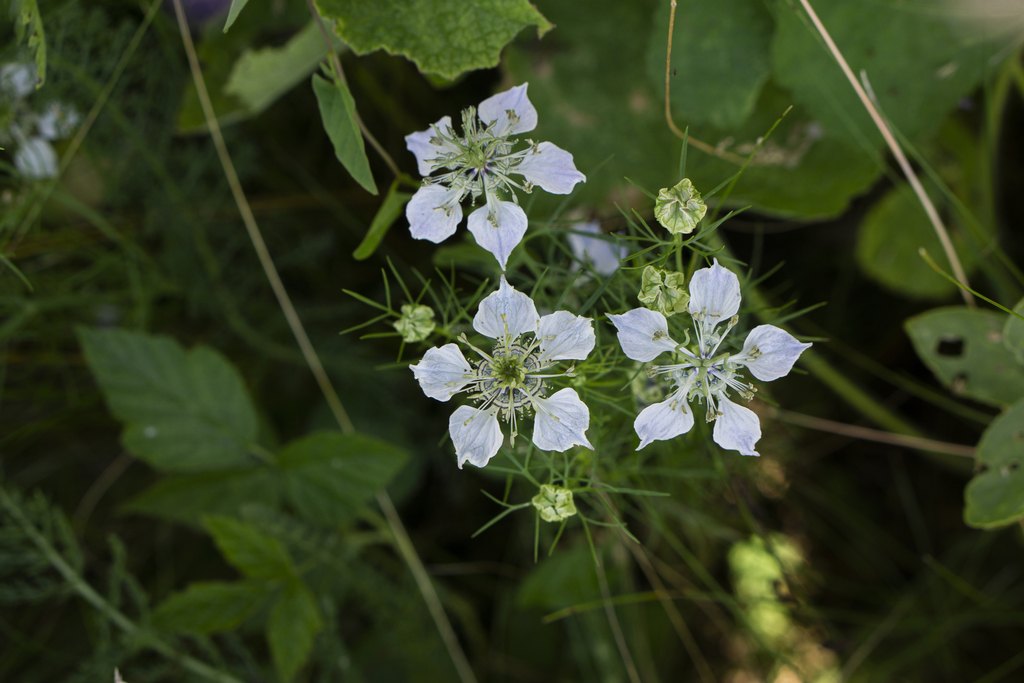
LATIN NAME: Nigella sativa
COMMON NAME: Black Cumin
Plant Profile
Black cumin is a slender annual, 20 to 30 cm tall, with finely divided leaves that are linear rather than thread-like, and pale blue and white flowers of five to ten petals. It is a delicate thing, open and airy, and it looks nothing like the dense, ferny love-in-a-mist that most gardeners know from the same genus. The whole plant is faintly grey.
The fruit is the point and the surprise: a large, inflated capsule formed from three to seven united follicles, ballooning out around the seeds and turning papery as it ripens. Inside, the seeds are small, black, angular and rough, and they are what the spice trade sells. A capsule holds dozens.
It is native from Bulgaria and Romania across Turkey, Cyprus, the Levant, Iraq and Iran, and it has been carried so far as a crop that it is now naturalised across parts of Europe, North Africa and east to Myanmar. It is not a wild plant anywhere in the way that a meadow flower is wild.
Science & Biotechnology
The seeds are 32 to 40 percent oil, high in linoleic and oleic acid, with trans-anethole and a group of alkaloids named for the plant: nigellicine, nigellidine, nigellimine and nigellimine N-oxide. The aromatic that gets the most attention is thymoquinone, which is also found in thyme oil and which accounts for much of the smell when the seed is crushed.
Its history is older than its chemistry. Seeds have been recovered from several ancient Egyptian sites, including the tomb of Tutankhamun, and from a Hittite flask in Turkey dated to the second millennium BC. Avicenna treated dyspnoea with it in the Canon of Medicine, and it has been a household medicine across western Asia for as long as there are records.
That history is not evidence, and the modern supplement trade has run well ahead of the trials. The seed is classified as generally recognised as safe as a spice and a flavouring; the capsules sold for health are a different proposition, and the difference between a flavouring and a drug is the whole of the argument. Use it as a spice and it is excellent.
Uses & Benefits
It is the seed on top of the bread. In Bengal it ranks among the five spices in panch phoron; in Iran and Turkey it goes on nan-e barbari; in Palestine the seeds are ground into qizha, a bitter black paste; in Lebanon it is packed into the braided cheese called majdouleh. Dry-roasted and scattered over pulses or yoghurt it does more than most spices for very little.
The naming is a trap. It is sold as black cumin, black caraway, black onion seed, nutmeg flower, Roman coriander and fennel flower, and none of those names is accurate. Black onion seed is the worst of them, because cooks read it, believe it, and expect onion. Bunium persicum and Elwendia persica are also called black cumin, so even the accurate name points at two other plants.
In the garden it is a cut-flower and a border filler rather than a crop, and the dried capsules are better in an arrangement than the flowers, which last a day and have almost no scent. Grow a row for the kitchen and a few plants for the vase, and treat the rest as a green manure. It shares the family with Nigella damascena, Nigella orientalis and Delphinium cultorum.
Growing from Seed
Sow direct in spring, 5 mm deep, once the soil is above 12 °C. It resents root disturbance and will not transplant from a module without sulking, so sow where it is to grow and thin to 15 cm. Germination is quick, seven to fourteen days, and the seedlings are easy to spot once the first true leaves appear.
It wants sun and a light, warm soil; rich ground makes leaf at the expense of flower and the plants flop. In a cold summer it is a disappointment, and in a hot one it seeds itself about and comes back without being asked. Water until established and then leave it alone.
Harvest when the capsules turn papery and the tips begin to split, cutting the stems and hanging them head down over a cloth. The seed keeps for years in a dark jar. If you want it to self-sow, leave a few capsules on the plants and do not mulch over the ground where they fall.
Our Take
It ranks among the easiest annuals in the seed catalogue and one of the most useful, and it earns its place twice: as a spice and as a plant that fills a gap between the hardy annuals in June. The flowers are modest, the seed heads are not.
Ignore the health claims and the names on the packet. Grow it for bread, for cheese and for the look of those papery balloons in a dry arrangement, and it will never disappoint you. Sown once, it tends to stay, which is more than most annuals manage.
Related Reading
More species in the same orbit as Black Cumin: