


Ammi visnaga Seeds | Khella
LATIN NAME: Ammi visnaga
COMMON NAME: Khella
Plant Profile
Khella, toothpickweed, bisnaga, bishop’s weed: the names come from the plant’s two lives, one medicinal and one domestic. Egyptian children used the dried stem of the umbel as a toothpick, and the habit travelled with the Arabic name khella into half a dozen European pharmacopoeias before the plant had a settled botanical name.
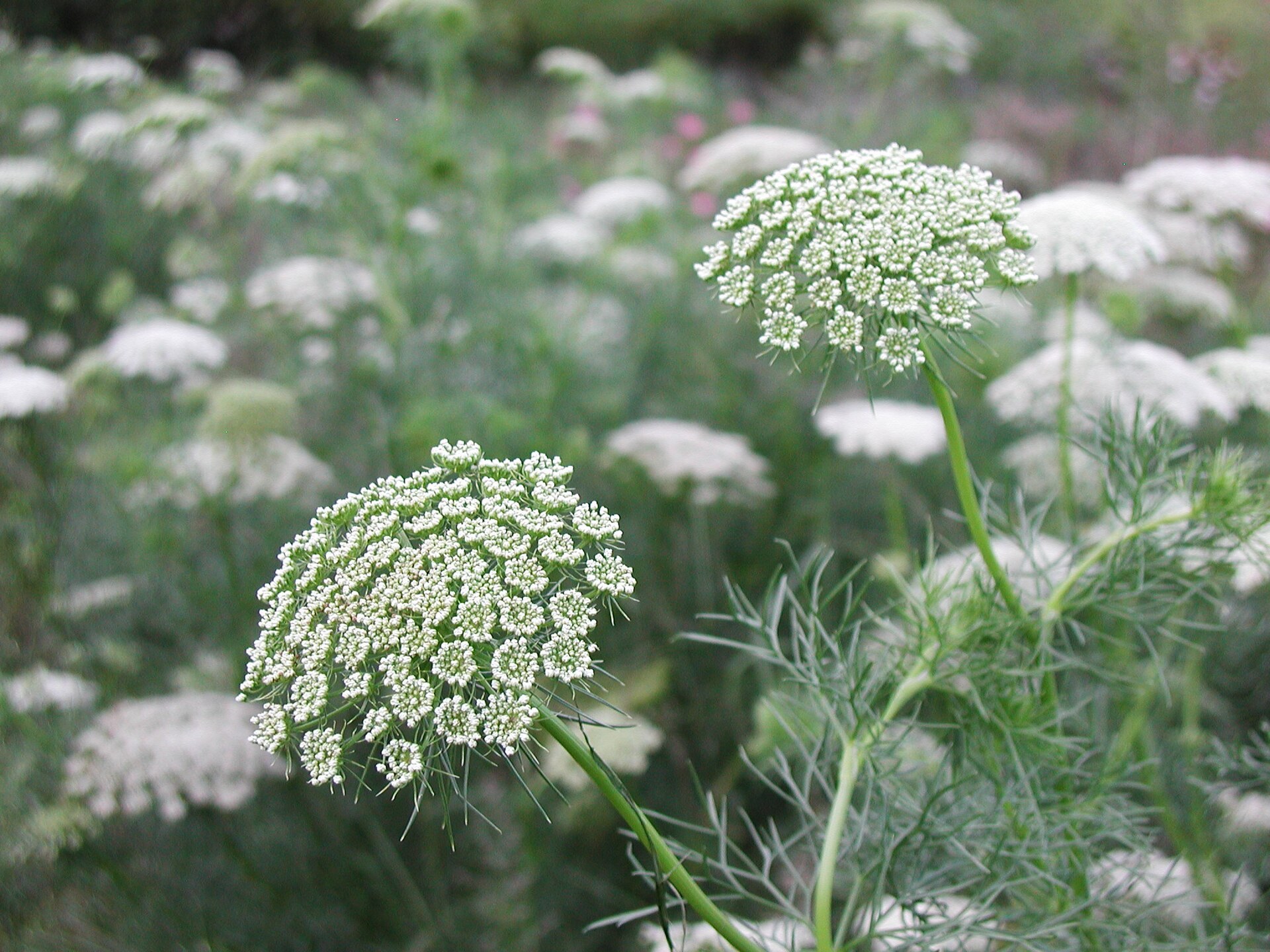
It is an erect annual from a taproot, reaching about 80 cm, with leaves up to 20 cm long and divided into fine linear segments. The inflorescence is a compound umbel of white flowers, tight and flat-topped, the kind of structure that reads as a single flower from three metres away and as fifty small ones from thirty centimetres.
The fruit is a compressed oval body under 3 mm long, and it is the part the pharmacists wanted. The plant is native across southern Europe, North Africa and western Asia, from Portugal and the Balearics through Italy, Greece and Turkey to Iran and the Levant, and it is now introduced in England, Germany, China, Japan, Australia and both Americas. The same family turns up again in Libanotis seseloides, Eryngium yuccifolium and Cuminum cyminum.
Science & Biotechnology
The active compound is khellin, a furanochromone that relaxes smooth muscle. It was used clinically as a vasodilator for angina in the mid-twentieth century and then withdrawn, not because it did not work but because the side effects were unpleasant and the dosing was difficult. Nausea, vomiting and vertigo at therapeutic doses are a poor trade for a drug that has to be taken every day.
Its real contribution came afterwards. Chemists took the khellin skeleton and modified it, and two of the resulting compounds are still in use. Amiodarone, one of the most widely prescribed antiarrhythmics, is a benzofuran derivative of khellin. Cromoglicate, the mast-cell stabiliser used in asthma and hay fever, is a chromone built on the same core. One weed from the Nile Delta is the ancestor of both.
The plant also contains visnagin, which is toxic in the pure state, and visnadine, a natural vasodilator. That mixture of actives in one tissue is why the crude drug was unreliable: the ratio of the three compounds varies with the population, the season and the drying method, and a tea made in one village was not the same as a tea made in the next.
Uses & Benefits
The traditional use is kidney stones. In Egypt a tea made from the fruit was taken for that purpose, and laboratory work in rats supports the rationale: the extract slows the build-up of calcium oxalate crystals and acts as a diuretic, which is exactly what a stone-former needs. Whether it helps a human being is still not established, and the difference matters.
For angina the fruits were used in preparations that have since been replaced. That history is worth knowing because it explains the plant’s presence in European herbals, and because the replacement drugs came from the plant itself. The line from a village tea to a cardiology ward runs through this species in three steps.
In the garden it is grown for the umbels, which are architectural in a way that most annuals are not. They hold up in a vase, they dry well, and they seed themselves into gravel with no encouragement. The catch is the sap: contact causes photosensitivity and dermatitis in some people, so gloves are sensible on a sunny day.
Growing from Seed
Sow in autumn or early spring, direct where the plants are to flower. The seed needs light, so press it into the surface and water with a fine rose. Germination is fast at 15 to 18 °C, usually ten days to a fortnight, and the seedlings are wiry and upright almost from the start.
Thin to 30 cm. The plant resents transplanting because of the taproot, and a moved seedling sits for three weeks and then bolts at 30 cm with a single umbel. Direct sowing avoids the whole problem. On poor, sandy ground it will flower at 60 cm and stand without support; on rich soil it reaches 80 cm and leans.
Leave two or three plants to set seed and the colony continues. The fruit ripens unevenly on the umbel, from the outer edge inward, so collect in two passes rather than one. Dry the umbels upside down over paper and the seed falls clean; a plastic bag produces mould within a week.
Our Take
It is a plant with a double reputation and both halves are true. As a garden annual it is a clean, airy thing that looks better in September than most of what was sown with it. As a drug source it is the origin of two pharmaceuticals that most people have taken without knowing where they came from.
Grow it for the umbels and leave the medicine alone. The therapeutic dose and the toxic dose are close, the actives vary between plants, and the side effects are well documented. There are better ways to treat angina now, and they all descend from this one.
Related Reading
Gardeners who grow Khella often pair it with these related subjects: