


Echeveria peacockii Seeds | Peacock Echeveria
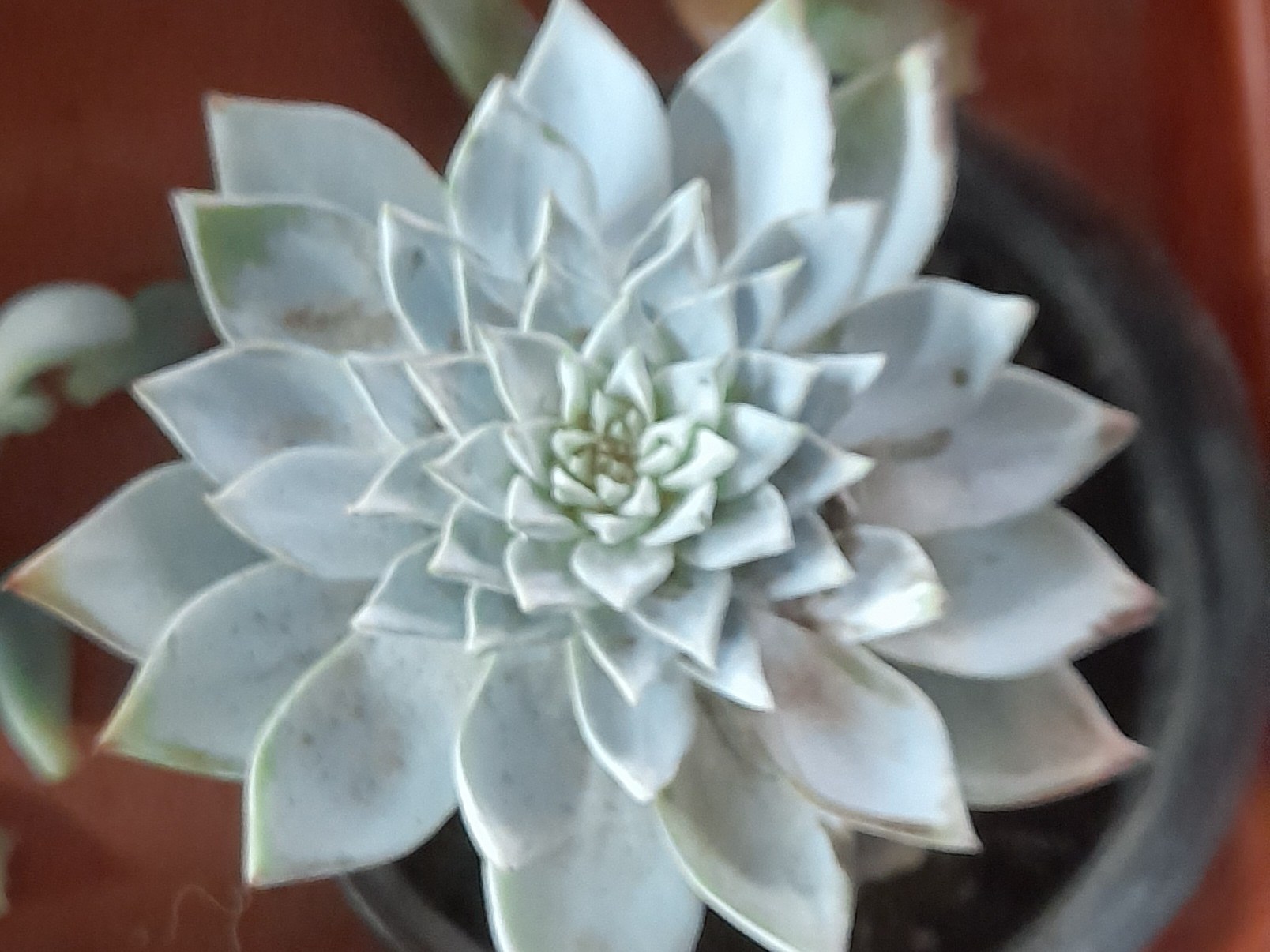
LATIN NAME: Echeveria peacockii
COMMON NAME: Peacock Echeveria
Plant Profile
This is the echeveria most people picture before they know the name. Echeveria peacockii builds a tight rosette of thick, spoon-shaped leaves fifteen to twenty-five centimetres across, the whole surface dusted in a blue-white powder that gives the plant its cool, ghostly colour under any light.
The powder, a layer of wax called farina, is the plant’s sunshade and raincoat, shed water and scatter ultraviolet light. It does not regenerate where a finger wipes it away, so greenhouse-grown specimens carry perfect halos of untouched bloom and handled ones look patchy for months. The leaves themselves are pale blue-green beneath the coating.
In late spring the rosette sends out an arching stem a decimetre or more tall, hung with coral-red, yellow-inside, bell-shaped flowers that feed hummingbirds in habitat. The rosette itself is single and unbranched for years, slowly thickening its stem with age until old plants lean and need re-heading.
The naming story is a Victorian nursery quarrel. The plant was described as peacockii by one hand and sold from Belgium as desmetiana, named for the dealer De Smet; both names date from the 1870s, and authorities have traded them back and forth ever since. Recent checklists lean toward desmetiana as the older published name, while the trade, as usual, keeps both. Three more Crassulaceae sit in the same catalogue: Sedum spurium, Sedum kamtschaticum and Sedum forsterianum.
Science & Biotechnology
Native populations record from three Mexican states, Oaxaca, Puebla and Coahuila, on rocky slopes and cliffs where drainage is absolute and summer rain arrives in pulses. The farina layer maps exactly onto that ecology: exposed rock at altitude means fierce ultraviolet and dew rather than rain, and wax is cheaper armour than a thicker cuticle.
Like all its family it runs crassulacean acid metabolism, opening its stomata at night to fix carbon and closing them through the day. In cultivation this translates into a simple rule: water deeply and rarely, never lightly and often. The root system is shallow and fine, adapted to grabbing pulse rain, and it rots quickly in any pot that stays wet.
Reproduction in the wild is mostly seed, set after hummingbird visits, and seedlings are the genetic lottery behind the species’ variation. In cultivation the economics reverse: leaf cuttings and, in industry, tissue culture dominate because a rosette takes years from seed, while a leaf strikes in weeks. Seed remains the only route to new combinations, so serious growers still sow.
Uses & Benefits
As a garden plant it is a container subject of the first order: architectural, colour-stable through the seasons, and content in the same pot for years with a palmful of water a week in summer. In frost-free climates it sits out the winter outdoors; elsewhere it comes indoors to a bright sill, where it sulks only if watered.
Its service to the grower is caloric honesty: it stores what it needs and asks for less than almost anything else sold as a plant. The pests that bother it are few, mealybugs and rot being the whole list, and both are caused by care rather than attracted by weakness. Overwatering kills faster than every pest combined.
The honest limitation is frost. Hardiness stops around minus four for any length of time, and wet cold kills sooner than dry cold. The farina, its pride, is destroyed by handling, rain splash and overhead watering alike. Everything the plant needs from its keeper amounts to restraint, which is harder advice to sell than products.
Growing from Seed
Sow on the surface of gritty, sterile compost at twenty to twenty-two degrees, uncovered, in bright indirect light. Germination runs one to three weeks and is improved by fresh seed. Seedlings are pinhead-sized for their first weeks; water by capillary or mist, never by pouring, and keep air moving to stop damping off.
Growth is slow but steady: a year to a two-centimetre rosette, two to three years to the classic form. Pot on shallow, in fast-draining mineral mix, with the neck of the plant above the grit. Feed rarely and weakly; excess fertiliser breaks the compact form and dulls the colour.
For seed, let the flower stems dry and the follicles split, then tap seed onto paper. It is dust-fine and keeps several years cool and dry, though fresh sows more evenly. Rosettes that stretch or lean can be cut, dried a week, and re-rooted, leaving the base to sprout new heads.
Our Take
Our take: for the price of dinner this plant delivers a decade of architecture. Seed is slow, and a cutting or a nursery rosette is the honest shortcut for one specimen; but a packet sown in spring gives a bench of seedlings with real variation in blue and form to select from.
The honest deal is the same as every succulent: the grower’s main skill is doing nothing. Water less than feels right, never touch the leaves, give it the brightest sill in the house. Keep those three rules and the farina bloom, the whole point of the species, will look like frost for years.
Related Reading
Readers interested in Peacock Echeveria frequently explore these as well: