


Hibiscus rosa-sinensis Seeds | Chinese Hibiscus
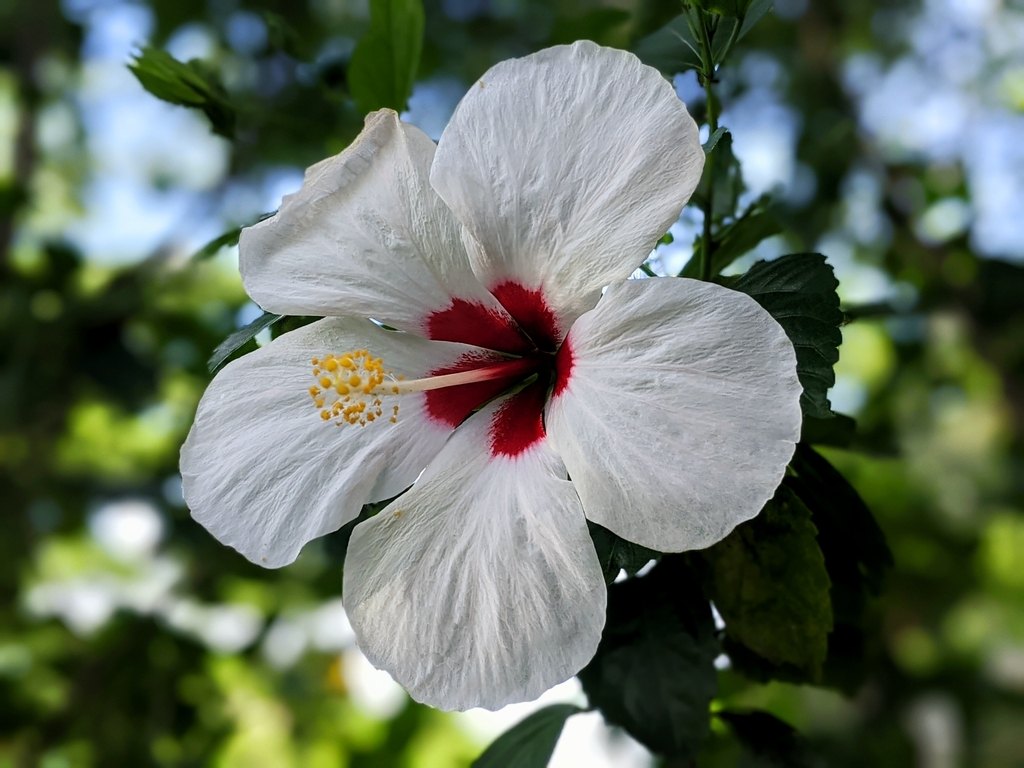
LATIN NAME: Hibiscus rosa-sinensis
COMMON NAME: Chinese Hibiscus
Plant Profile
Chinese hibiscus is a cultigen: a plant that exists only because people made it. It is an artificial hybrid, created in cultivation during the pre-Columbian era by Polynesians in the western Pacific, from Hibiscus cooperi, native to Vanuatu, and H. kaute, native to French Polynesia. Nothing quite like it grows wild anywhere.
It is a bushy evergreen shrub or small tree, 2.5 to 5 m tall and 1.5 to 3 m across, with a branched taproot and light grey bark that peels easily. Leaves are ovate with a serrated margin and glossy surfaces, arranged alternately on the stem.
Flowers appear in summer and autumn, solitary in the leaf axils, typically red with five petals 10 cm across and a prominent column of orange-tipped stamens. The cultivated forms run far beyond red, through yellow, peach, pink and white, single and double, and the range is the result of centuries of selection rather than breeding for a market.
Science & Biotechnology
The hybrid origin was worked out from chromosome and molecular evidence, and it explains a great deal about how the plant behaves. As a hybrid between two species that are themselves variable, it is genetically unstable, and seedlings raised from a named cultivar will not resemble the parent in any predictable way.
It is the national flower of Malaysia, where it holds official status, and it is treated as the unofficial national flower of Haiti. That status has driven a great deal of breeding, particularly in Malaysia and Hawaii, and the named cultivars now number in the thousands.
The flowers are also a useful study system for senescence. Each bloom opens for a day or two and then closes and falls, and the process is under fairly tight hormonal control, which makes it convenient for work on how petals age and how long a flower can be kept on the plant. Each bloom has five petals 10 cm across and a column of stamens tipped with orange-red anthers, a structure built for large bees and, where they occur, for sunbirds.
Uses & Benefits
In the tropics and subtropics it is a hedge plant, a specimen shrub and a container subject, and it flowers almost continuously where the climate suits it. In cooler regions it is grown under glass, where it needs full light and a winter minimum above 10 °C.
In a container it stays smaller and flowers at about a metre, which is how it is grown outside the tropics: out from June, under glass from October, and pruned hard in early spring before growth starts. The flowers are used in the Pacific for lei and for hair decoration, and in parts of Asia the petals are eaten in salads or used to colour drinks. The red forms give a strong infusion, and the flavour is mild and slightly acidic.
The bark yields a fibre in some traditional uses, and the plant has a long record in folk medicine across its cultivated range. As with most ornamentals with a medicinal reputation, the useful part is the flower and the risk is in assuming that a garden plant is a safe one. The other Malvaceae in the catalogue are Hibiscus mutabilis, Hibiscus manihot and Abutilon.
Growing from Seed
Seed is possible but it is a lottery. The plant is a hybrid of two variable species, so seedlings vary widely, and named cultivars cannot be reproduced this way. If you want a specific flower, propagate by cutting; Named cultivars are kept true by cuttings taken in summer from semi-ripe wood, which root in three or four weeks. if you want the experience, sow and see.
Sow fresh seed at 20 to 25 °C, 5 mm deep, and germination takes two to four weeks. Soak the seed for a few hours first, because the coat is hard. Seedlings grow quickly and should be potted on before they become root-bound.
Grow plants in a free-draining compost, water freely in summer and sparingly in winter, and feed with a high-potassium fertiliser through the flowering season. Prune in early spring In dry indoor air the plant attracts mealybug and red spider mite, and it drops its buds if the pot is moved while they are forming., cutting back to a strong bud, and the plant will flower on the new growth.
Our Take
This is not a plant for a cold garden, and it is not honestly a seed crop. It is, though, one of the great tropical ornamentals, and the story of its origin is better than most garden legends: a hybrid made by Pacific voyagers centuries before Europeans reached the islands, carried around the world, and now the national flower of a country it never grew in.
Related Reading
If Chinese Hibiscus appeals to you, these related plants are worth a look: